Motion in two directions · Movimiento en dos direcciones
| English | Español |
|---|---|
| vertical/ˈvɜːtɪkl/ | vertical |
| horizontal/ˌhɒrɪˈzɒntl/ | horizontal |
| parabola/pəˈræbələ/ | parábola |
| range/reɪndʒ/ | range |
| symmetric/sɪˈmetrɪk/ | simétrica |
| projectile/prəˈdʒektaɪl/ | proyectil |
Drop one, throw one
- Drop a ball and throw another one sideways at the same instant.
- They hit the ground at the same time.
- The sideways motion does not change how fast it falls.
Suelta uno, lanza otro
- Suelta una bola y lanza otra horizontalmente al mismo tiempo.
- Ambas tocan el suelo al mismo tiempo.
- El movimiento lateral no cambia la rapidez con la que cae.
Two motions, side by side
- Horizontal 水平 and vertical 竖直 motion are independent.
- Treat each direction as its own SUVAT problem, linked only by the time $t$.
A high-speed train: its motion can be shown on a distance-time graph
Dos movimientos, lado a lado
- El movimiento horizontal 水平 y el movimiento vertical 竖直 son independientes.
- Trata cada dirección como un problema SUVAT propio, ligados únicamente por el tiempo $t$.

Un tren de alta velocidad: su movimiento puede representarse en una gráfica de distancia-tiempo
Launch a projectile · Lanzar un proyectil
Fire the ball, then change the angle and speed. The horizontal motion is steady while gravity pulls it down — together they trace a parabola. Find the angle for the longest range, and try the Moon. · Lanza la pelota, luego cambia el ángulo y la velocidad. El movimiento horizontal es constante mientras la gravedad la atrae hacia abajo — juntos trazan una parábola. Encuentra el ángulo para el mayor alcance e intenta con la Luna.
A horizontal throw
- Horizontal: constant velocity $u_{\text{H}}$, so $x = u_{\text{H}}t$.
- Vertical: free fall from rest, so $y = \tfrac{1}{2}gt^{2}$.
- The time to land depends only on the height, not on $u_{\text{H}}$.
Displacement–time graph of a car on a test track
Un lanzamiento horizontal
- Horizontal: velocidad constante $u_{\text{H}}$, por lo tanto $x = u_{\text{H}}t$.
- Vertical: caída libre desde el reposo, por lo tanto $y = \tfrac{1}{2}gt^{2}$.
- El tiempo para aterrizar depende solo de la altura, no de $u_{\text{H}}$.

Gráfica de desplazamiento-tiempo de un coche en una pista de ensayo
A ball thrown horizontally and a ball dropped from the same height hit the ground at the same time (no air resistance). · Una bola lanzada horizontalmente y una bola que cae desde la misma altura tocan el suelo al mismo tiempo (sin resistencia del aire).
Yes — the vertical motion is the same free fall for both, and the horizontal speed does not change the fall time. · Sí — el movimiento vertical es la misma caída libre para ambas, y la velocidad horizontal no cambia el tiempo de caída.
Launched at an angle
- Split the launch velocity: horizontal $u\cos\theta$ (stays constant), vertical $u\sin\theta$.
- The vertical part slows, stops at the top, then grows downward — tracing a parabola 抛物线.
Lanzado en ángulo
- Descompón la velocidad de lanzamiento: horizontal $u\cos\theta$ (permanece constante), vertical $u\sin\theta$.
- La componente vertical se desacelera, se detiene en la cima, luego aumenta hacia abajo — trazando una parábola 抛物线.

A projectile is launched at $20\ \dfrac{\text{m}}{\text{s}}$, $30^{\circ}$ above the horizontal. What is the vertical part of the launch velocity? · Un proyectil se lanza a $20\ \dfrac{\text{m}}{\text{s}}$, $30^{\circ}$ por encima de la horizontal. ¿Cuál es la parte vertical de la velocidad de lanzamiento?
Vertical part $= u\sin\theta = 20 \times \sin 30^{\circ} = 20 \times 0.5 = 10\ \dfrac{\text{m}}{\text{s}}$. · Componente vertical $= u\sin\theta = 20 \times \sin 30^{\circ} = 20 \times 0.5 = 10\ \dfrac{\text{m}}{\text{s}}$.
At the top and the range 射程
- At the highest point $v_{\text{V}} = 0$, but $v_{\text{H}} = u\cos\theta$ is unchanged.
- Time to the top $= \dfrac{u\sin\theta}{g}$; the flight is symmetric 对称, so total time is twice that.
Projectile 抛体 launched at angle $\theta$ — horizontal and vertical motions are independent
En la cima y el alcance 射程
- En el punto más alto $v_{\text{V}} = 0$, pero $v_{\text{H}} = u\cos\theta$ permanece sin cambios.
- Tiempo hasta la cima $= \dfrac{u\sin\theta}{g}$; el vuelo es simétrico 对称, por lo que el tiempo total es el doble de ese valor.
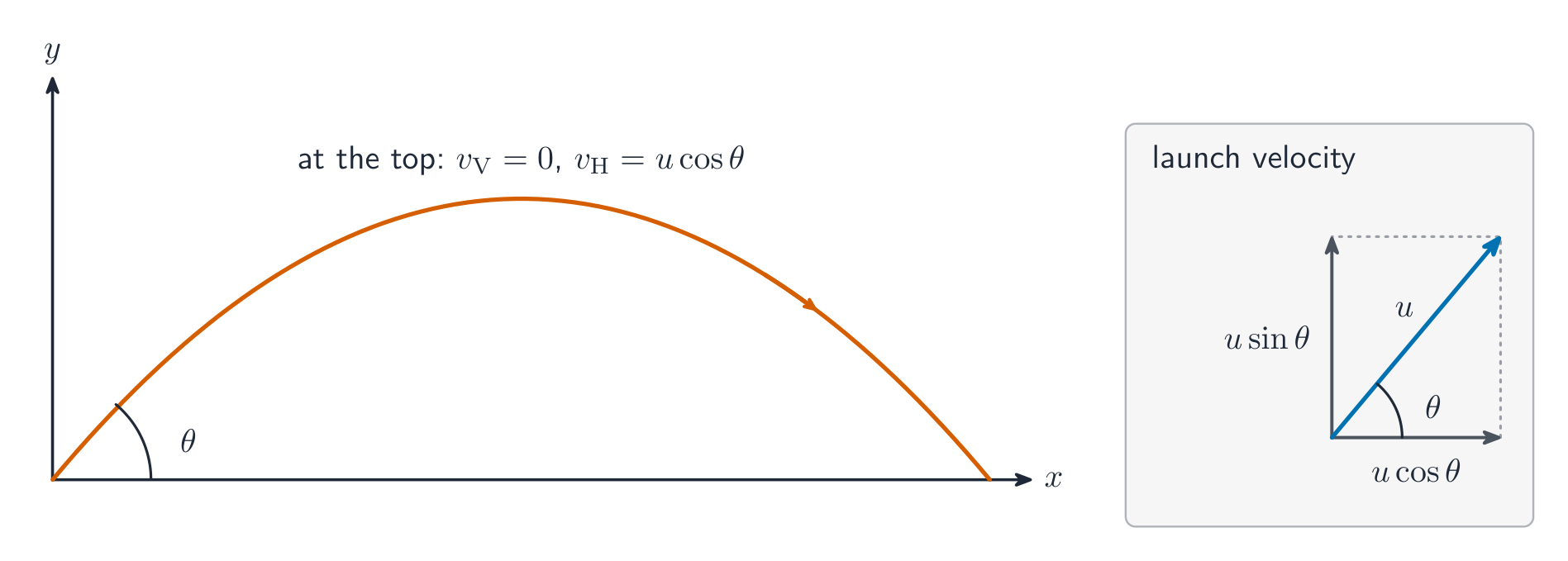
Proyectil 抛体 lanzado en ángulo $\theta$ — los movimientos horizontal y vertical son independientes
Select all · todos the statements that are true for a projectile (ignore air). · Seleccione todas las afirmaciones que sean verdaderas para un proyectil (ignore la resistencia del aire).
At the top only the vertical velocity is zero — the horizontal velocity $u\cos\theta$ carries on, so the ball keeps moving. Mass does not change free fall. · En la cima solo la velocidad vertical es cero: la velocidad horizontal $u\cos\theta$ continúa, así que la bola sigue moviéndose. La masa no afecta la caída libre.
That projectile has a vertical launch velocity of $10\ \dfrac{\text{m}}{\text{s}}$. How long does it take to reach the top? (Use $g = 9.81\ \dfrac{\text{m}}{\text{s}^2}$.) · Ese proyectil tiene una velocidad de lanzamiento vertical de $10\ \dfrac{\text{m}}{\text{s}}$. ¿Cuánto tarda en alcanzar la cima? (Use $g = 9.81\ \dfrac{\text{m}}{\text{s}^2}$.)
Time to the top $= \dfrac{u\sin\theta}{g} = \dfrac{10}{9.81} \approx 1.0\ \text{s}$. · Tiempo hasta la cima $= \dfrac{u\sin\theta}{g} = \dfrac{10}{9.81} \approx 1.0\ \text{s}$.
A bouncing ball
- Between bounces the velocity–time graph is a straight sloping line (constant $g$).
- Each bounce is a sudden jump: the velocity flips direction (and shrinks if energy is lost).
Una pelota que rebota
- Entre rebotes, la gráfica de velocidad-tiempo es una línea recta inclinada ($g$ constante).
- Cada rebote es un salto repentino: la velocidad invierte su dirección (y disminuye si hay pérdida de energía).
On the velocity–time graph of a bouncing ball, each bounce appears as: · En la gráfica de velocidad-tiempo de una pelota que rebota, cada rebote aparece como:
At a bounce the velocity flips from downward to upward almost instantly — a sudden vertical jump on the graph (smaller if energy is lost). · En un rebote la velocidad cambia de hacia abajo hacia arriba casi instantáneamente: un salto vertical repentino en la gráfica (menor si hay pérdida de energía).
Two objects meeting
- Write a displacement equation for each, using the same start time and positive direction.
- They are level again when their displacements are equal — set $s_1 = s_2$ and solve.
Dos objetos encontrándose
- Escribe una ecuación de desplazamiento para cada uno, usando el mismo inicio de tiempo y dirección positiva.
- Estarán al mismo nivel cuando sus desplazamientos sean iguales; iguala $s_1 = s_2$ y resuelve.
Two objects moving along the same line are level again when their ____ are equal. · Dos objetos que se mueven a lo largo de la misma línea están nivelados nuevamente cuando sus ____ son iguales.
Set the two displacement equations equal ($s_1 = s_2$) and solve for the time. · Igualar las dos ecuaciones de desplazamiento ($s_1 = s_2$) y resolver para el tiempo.
Worked example: thrown off a cliff
- A ball is thrown horizontally at $15\ \text{m/s}$ from a cliff $20\ \text{m}$ high. Find the time to land and how far from the base it lands. Take $g = 9.81\ \text{m/s}^2$.
- Vertical, to get the time. The initial vertical velocity is zero, so $s = \tfrac{1}{2}gt^2$ gives $20 = \tfrac{1}{2}(9.81)t^2$ and $t = 2.02\ \text{s}$.
- Horizontal, to get the range. There is no horizontal acceleration, so $x = ut = 15 \times 2.02 = 30\ \text{m}$.
- The horizontal speed plays no part in finding the time. A ball dropped from the same cliff lands at exactly the same moment.
- Time is the only quantity the two motions share, and it is always the bridge between them.
Ejemplo resuelto: lanzado desde un acantilado
- Una bola se lanza horizontalmente a $15\ \text{m/s}$ desde un acantilado de $20\ \text{m}$ de altura. Encuentra el tiempo para aterrizar y a qué distancia de la base aterriza. Toma $g = 9.81\ \text{m/s}^2$.
- Vertical, para obtener el tiempo. La velocidad vertical inicial es cero, así que $s = \tfrac{1}{2}gt^2$ da $20 = \tfrac{1}{2}(9.81)t^2$ y $t = 2.02\ \text{s}$.
- Horizontal, para obtener el alcance. No hay aceleración horizontal, así que $x = ut = 15 \times 2.02 = 30\ \text{m}$.
- La velocidad horizontal no juega ningún papel para encontrar el tiempo. Una bola soltada desde el mismo acantilado aterriza exactamente en el mismo momento.
- El tiempo es la única magnitud que ambos movimientos comparten, y siempre es el puente entre ellos.
A ball is thrown horizontally at 15 m/s from a 20 m cliff. How long does it take to land, in seconds? (g = 9.81 m/s^2) · Una bola se lanza horizontalmente a 15 m/s desde un acantilado de 20 m. ¿Cuánto tarda en caer, en segundos? (g = 9.81 m/s^2)
Vertical only: 20 = 0.5 x 9.81 x t^2, so t = 2.02 s. The 15 m/s plays no part; a dropped ball lands at the same moment. · Solo vertical: 20 = 0.5 x 9.81 x t^2, entonces t = 2.02 s. Los 15 m/s no juegan ningún papel; una bola que cae toca el suelo al mismo momento.
That same ball, thrown horizontally at 15 m/s and landing after 2.02 s, lands how far from the base of the cliff, in metres? · Esa misma bola, lanzada horizontalmente a 15 m/s y cayendo después de 2.02 s, ¿a qué distancia de la base del acantilado aterriza, en metros?
Horizontal has no acceleration, so x = ut = 15 x 2.02 = 30 m. Time is the bridge between the two directions. · Horizontal no tiene aceleración, entonces x = ut = 15 x 2.02 = 30 m. El tiempo es el puente entre las dos direcciones.
Worked example: launched at an angle
- A ball leaves the ground at $18\ \text{m/s}$ at $60°$ to the horizontal. Show that it reaches its greatest height at $t = 1.6\ \text{s}$.
- Resolve first. Vertical: $u_y = 18\sin 60° = 15.6\ \text{m/s}$. Horizontal: $u_x = 18\cos 60° = 9.0\ \text{m/s}$.
- At the top the vertical velocity is zero, so $v = u + at$ gives $0 = 15.6 - 9.81t$ and $t = 1.59 \approx 1.6\ \text{s}$.
- The horizontal velocity is still $9.0\ \text{m/s}$ at the top. The speed there is $9.0\ \text{m/s}$, not zero.
- Total time of flight is twice this, $3.2\ \text{s}$, and the range is $u_x \times 3.2 = 29\ \text{m}$.
Ejemplo resuelto: lanzado en ángulo
- Una bola sale del suelo a $18\ \text{m/s}$ a $60°$ respecto a la horizontal. Demuestra que alcanza su altura máxima en $t = 1.6\ \text{s}$.
- Resuelve primero. Vertical: $u_y = 18\sin 60° = 15.6\ \text{m/s}$. Horizontal: $u_x = 18\cos 60° = 9.0\ \text{m/s}$.
- En la cima la velocidad vertical es cero, así que $v = u + at$ da $0 = 15.6 - 9.81t$ y $t = 1.59 \approx 1.6\ \text{s}$.
- La velocidad horizontal sigue siendo $9.0\ \text{m/s}$ en la cima. La rapidez allí es $9.0\ \text{m/s}$, no cero.
- El tiempo total de vuelo es el doble, $3.2\ \text{s}$, y el alcance es $u_x \times 3.2 = 29\ \text{m}$.
Put the method for a projectile launched at an angle in order. · Ordene el método para un proyectil lanzado con un ángulo.
Time is the only quantity the two directions share, which is why it is always found from the vertical motion first. · El tiempo es la única magnitud que comparten las dos direcciones, por eso siempre se encuentra primero a partir del movimiento vertical.
At the highest point of a projectile's flight, match each quantity to its value. · En el punto más alto del vuelo de un proyectil, empareje cada cantidad con su valor.
The speed at the top is the horizontal component, not zero. And the acceleration never pauses, not even for an instant at the top. · La velocidad en la cima es la componente horizontal, no cero. Y la aceleración nunca se detiene, ni siquiera por un instante en la cima.
Marks that slip away
- Resolve before you start. Every projectile question is two one-dimensional problems sharing a value of $t$.
- The horizontal velocity is constant and takes no part in the time calculation.
- At the highest point the vertical velocity is zero, not the speed. The horizontal component is unchanged.
- A ball thrown horizontally and a ball dropped from the same height land at the same time.
- Keep the sign convention for the whole flight. With up positive, $a = -9.81\ \text{m/s}^2$ on the way down too.
Puntos que se escapan
- Resuelve antes de empezar. Cada pregunta de proyectiles son dos problemas unidimensionales que comparten un valor de $t$.
- La velocidad horizontal es constante y no participa en el cálculo del tiempo.
- En el punto más alto la velocidad vertical es cero, no la rapidez. La componente horizontal no cambia.
- Una bola lanzada horizontalmente y una bola soltada desde la misma altura aterrizan al mismo tiempo.
- Mantén la convención de signos durante todo el vuelo. Con arriba positivo, $a = -9.81\ \text{m/s}^2$ también en la bajada.
A ball thrown horizontally from a cliff lands later than a ball dropped from the same cliff at the same moment. · Una bola lanzada horizontalmente desde un acantilado cae después de otra bola que se deja caer desde el mismo acantilado al mismo momento.
They land together. The vertical motion is identical, and the horizontal velocity has no effect on it, which is the whole point of treating the two directions separately. · Ambas caen juntas. El movimiento vertical es idéntico, y la velocidad horizontal no tiene efecto sobre él, que es todo el punto de tratar las dos direcciones por separado.
You've got it
- horizontal and vertical motion are independent — share only the time $t$
- a horizontal throw lands in a time set only by its height
- resolve a launch: $u\cos\theta$ stays constant, $u\sin\theta$ behaves like a vertical throw
Lo has entendido
- el movimiento horizontal y vertical son independientes — solo comparten el tiempo $t$
- un lanzamiento horizontal aterriza en un tiempo determinado solo por su altura
- resuelve un lanzamiento: $u\cos\theta$ permanece constante, $u\sin\theta$ se comporta como un lanzamiento vertical