Permutaciones y combinaciones
Introducido| English | Significado |
|---|---|
| permutation/ˌpɜːmjuːˈteɪʃn/ | permutación |
| combination/ˌkɒmbɪˈneɪʃn/ | combinación |
| factorial/fækˈtɔːrɪəl/ | factorial |
| multiplication principle/ˌmʌltɪplɪˈkeɪʃn ˈprɪnsɪpl/ | principio de multiplicación |
How many ways to arrange a bookshelf?
- You have 10 books and want to choose 3 to display. How many ways? If order matters, it's a permutation 排列. If you just want any 3, it's a combination 组合.
- Counting techniques are the foundation of probability — and they appear everywhere, from lottery odds to password security.
Laboratorio de permutación o combinación
Elegir si el orden importa en un problema de conteo.
Permutations (order matters)
- A permutation is an arrangement where order matters: ${}^nP_r = \dfrac{n!}{(n-r)!}$.
- Example: arranging 3 books from 10: ${}^{10}P_3 = \dfrac{10!}{7!} = 10 \times 9 \times 8 = 720$.
Worked example. How many 3-letter codes can be made from 26 letters (no repeats)? ${}^{26}P_3 = 26 \times 25 \times 24 = 15\,600$.
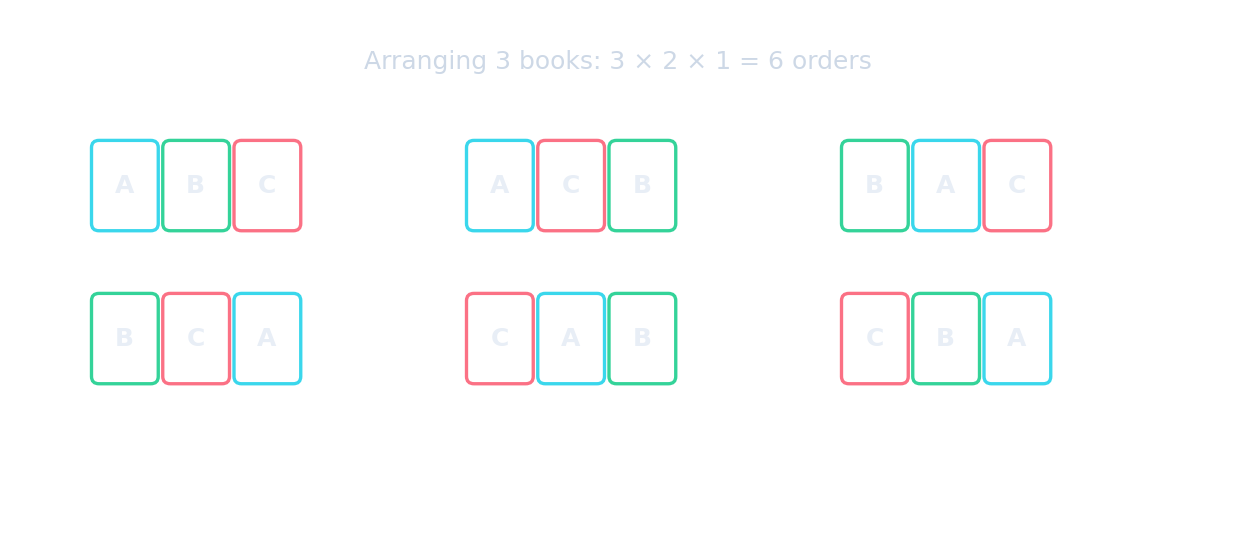
Permutations: 3 books arrange in 3 × 2 × 1 = 6 different orders
En una combinación, el orden de los elementos elegidos:
Dificultad 1/5 · 100 monedas + un pequeño bono en el primer intento de hoy
Las combinaciones ignoran el orden; las permutaciones lo cuentan.
¿De cuántas formas se pueden organizar 3 libros de 10 en un estante (¹⁰P₃)?
Dificultad 2/5 · 140 monedas + un pequeño bono en el primer intento de hoy
¹⁰P₃ = 10!/(10-3)! = 10!/7! = 10 × 9 × 8 = 720.
Combinations (order doesn't matter)
- A combination is a selection where order doesn't matter: ${}^nC_r = \dbinom{n}{r} = \dfrac{n!}{r!\,(n-r)!}$.
- Example: choosing 3 books from 10: ${}^{10}C_3 = \dfrac{10!}{3!\,7!} = \dfrac{720}{6} = 120$.
Permutation vs combination. Choosing a committee of 3 from 10 people is a combination (order doesn't matter). Choosing a president, vice-president, and secretary from 10 is a permutation (order matters — the roles are different).
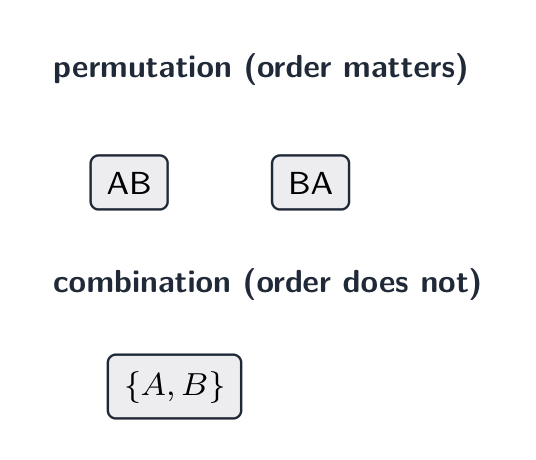
Order matters for a permutation, but not for a combination
¿De cuántas formas se pueden elegir 2 de 5 (⁵C₂)?
Dificultad 2/5 · 140 monedas + un pequeño bono en el primer intento de hoy
⁵C₂ = 5!/(2!3!) = 120/(2×6) = 10.
⁵P₃ es mayor que ⁵C₃.
Dificultad 1/5 · 100 monedas + un pequeño bono en el primer intento de hoy
⁵P₃ = 60 (el orden importa), ⁵C₃ = 10 (el orden no importa). Las permutaciones siempre ≥ combinaciones.
Arrangements with repeats
- To arrange a word with repeated letters, divide by the factorial 阶乘 of each repeat count.
- Example: NEEDLESS has 8 letters with 3 E's and 2 S's: arrangements $= \dfrac{8!}{3!\,2!} = \dfrac{40320}{12} = 3360$.
¿Cuántos arreglos hay de las letras de NEEDLESS? (8 letras: E×3, S×2 → 8!/(3!2!))
Dificultad 2/5 · 140 monedas + un pequeño bono en el primer intento de hoy
8!/(3!2!) = 40320/(6×2) = 40320/12 = 3360.
The multiplication principle 乘法原理
- If one choice can be made in $m$ ways and another in $n$ ways, both together can be made in $m \times n$ ways.
- Example: 3 shirts and 4 trousers → $3 \times 4 = 12$ outfits.
Tienes 3 camisas y 4 pantalones. ¿Cuántos atuendos puedes formar?
Dificultad 2/5 · 140 monedas + un pequeño bono en el primer intento de hoy
3 × 4 = 12 atuendos (principio de multiplicación).
You've got it
- permutation (order matters): ${}^nP_r = \dfrac{n!}{(n-r)!}$
- combination (order doesn't): ${}^nC_r = \dfrac{n!}{r!(n-r)!}$
- repeated letters: divide $n!$ by each repeat's factorial (NEEDLESS → $\dfrac{8!}{3!\,2!}$)
Write from the data given
- Eight distinct letters are available and two are chosen.
- Find the permutation count and the combination count.
De 8 letras distintas, ¿cuántos pares ordenados y cuántos pares desordenados se pueden elegir?
8 veces 7 es 56, y cada par no ordenado se ha contado dos veces.
¿Cuántos pares no ordenados hay?
Dificultad 1/5 · 100 monedas + un pequeño bono en el primer intento de hoy
8 C 2 es 28.