Halogenoarenes
| English | Español |
|---|---|
| halogenoarene/ˈheɪləʊdʒnɔːren/ | haloareno |
| aryl halide/ˈɑːrɪl ˈhælaɪd/ | haluro arílico |
| nucleophilic substitution/ˌnjuːklɪəˈfɪlɪk ˌsʌbstɪˈtjuːʃn/ | sustitución nucleofílica |
| persistent/pəˈsɪstənt/ | persistente |
| pesticide/ˈpestɪsaɪd/ | pesticida |
| bioaccumulate/ˌbaɪəʊəˈkjuːmjʊleɪt/ | bioacumular |
Halogens on a ring
- A halogenoarene 卤代芳烃 (aryl halide 芳基卤) has a halogen joined to a benzene ring.
- It is made by electrophilic substitution.
- It is far less reactive than a halogenoalkane.
Halógenos en un anillo
- Una haloarilina (haluro de arilo) tiene un halógeno unido a un anillo de benceno.
- Se forma mediante sustitución electrofílica.
- Es mucho menos reactiva que una haloalcano.
Halogenoarene lab · Laboratorio de halogenares
Compare halogenoarenes with halogenoalkanes.
The C–halogen bond in a halogenoarene is less reactive than in a halogenoalkane.
The ring's delocalised electrons strengthen the bond.
Making one
- An arene reacts with $\text{Cl}_2$ or $\text{Br}_2$ using $\text{AlCl}_3$/$\text{AlBr}_3$ as catalyst — the halogen replaces a ring hydrogen.
- benzene → chlorobenzene; methylbenzene → 2- and 4-chloromethylbenzene.
Benzene + Cl₂ with an AlCl₃ catalyst → chlorobenzene, by electrophilic substitution
Cómo prepararlas
- Un arilina reacciona con $\text{Cl}_2$ o $\text{Br}_2$ usando $\text{AlCl}_3$/$\text{AlBr}_3$ como catalizador — el halógeno sustituye a un hidrógeno del anillo.
- benceno → clorobenceno; metilbenceno → 2- y 4-clorometilbenceno.

Benceno + Cl₂ con un catalizador AlCl₃ → clorobenceno, por sustitución electrofílica
A halogenoarene is made by reacting an arene with a halogen and:
The halogen-carrier catalyst enables electrophilic substitution of a ring hydrogen.
Match each term to its meaning.
Each item links the term to its correct meaning.
Benzene reacts with Cl₂ using the catalyst AlCl₃ to form ____.
Electrophilic substitution replaces a ring hydrogen with chlorine.
Why it is unreactive
A halogenoalkane reacts easily by nucleophilic substitution 亲核取代 (polar C–Cl). A halogenoarene does not, for two reasons:
- a lone pair on the halogen overlaps the delocalised ring, giving the C–Cl bond partial double-bond character — shorter and stronger, so hard to break.
- the electron-rich ring repels an approaching nucleophile.
So chlorobenzene does not react with $\text{OH}^-$ under normal conditions, while chloroethane does.
Why a halogenoarene is much less reactive than a halogenoalkane
Por qué es poco reactivo
Una haloalcano reacciona fácilmente por sustitución nucleofílica (enlace C–Cl polar). Una haloarilina no lo hace, por dos razones:
- un par libre en el halógeno se superpone al anillo deslocalizado, otorgando al enlace C–Cl carácter de doble enlace parcial — más corto y más fuerte, por lo que es difícil de romper.
- el anillo rico en electrones rechaza a un nucleófilo entrante.
Por ello, el clorobenceno no reacciona con $\text{OH}^-$ bajo condiciones normales, mientras que la cloroetano sí lo hace.

Por qué una haloarilina es mucho menos reactiva que una haloalcano
A halogenoarene is unreactive towards nucleophiles partly because:
The lone-pair overlap gives partial double-bond character, making C–Cl shorter and stronger.
The second reason a halogenoarene resists nucleophiles is that the ring:
The delocalised, electron-rich ring repels electron-rich nucleophiles.
Under normal conditions, with OH⁻:
The halogenoalkane (chloroethane) undergoes nucleophilic substitution; the halogenoarene (chlorobenzene) does not.
Lone-pair overlap with the ring makes the C–Cl bond in chlorobenzene easier to break.
Overlap gives partial double-bond character, so the bond is shorter and stronger.
Which is more readily hydrolysed by aqueous OH⁻ under usual laboratory conditions?
Chloroethane undergoes nucleophilic substitution. The aryl C–Cl bond is strengthened by overlap with the ring.
Useful but persistent 持久
- That same stability makes halogenoarenes useful — in pesticides 农药 (e.g. DDT), dyes and many synthesis intermediates.
- But being unreactive, they do not break down in the environment.
- So they persist and bioaccumulate 生物累积 up food chains — which is why several, including DDT, have been banned.
Many pesticides and herbicides are halogenoarenes — chlorine atoms bonded to a benzene ring.
Útiles pero persistentes
- Esa misma estabilidad las hace útiles — en pesticidas (ej. DDT), colorantes y muchos intermedios de síntesis.
- Pero al ser inertes, no se degradan en el medio ambiente.
- Por tanto, persisten y bioacumulan en las cadenas alimentarias — razón por la cual varios, incluido el DDT, han sido prohibidos.
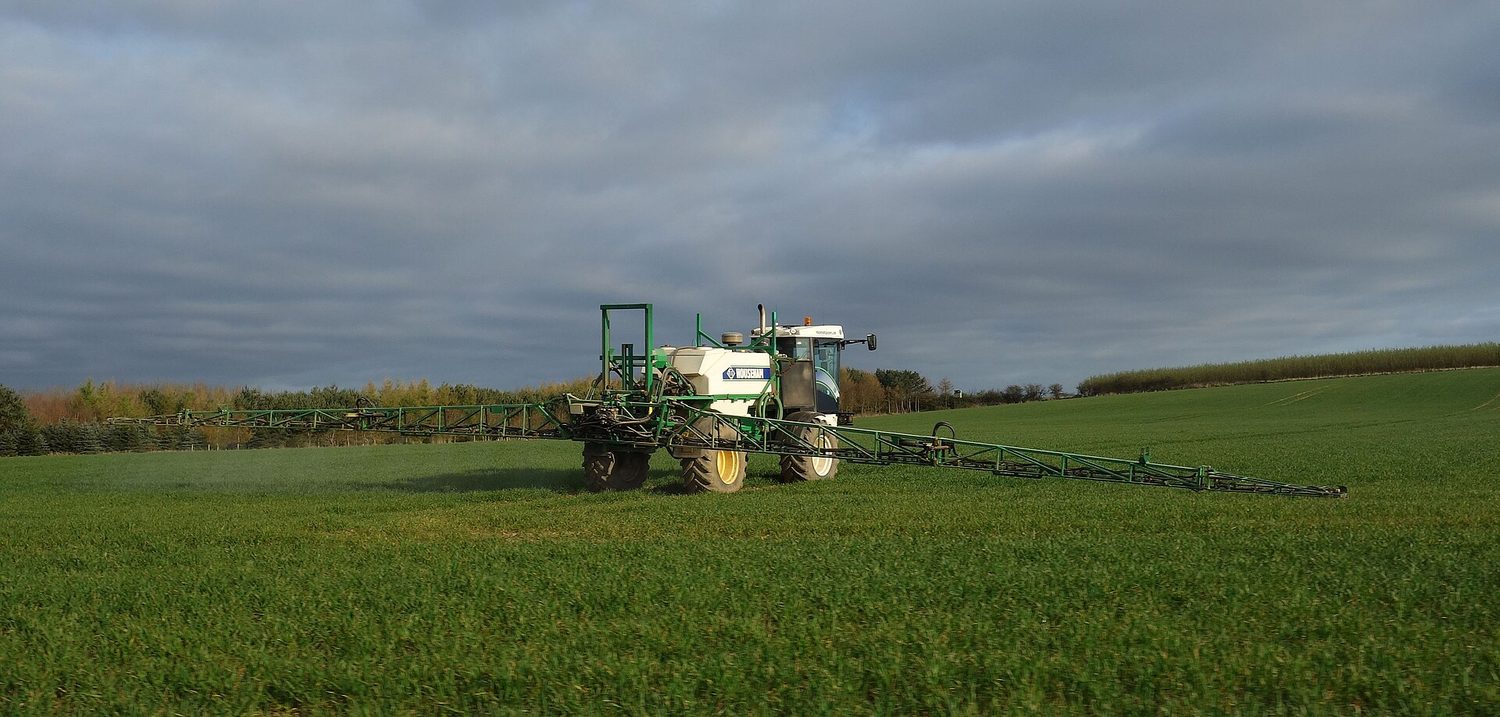
Muchos pesticidas y herbicidas son haloarilinas — átomos de cloro unidos a un anillo de benceno.
You've got it
- a halogenoarene is made by electrophilic substitution (arene + Cl₂/AlCl₃)
- it is unreactive to nucleophiles: the Cl lone pair strengthens the C–Cl bond, and the ring repels nucleophiles
- chlorobenzene does not react with OH⁻; chloroethane does
- that stability makes them useful (pesticides, dyes) but persistent pollutants (DDT was banned)
Ya lo tienes
- una haloarilina se forma por sustitución electrofílica (arilina + Cl₂/AlCl₃)
- es inerte ante nucleófilos: el par libre del Cl fortalece el enlace C–Cl, y el anillo rechaza a los nucleófilos
- el clorobenceno no reacciona con OH⁻; la cloroetano sí
- esa estabilidad las hace útiles (pesticidas, colorantes) pero contaminantes persistentes (el DDT fue prohibido)