Alcohols with acyl chlorides
Introducido| English | Significado |
|---|---|
| ester/ˈestə/ | éster |
| acyl chloride/əˈkɪl ˈklɔːraɪd/ | cloruro de acilo |
| esterification/ˌestəˌrɪfɪˈkeɪʃn/ | esterificación |
| by-product/baɪ ˈprɒdʌkt/ | subproducto |
| phenol/ˈfenɒl/ | An aromatic compound with a hydroxyl group directly attached to a benzene ring. |
| phenyl ethanoate | phenyl ethanoate |
A faster way to esters 酯
- At A Level, an alcohol gains one more reaction.
- It reacts with an acyl chloride 酰氯 to make an ester.
- This works faster and more completely than using a carboxylic acid.
Acyl chloride with alcohol route
Follow nucleophilic acyl substitution to an ester.
An alcohol reacting with an acyl chloride gives:
Dificultad 1/5 · 100 monedas + un pequeño bono en el primer intento de hoy
The alcohol's –OH reacts with the acyl chloride to form an ester, releasing HCl.
An acyl chloride reacts with an alcohol to form an ______.
Dificultad 1/5 · 100 monedas + un pequeño bono en el primer intento de hoy
Releasing hydrogen chloride gas.
Carboxylic acids are more reactive than acyl chlorides.
Dificultad 1/5 · 100 monedas + un pequeño bono en el primer intento de hoy
False. Acyl chlorides are more reactive than carboxylic acids, because chloride is a good leaving group and the carbonyl carbon is strongly δ+.
The reaction
- An alcohol + an acyl chloride → an ester (plus fumes of $\text{HCl}$).
- It is faster and more complete than esterification 酯化 with a carboxylic acid.
- E.g. ethanol + ethanoyl chloride → ethyl ethanoate + HCl.
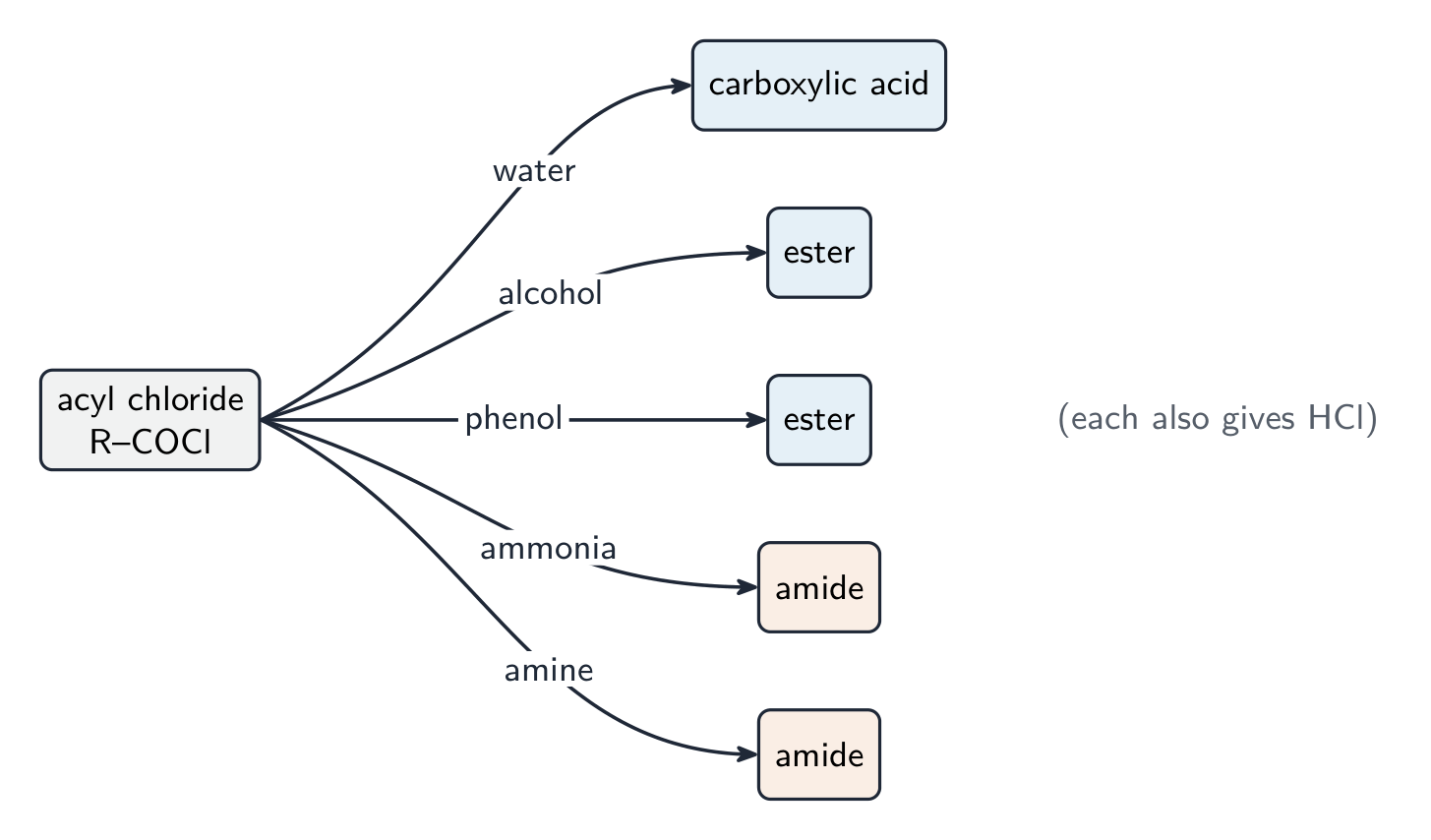
An acyl chloride reacts with an alcohol to form an ester
Compared with using a carboxylic acid, making an ester from an acyl chloride is:
Dificultad 1/5 · 100 monedas + un pequeño bono en el primer intento de hoy
Acyl chlorides are very reactive, so esterification with them is fast and goes essentially to completion.
Ethanol + ethanoyl chloride gives:
Dificultad 1/5 · 100 monedas + un pequeño bono en el primer intento de hoy
The ester ethyl ethanoate forms, along with HCl fumes.
Why it beats a carboxylic acid
- With a carboxylic acid you need a strong-acid catalyst and heat, and the reaction is an equilibrium, so the yield is never complete. With an acyl chloride the reaction is fast at room temperature, needs no catalyst and is not reversible.
- The by-product is HCl gas, which escapes. Acyl chlorides also react violently with water and fume in moist air, so they are kept dry and used in a fume cupboard.
Like esterification with a carboxylic acid, the reaction of an alcohol with an acyl chloride reaches an equilibrium.
Dificultad 1/5 · 100 monedas + un pequeño bono en el primer intento de hoy
It is not reversible: the HCl escapes as a gas, so the reaction goes to completion at room temperature.
Worked example: name the ester
Propan-1-ol reacts with ethanoyl chloride. Give the equation and name the ester.
- The alcohol supplies the first word of the name (propan-1-ol → propyl). The acyl chloride supplies the second (ethanoyl → ethanoate).
- So the ester is propyl ethanoate. The Cl of the acyl chloride and the H of the OH group leave together as HCl.
Methanol reacts with propanoyl chloride, $\text{CH}_3\text{CH}_2\text{COCl}$. Which ester forms?
Dificultad 1/5 · 100 monedas + un pequeño bono en el primer intento de hoy
The alcohol gives the first word (methyl) and the acyl chloride gives the second (propanoate).
Phenol reacts the same way
- Phenol 苯酚 reacts only very slowly with carboxylic acids, so phenyl esters are made with an acyl chloride instead.
- Ethanoyl chloride and phenol give phenyl ethanoate 乙酸苯酯: $\text{CH}_3\text{COCl} + \text{C}_6\text{H}_5\text{OH} \rightarrow \text{CH}_3\text{COOC}_6\text{H}_5 + \text{HCl}$.
What is the best way to make phenyl ethanoate?
Dificultad 1/5 · 100 monedas + un pequeño bono en el primer intento de hoy
Phenol reacts only very slowly with carboxylic acids, so the acyl chloride is used. Ethanol with benzoyl chloride gives ethyl benzoate, a different ester.
You've got it
- an alcohol + acyl chloride → ester (+ HCl)
- this is faster and more complete than using a carboxylic acid
- e.g. ethanol + ethanoyl chloride → ethyl ethanoate