Le Chatelier's principle
Introducido| English | Significado |
|---|---|
| Le Chatelier's principle/lə ˈtʃeɪtlɪəz ˈprɪnsɪpl/ | principio de Le Chatelier |
| equilibrium/ˌiːkwɪˈlɪbrɪəm/ | equilibrio |
| catalyst/ˈkætəlɪst/ | catalizador |
| endothermic/ˌendəʊˈθɜːmɪk/ | endotérmico |
Nudging a balance
- Le Chatelier's principle 勒夏特列原理: if you change a system at equilibrium 平衡, it shifts to oppose the change.
- This predicts which way the equilibrium moves.
- A catalyst 催化剂 is the exception — it shifts nothing.
Le Chatelier's principle says that a change to a system at equilibrium causes it to:
Dificultad 1/5 · 100 monedas + un pequeño bono en el primer intento de hoy
The equilibrium position always moves in the direction that lessens the change you made.
Increasing the pressure shifts equilibrium towards the side with more gas molecules.
Dificultad 1/5 · 100 monedas + un pequeño bono en el primer intento de hoy
False. By Le Chatelier's principle, higher pressure shifts equilibrium towards the side with fewer gas molecules, which reduces the pressure.
The changes
| Change | Equilibrium moves |
|---|---|
| increase a reactant's concentration | towards products |
| increase pressure | towards the side with fewer gas molecules |
| increase temperature | towards the endothermic 吸热 direction |
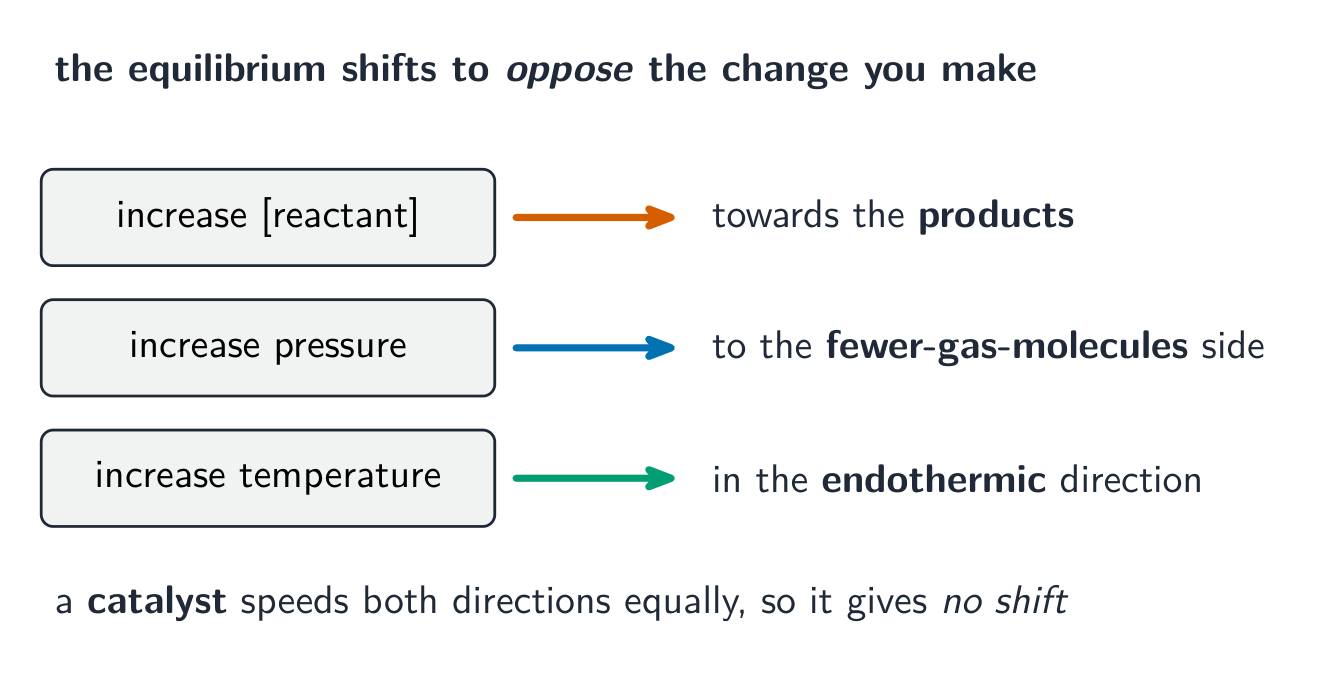
Le Chatelier's principle: the equilibrium shifts to oppose the change you make
Principio de Le Chatelier
el sistema se opone al cambio
Raise T, P or reactant and the equilibrium shifts to oppose your change.
Increasing the pressure shifts the equilibrium towards:
Dificultad 1/5 · 100 monedas + un pequeño bono en el primer intento de hoy
Moving to fewer gas molecules reduces the pressure, opposing the increase.
Increasing the temperature shifts the equilibrium towards:
Dificultad 1/5 · 100 monedas + un pequeño bono en el primer intento de hoy
The endothermic direction absorbs the added heat, opposing the temperature rise.
Catalysts
- A catalyst speeds up both the forward and reverse reactions equally.
- So equilibrium is reached faster, but its position does not change.
Adding a catalyst to a system at equilibrium:
Dificultad 1/5 · 100 monedas + un pequeño bono en el primer intento de hoy
A catalyst speeds up both directions equally, so the position of equilibrium is unchanged.
Match each change to how the equilibrium responds.
Dificultad 2/5 · 140 monedas + un pequeño bono en el primer intento de hoy
Each item links the term to its correct meaning.
Worked example: the Contact equilibrium
$2\text{SO}_2(\text{g}) + \text{O}_2(\text{g}) \rightleftharpoons 2\text{SO}_3(\text{g})$, $\Delta H = -197\ \dfrac{\text{kJ}}{\text{mol}}$. Predict each change.
- Raise the pressure: 3 gas molecules on the left, 2 on the right, so the position moves right and more $\text{SO}_3$ forms. Remove $\text{SO}_3$: the position moves right to replace it.
- Raise the temperature: the forward reaction is exothermic, so the position moves left (the endothermic direction) and the yield of $\text{SO}_3$ falls. Add $\text{V}_2\text{O}_5$: no shift, equilibrium is just reached sooner.
$\text{N}_2\text{O}_4(\text{g}) \rightleftharpoons 2\text{NO}_2(\text{g})$, $\Delta H = +58\ \dfrac{\text{kJ}}{\text{mol}}$. Colourless $\text{N}_2\text{O}_4$ and brown $\text{NO}_2$ are at equilibrium. What happens when the mixture is heated?
Dificultad 1/5 · 100 monedas + un pequeño bono en el primer intento de hoy
Heating favours the endothermic direction, which is forward here, so more brown $\text{NO}_2$ forms.
For the same equilibrium, which way does the position move when the pressure is increased?
Dificultad 1/5 · 100 monedas + un pequeño bono en el primer intento de hoy
There is 1 gas molecule on the left and 2 on the right, so higher pressure favours the left.
You've got it
- Le Chatelier: the equilibrium shifts to oppose any change you make
- more reactant → towards products; more pressure → fewer-gas-molecules side; more heat → endothermic direction
- a catalyst speeds both ways equally → reaches equilibrium faster, no shift