Artificial selection
Introducido| English | Significado |
|---|---|
| selective breeding/sɪˈlektɪv ˈbriːdɪŋ/ | selección dirigida |
| artificial selection/ˌɑːtɪˈfɪʃl sɪˈlekʃn/ | selección artificial |
| inbreeding/ˈɪnbriːdɪŋ/ | endogamia |
| hybridisation/ˌhaɪbrɪdaɪˈzeɪʃn/ | hibridación |
| gene pool/dʒiːn puːl/ | pool génico |
Selective breeding 选择育种
- In selective breeding (artificial selection 人工选择), humans — not nature — choose which organisms breed.
- This passes on useful features.
- It is how we shaped our crops and farm animals.
Selective breeding (artificial selection) differs from natural selection because:
Dificultad 1/5 · 100 monedas + un pequeño bono en el primer intento de hoy
In artificial selection, people choose the breeders to pass on useful features; in natural selection, the environment selects.
When humans choose which organisms breed to pass on useful features, it is called ______ selection.
Dificultad 1/5 · 100 monedas + un pequeño bono en el primer intento de hoy
Artificial selection (selective breeding) is the same mechanism as natural selection — but humans, not the environment, do the selecting.
Repeated artificial selection from a few individuals can reduce the gene pool and cause inbreeding problems.
Dificultad 1/5 · 100 monedas + un pequeño bono en el primer intento de hoy
A narrow gene pool concentrates harmful recessive alleles and lowers the population's resilience.
Examples
- breeding disease resistance into varieties of wheat and rice.
- using inbreeding 近交 and hybridisation 杂交 (crossing different lines) to make vigorous, uniform maize.
- breeding dairy cattle to improve their milk yield.
Cría selectiva
Step through it. Humans take the role of the environment — choosing the breeders, generation after generation.
Which is an example of selective breeding?
Dificultad 1/5 · 100 monedas + un pequeño bono en el primer intento de hoy
Breeding cattle for milk yield (or disease-resistant crops) is humans choosing which organisms reproduce.
Put selective breeding in order.
Dificultad 3/5 · 200 monedas + un pequeño bono en el primer intento de hoy
Choose → breed → select offspring → repeat. Each round pushes the feature further.
Hybridisation in selective breeding means:
Dificultad 1/5 · 100 monedas + un pequeño bono en el primer intento de hoy
Hybridisation crosses different lines (often with inbreeding) to make vigorous, uniform crops like maize.
How it is done
- Choose parents with the desired feature, breed them, and select the best offspring to breed again.
- Repeat over many generations until the feature is firmly established.
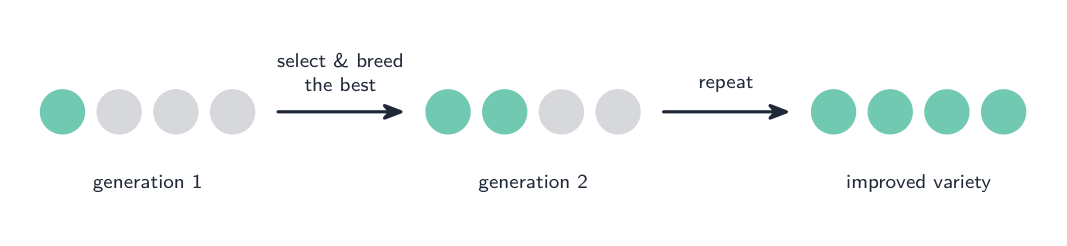
Choosing the best parents each generation makes a wanted feature more and more common
The problems with it
- Repeatedly breeding from a few "best" individuals shrinks the gene pool 基因库.
- This inbreeding can concentrate harmful alleles and leaves the population vulnerable to disease.
Worked example: breeding a high-yield dairy herd
A farmer wants cows that give more milk. Describe how selective breeding could be used, and a risk.
- Measure milk yield of each cow, select the highest-yielding cows, and mate them with a bull whose mothers and daughters had high yields (bulls give no milk themselves). Select the best daughters and repeat over many generations.
- Risk: breeding from a few related animals causes inbreeding, which shrinks the gene pool; harmful recessive alleles become homozygous more often, and the herd may lose resistance to a new disease. Bringing in unrelated animals helps.
Crossing two different inbred lines of maize can produce vigorous, uniform hybrid plants.
Dificultad 1/5 · 100 monedas + un pequeño bono en el primer intento de hoy
This is hybrid vigour.
How does selective breeding differ from natural selection?
Dificultad 1/5 · 100 monedas + un pequeño bono en el primer intento de hoy
In natural selection the environment does the choosing.
You've got it
- selective breeding (artificial selection) = humans choose which organisms reproduce
- examples: disease-resistant wheat/rice; inbreeding + hybridisation for maize; higher milk yield in cattle
- it passes on the features people find useful
Write from this case
- A farmer breeds only the cows that give the most milk.
- Wild survival does not choose the parents.
What kind of selection is this?
People, not the wild environment, pick who breeds.
Who selects in this breeding programme?
Dificultad 1/5 · 100 monedas + un pequeño bono en el primer intento de hoy
The farmer's choice is artificial selection.