The nerve impulse
Introducido| English | Significado |
|---|---|
| resting potential/ˈrestɪŋ pəˈtenʃl/ | potencial de reposo |
| action potential/ˈækʃn pəˈtenʃl/ | potencial de acción |
| depolarisation/diːˌpəʊləraɪˈzeɪʃn/ | despolarización |
| repolarisation/rɪˌpəʊləraɪˈzeɪʃn/ | repolarización |
| refractory period/rɪˈfræktəri ˈpɪərɪəd/ | período refractario |
| myelin sheath/ˈmaɪɪlɪn ʃiːθ/ | vaina de mielina |
| saltatory conduction/ˈsɒltətəri kənˈdʌkʃn/ | conducción saltatoria |
A wave of electricity
- An impulse is a change in the voltage across the neurone's membrane.
- At rest the inside is negative; an impulse flips it briefly positive.
- A fatty sheath can make it travel far faster.
The brief reversal of charge across a neurone membrane is an action ______.
Dificultad 1/5 · 100 monedas + un pequeño bono en el primer intento de hoy
It travels along the axon as the nerve impulse.
The resting potential 静息电位
- When no impulse passes, the inside is negative compared with the outside — the resting potential.
- It is kept this way by a pump that moves sodium out and potassium in, and by the membrane being more permeable to potassium.
El impulso nervioso
resting −70 → spike +40 mV
Scrub the spike: Na⁺ floods in to depolarise, then K⁺ leaves to repolarise.
At the resting potential, the inside of the neurone is:
Dificultad 1/5 · 100 monedas + un pequeño bono en el primer intento de hoy
The resting potential keeps the inside negative, maintained by the Na⁺/K⁺ pump and K⁺ permeability.
The action potential 动作电位
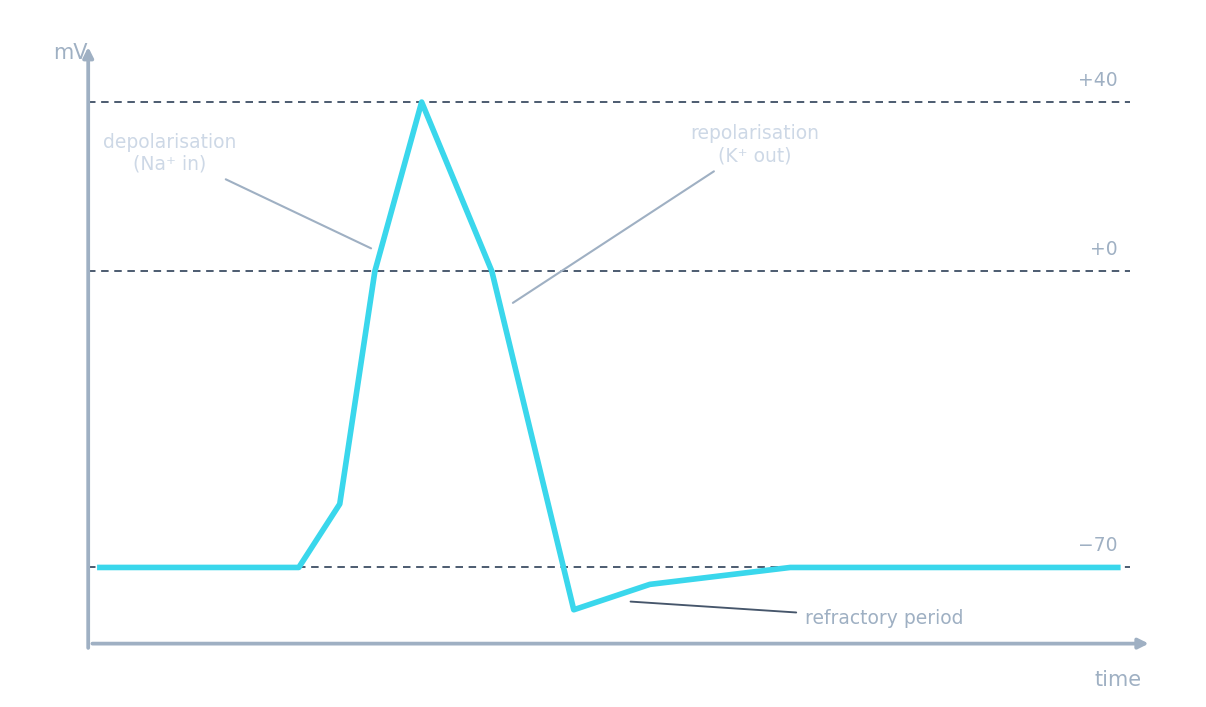
- A stimulus opens sodium channels → Na⁺ rushes in → inside briefly positive (depolarisation 去极化).
- Then potassium channels open → K⁺ leaves → the membrane returns to negative (repolarisation 复极化).
- A short refractory period 不应期 follows: sodium channels can't reopen, restoring rest and limiting how often impulses fire.
Depolarisation during an action potential is caused by:
Dificultad 1/5 · 100 monedas + un pequeño bono en el primer intento de hoy
Sodium channels open and Na⁺ floods in, reversing the charge (depolarisation); then K⁺ leaves to repolarise.
Put the action potential in order.
Dificultad 3/5 · 200 monedas + un pequeño bono en el primer intento de hoy
Rest → Na⁺ in (depolarise) → K⁺ out (repolarise) → reset. The spike is brief and all-or-nothing.
Match each phase to what is happening.
Dificultad 2/5 · 140 monedas + un pequeño bono en el primer intento de hoy
Na⁺ in flips the charge; K⁺ out restores it; the refractory period stops a backward impulse.
The refractory period resets the neurone and limits how often impulses can fire.
Dificultad 1/5 · 100 monedas + un pequeño bono en el primer intento de hoy
Sodium channels cannot reopen for a moment, so the neurone resets and impulses stay separate and one-way.
Faster: myelin
- Some axons are wrapped in a fatty myelin sheath 髓鞘 that the impulse cannot cross.
- So the impulse jumps from one gap (node) to the next — saltatory conduction 跳跃式传导 — travelling much faster.
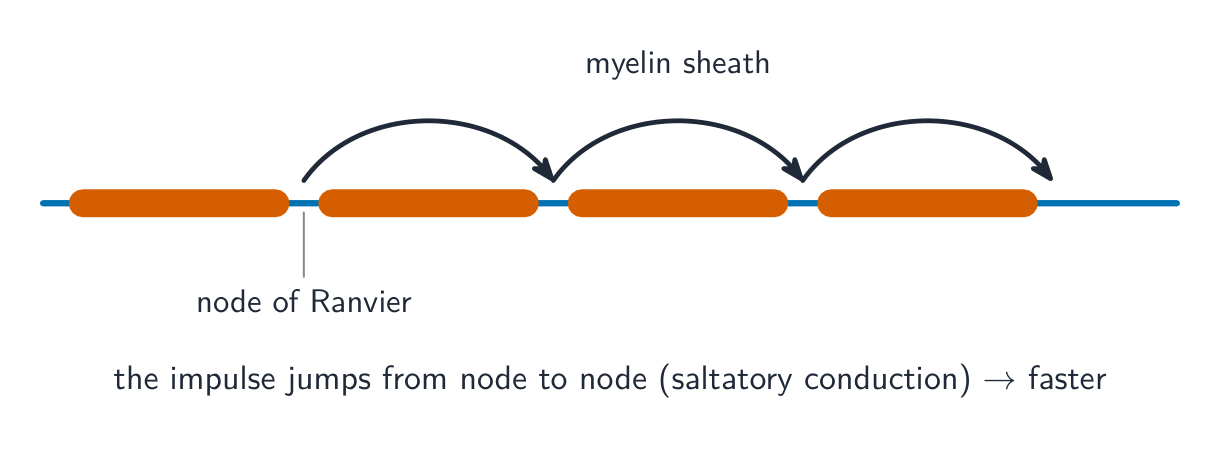
Saltatory conduction: the impulse jumps between the gaps in the myelin
Saltatory conduction makes impulses faster because the impulse:
Dificultad 1/5 · 100 monedas + un pequeño bono en el primer intento de hoy
The impulse cannot cross the myelin, so it jumps node to node — much faster than along a bare axon.
Worked example: reading an action potential trace
A trace starts at −70 mV, rises to +40 mV in 1 ms, falls to −80 mV, then returns to −70 mV. Explain each part.
- −70 mV: the resting potential, inside negative. Rise to +40 mV: voltage-gated Na⁺ channels open after the threshold (about −55 mV) is reached, and Na⁺ diffuses in: depolarisation. At the peak the Na⁺ channels close.
- Fall: K⁺ channels open and K⁺ diffuses out: repolarisation. The dip to −80 mV is hyperpolarisation, because K⁺ channels close slowly. The Na⁺/K⁺ pump then restores −70 mV. The total change from rest to peak is $40-(-70)=110$ mV.
A neurone rests at −65 mV and peaks at +35 mV. What is the change in potential, in mV?
Dificultad 2/5 · 140 monedas + un pequeño bono en el primer intento de hoy
35 − (−65) = 100 mV.
A stronger stimulus above threshold produces bigger action potentials.
Dificultad 1/5 · 100 monedas + un pequeño bono en el primer intento de hoy
Action potentials are all-or-nothing; a stronger stimulus gives them more often.
You've got it
- resting potential: inside negative (Na⁺ pumped out, K⁺ in; membrane leaks K⁺)
- action potential: Na⁺ in → depolarisation (+); K⁺ out → repolarisation (−)
- refractory period: Na⁺ channels can't reopen → limits impulse frequency
- myelin → saltatory conduction (jumps node to node) → much faster
Write from this case
- One stimulus is below threshold.
- A stronger stimulus is above threshold.
How do the two action potentials compare if both were above threshold?
The action potential does not come in half sizes.
What does a stimulus below threshold produce?
Dificultad 1/5 · 100 monedas + un pequeño bono en el primer intento de hoy
Threshold must be reached for a full impulse.