The heart · El corazón
| English | Español |
|---|---|
| atria/ˈeɪtrɪə/ | aurículas |
| ventricle/ˈventrɪkl/ | ventrículo |
| cardiac cycle/ˈkɑːdiæk ˈsaɪkl/ | ciclo cardíaco |
| systole/ˈsɪstəʊl/ | sístole |
| diastole/ˈdaɪəstəʊl/ | diástole |
| sinoatrial node/sɪˈnəʊtrɪəl nəʊd/ | nodo sinoauricular |
| pacemaker/ˈpeɪsmeɪkə/ | marcapasos |
| atrioventricular node/ˌeɪtrɪˌəʊvənˈtrɪkjʊlə nəʊd/ | nodo auriculoventricular |
| Purkyne tissue/ˈpɜːkaɪn ˈtɪʃuː/ | tejido de Purkinje |
The pump that never rests
- The heart is a double pump with four chambers.
- Its walls are thicker where it must push blood further.
- And it sets its own rhythm — no outside command needed.
La bomba que nunca descansa
- El corazón es una doble bomba con cuatro cámaras.
- Sus paredes son más gruesas donde debe impulsar la sangre más lejos.
- Y establece su propio ritmo — no necesita ninguna orden externa.
Structure
- The two upper chambers are the atria 心房 — thin walls, because they only push blood down into the chambers below.
- The two lower chambers are the ventricles 心室 — thick muscular walls, because they pump blood out of the heart.
- The left ventricle wall is the thickest: it pumps blood all the way round the body (the right side only reaches the nearby lungs).
The internal structure of the human heart
Estructura
- Las dos cámaras superiores son las aurículas 心房 — paredes delgadas, porque solo impulsan la sangre hacia abajo a las cámaras inferiores.
- Las dos cámaras inferiores son los ventrículos 心室 — paredes musculares gruesas, porque bombean la sangre hacia afuera del corazón.
- La pared del ventrículo izquierdo es la más gruesa: bombea sangre por todo el cuerpo (el lado derecho solo llega a los pulmones cercanos).

La estructura interna del corazón humano
Explore the heart · Explorar el corazón
Tap each part. The right side pumps blood to the lungs; the thicker-walled left side pumps it round the whole body. · Toca cada parte. El lado derecho bombea sangre a los pulmones; el lado izquierdo, con paredes más gruesas, la bombea por todo el cuerpo.
Ventricles have thicker walls than atria because they: · Los ventrículos tienen paredes más gruesas que las aurículas porque:
Atria only push blood into the ventricles below; ventricles pump blood out, so need thick muscular walls. · Las aurículas solo empujan la sangre hacia los ventrículos inferiores; los ventrículos bombean sangre hacia afuera, por lo que necesitan paredes musculares gruesas.
The thickest, most muscular chamber, which pumps blood around the whole body, is the left ______. · La cámara más gruesa y musculosa, que bombea sangre por todo el cuerpo, es el ______ izquierdo.
The left ventricle drives the systemic circulation (whole body), so it needs the most muscle. · El ventrículo izquierdo impulsa la circulación sistémica (todo el cuerpo), por lo que necesita la mayor cantidad de músculo.
The cardiac cycle 心动周期
- One heartbeat is the cardiac cycle: systole 收缩期 (muscle contracts) and diastole 舒张期 (relaxes and fills).
- When a chamber contracts, the pressure inside rises.
- These pressure changes open and close the valves, so blood flows one way only.
Pressure rises and falls in the atria, ventricles and aorta through one cardiac cycle, working the valves
Ciclo cardíaco 心动周期
- Un latido cardíaco es el ciclo cardíaco: sístole 收缩期 (el músculo se contrae) y diástole 舒张期 (se relaja y se llena).
- Cuando una cámara se contrae, la presión interna aumenta.
- Estos cambios de presión abren y cierran las válvulas, para que la sangre fluya solo en una dirección.
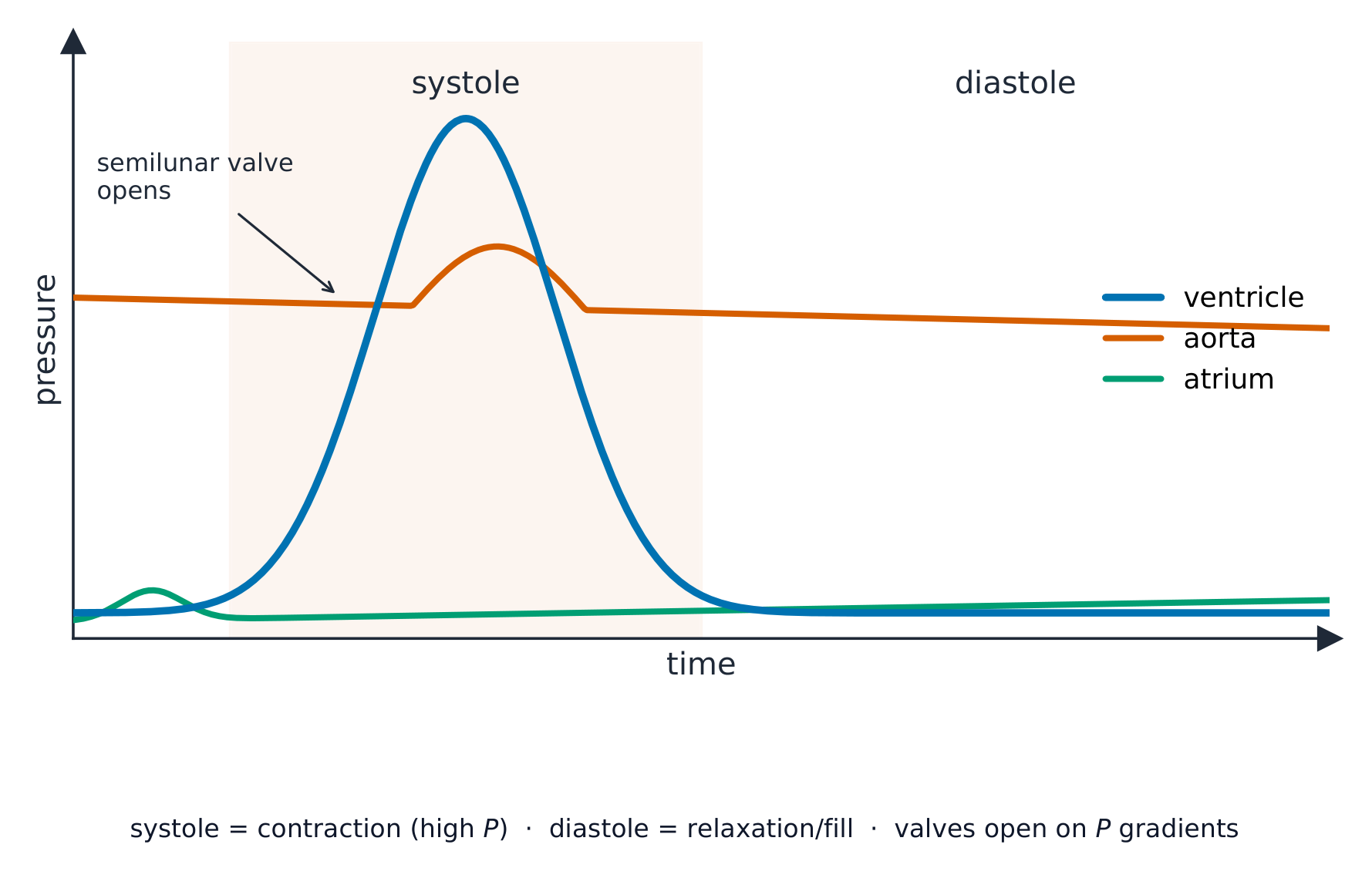
La presión sube y baja en las aurículas, ventrículos y aorta a través de un ciclo cardíaco, accionando las válvulas
The cardiac cycle · El ciclo cardíaco
Step through one heartbeat — atria contract, then ventricles contract, then everything relaxes and refills. · Pasa por una latido completo: las aurículas se contraen, luego los ventrículos, y finalmente todo se relaja y se rellena.
In the cardiac cycle, systole is when the heart muscle: · En el ciclo cardíaco, la sístole es cuando el músculo cardíaco:
Systole = contraction (pressure rises); diastole = relaxation and filling. · Sístole = contracción (la presión sube); diástole = relajación y llenado.
Match each stage of the cardiac cycle. · Empareja cada etapa del ciclo cardíaco.
Atria contract first, then ventricles, then everything relaxes; the valves keep blood moving one way. · Las aurículas se contraen primero, luego los ventrículos, y después todo se relaja; las válvulas mantienen el flujo de sangre en una sola dirección.
The semilunar valves stop blood flowing back into the ventricles from the arteries. · Las válvulas semilunares evitan que la sangre fluya de regreso a los ventrículos desde las arterias.
When the ventricles relax, the semilunar valves (in the aorta and pulmonary artery) shut to stop backflow. · Cuando los ventrículos se relajan, las válvulas semilunares (en la aorta y la arteria pulmonar) se cierran para evitar el reflujo.
Controlling the heartbeat
- The sinoatrial node 窦房结 (SAN) in the right atrium is the pacemaker 起搏点 — its wave of excitation makes the atria contract.
- The atrioventricular node 房室结 (AVN) picks up the wave and delays it (so the atria empty first).
- The Purkyne tissue 浦肯野组织 carries the wave down and up the ventricle walls, so the ventricles contract from the bottom up.
The heart's electrical conduction system
Control del latido cardíaco
- El nodo sinoatrial 窦房结 (SAN) en la aurícula derecha es el marcapasos 起搏点 — su onda de excitación hace que las aurículas se contraigan.
- El nodo auriculoventricular 房室结 (AVN) capta la onda y la retrasa (para que las aurículas se vacíen primero).
- El tejido de Purkinje 浦肯野组织 lleva la onda hacia abajo y hacia arriba por las paredes del ventrículo, para que los ventrículos se contraigan de abajo hacia arriba.

Sistema de conducción eléctrica del corazón
The pacemaker that sets the heart's rhythm is the: · El marcapasos que establece el ritmo cardíaco es el:
The SAN in the right atrium generates the wave of excitation that triggers each heartbeat. · El SAN en la aurícula derecha genera la onda de excitación que desencadena cada latido cardíaco.
Put the electrical conduction pathway in the correct order. · Coloca la vía de conducción eléctrica en el orden correcto.
SAN (pacemaker) → AVN (delay) → Purkyne tissue (ventricles contract from the bottom up). · SAN (marcapasos) → AVN (retraso) → tejido de Purkinje (los ventrículos se contraen de abajo hacia arriba).
You've got it
- atria = thin walls (push blood down); ventricles = thick walls (pump out)
- left ventricle is thickest — it pumps to the whole body
- cardiac cycle = systole (contract) + diastole (relax/fill); pressure works the valves (one-way flow)
- rhythm: SAN (pacemaker) → atria; AVN (delay) → Purkyne → ventricles contract bottom-up
Lo has entendido
- aurículas = paredes delgadas (impulsan sangre hacia abajo); ventrículos = paredes gruesas (bombean hacia afuera)
- El ventrículo izquierdo es el más grueso — bombea a todo el cuerpo
- ciclo cardíaco = sístole (contracción) + diástole (relajación/relleno); la presión acciona las válvulas (flujo unidireccional)
- ritmo: SAN (marcapasos) → aurículas; AVN (retraso) → Purkinje → ventrículos se contraen de abajo hacia arriba