Water potential and living cells
Introducido| English | Significado |
|---|---|
| water potential/ˈwɔːtə pəˈtenʃl/ | potencial hídrico |
| solute/ˈsɒljuːt/ | sóluto |
| turgid/ˈtɜːdʒɪd/ | turgente |
| plasmolysis/plæzˈmɒləsɪs/ | plasmólisis |
| haemolysis/hiːˈmɒləsɪs/ | hemólisis |
Which way will water move?
- Water potential 水势 measures how likely water is to leave a solution.
- It decides which way water moves by osmosis.
- It explains why a wilted plant perks up in water — and why a cell can burst.
What changes water potential
- Pure water has the highest water potential.
- Adding a solute 溶质 (a dissolved substance) lowers it.
- Water always moves by osmosis from higher to lower water potential.
- To estimate the water potential of plant tissue: soak pieces in sucrose solutions; the one causing no change in mass/length matches the tissue.
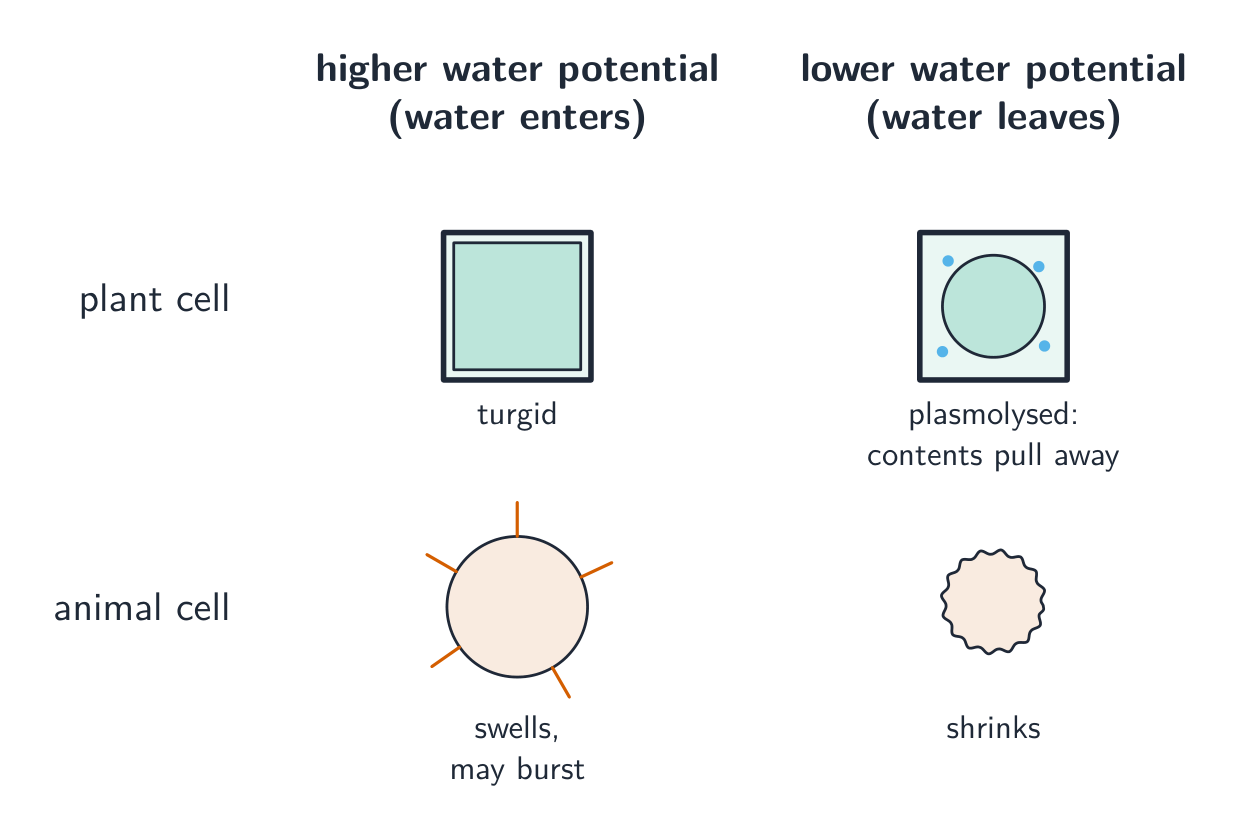
How plant and animal cells respond to solutions of different water potential
Potencial del agua
water follows the gradient
Drag the concentrations. A water-potential gradient drives net movement — it stops only when the two sides match.
Adding a solute to pure water:
Dificultad 1/5 · 100 monedas + un pequeño bono en el primer intento de hoy
Pure water has the highest water potential; dissolving a solute lowers it.
Pure water has the lowest possible water potential.
Dificultad 1/5 · 100 monedas + un pequeño bono en el primer intento de hoy
False. Pure water has the highest water potential, defined as 0 kPa. Adding solute lowers it, making it negative.
When estimating the water potential of plant tissue, the matching solution causes ______ change in mass or length.
Dificultad 1/5 · 100 monedas + un pequeño bono en el primer intento de hoy
No net osmosis (no mass/length change) means the solution and tissue have the same water potential.
Plant cells
- In a higher water potential (e.g. distilled water): water enters, the cell swells and becomes turgid 膨胀 — the strong cell wall stops it bursting.
- In a lower water potential: water leaves, the contents shrink and the membrane pulls away from the wall — plasmolysis 质壁分离.
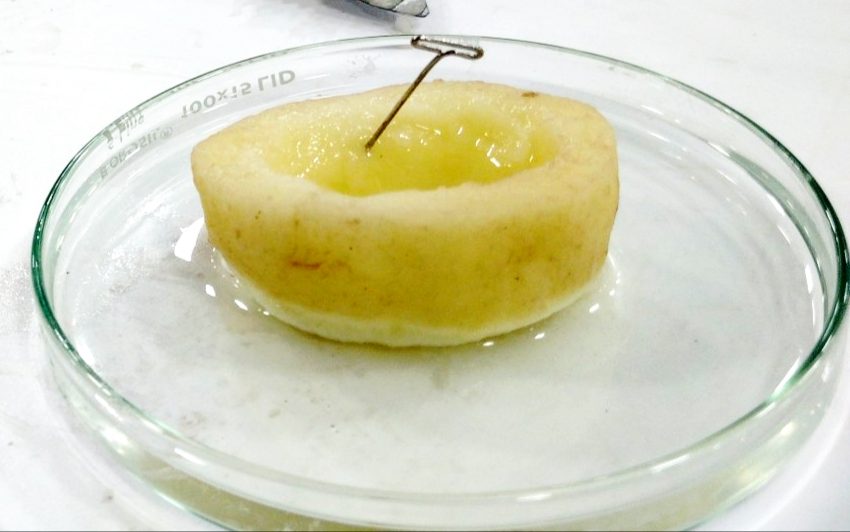
A potato osmometer: sugar solution rises up the tube as water enters by osmosis.
A plant cell placed in distilled water becomes turgid rather than bursting because:
Dificultad 1/5 · 100 monedas + un pequeño bono en el primer intento de hoy
Water enters (higher water potential outside), but the rigid cell wall stops the cell bursting — it becomes turgid.
Plasmolysis happens when a plant cell is in a solution of LOWER water potential, because:
Dificultad 1/5 · 100 monedas + un pequeño bono en el primer intento de hoy
Water leaves down the water-potential gradient; the contents shrink and the membrane peels away from the wall.
Animal cells
- Animal cells have no cell wall to protect them.
- In a higher water potential: water enters and the cell may burst — in a red blood cell this is haemolysis 溶血.
- In a lower water potential: water leaves and the cell shrinks.
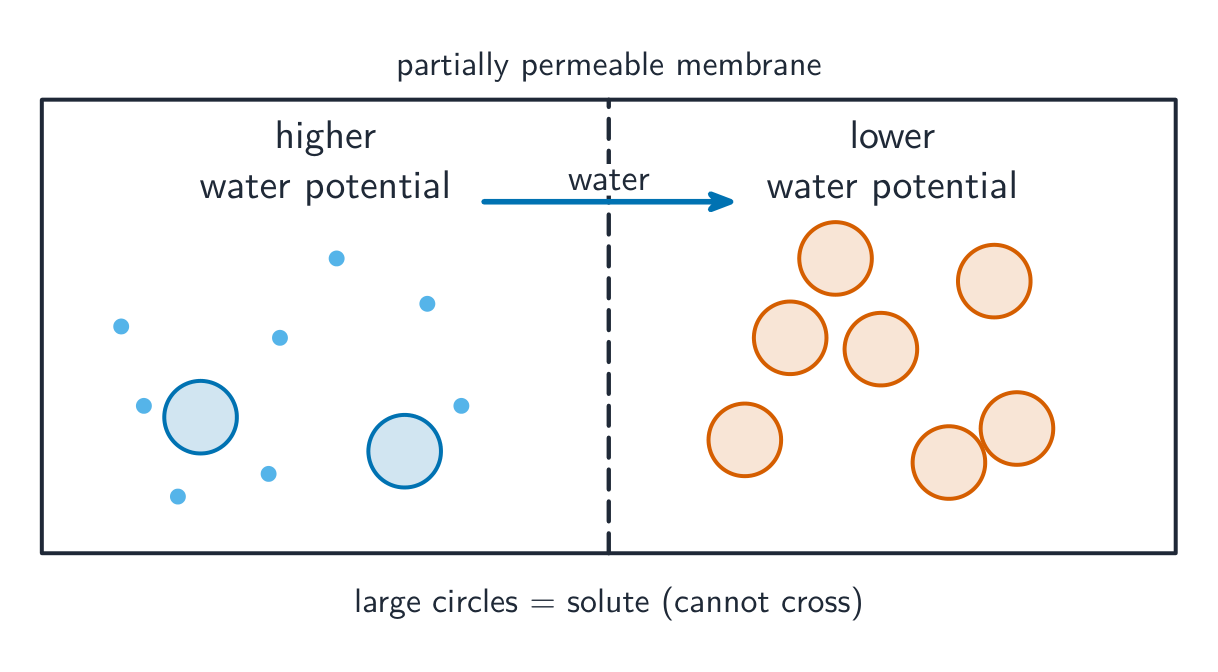
Osmosis: water crosses a partially permeable membrane to the lower water potential
Match each cell and solution to what happens.
Dificultad 2/5 · 140 monedas + un pequeño bono en el primer intento de hoy
The wall protects plant cells; without one, a red blood cell bursts in pure water and shrinks in a concentrated solution.
A red blood cell placed in pure water may undergo haemolysis. This is because it:
Dificultad 1/5 · 100 monedas + un pequeño bono en el primer intento de hoy
With no protective wall, water entering by osmosis swells the cell until the membrane bursts (haemolysis).
Worked examples
1. A plant cell has a water potential of $-400$ kPa and is placed in a solution of $-600$ kPa. Water moves from higher (less negative) to lower water potential, so it leaves the cell; if enough leaves, the membrane pulls away from the wall (plasmolysis).
2. Two neighbouring cells have water potentials of $-300$ kPa and $-500$ kPa. Water moves by osmosis from the $-300$ kPa cell into the $-500$ kPa cell, until the two are equal.
Which way does water move?
Water moves down the water-potential gradient.
What happens to the cell in this solution?
Dificultad 1/5 · 100 monedas + un pequeño bono en el primer intento de hoy
The outside water potential is lower.
Worked example: potato cylinders in sucrose
Potato cylinders are weighed, left in sucrose solutions for 24 hours, blotted dry and weighed again.
| Sucrose / mol/dm³ | 0.0 | 0.2 | 0.4 | 0.6 | 0.8 |
|---|---|---|---|---|---|
| change in mass / % | +18 | +7 | −3 | −12 | −19 |
- Use percentage change, because the cylinders start at different masses.
- Plot the change against concentration: the line crosses 0% at about 0.34 mol/dm³. A solution of this concentration has the same water potential as the potato cells, so there is no net osmosis.
Why is percentage change in mass used rather than change in mass?
Dificultad 1/5 · 100 monedas + un pequeño bono en el primer intento de hoy
A heavier cylinder would gain or lose more mass for the same water potential gradient.
In 0.2 mol/dm³ sucrose the potato gained mass. What does this show?
Dificultad 1/5 · 100 monedas + un pequeño bono en el primer intento de hoy
Water moves from higher to lower water potential, here from the solution into the cells.
You've got it
- pure water = highest water potential; solute lowers it; water moves higher → lower
- estimate tissue water potential by the no-change solution (mass/length)
- plant cell: turgid (high WP, wall protects) ↔ plasmolysis (low WP)
- animal cell (no wall): bursts/haemolysis (high WP) ↔ shrinks (low WP)
Write from this case
- A plant cell is placed in a solution.
- The solution has a more negative water potential than the cell contents.