A student investigates the refraction of light by a transparent block.
He determines a quantity known as the refractive index of the material of the block.
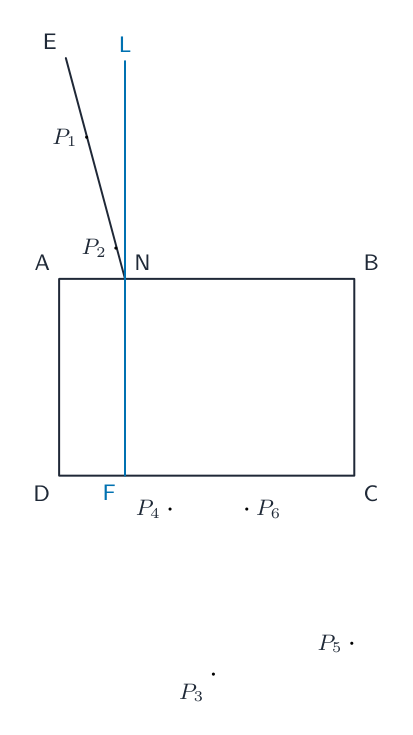
The student’s ray-trace sheet is shown full-size in Fig. 3.1.

The student places a transparent block ABCD near the centre of the ray-trace sheet as indicated in Fig. 3.1.
Draw a normal to point N, extending above AB. Label the upper end of the normal with the letter L.
Extend the normal downwards until it crosses line CD. Label the point at which it crosses CD with the letter F.[1]
The student draws line EN as shown in Fig. 3.1.
On Fig. 3.1, measure the acute angle $\theta_1$ between the lines LN and EN.
(An acute angle is always less than 90°.)
$\theta_1$ = [1]
The student places two pins $P_1$ and $P_2$ on line EN as shown in Fig. 3.1.
Measure distance $d$ between pins $P_1$ and $P_2$.
$d$ = [1]
Suggest whether the two pins are a suitable distance apart for accurate ray tracing.
Explain your answer.
statement
explanation
[1]
The student views the images of $P_1$ and $P_2$ through the block.
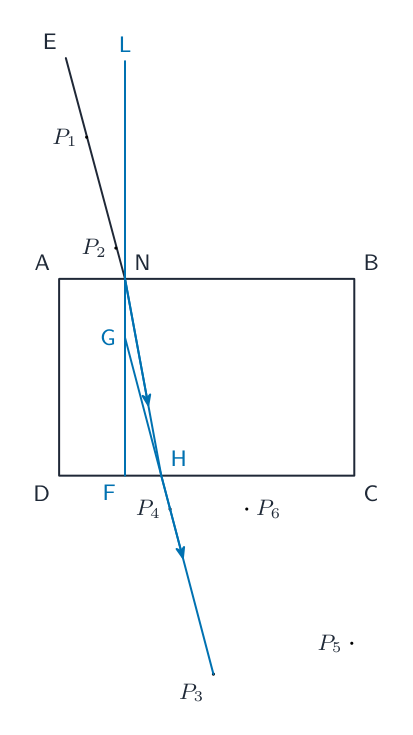
He places two pins $P_3$ and $P_4$ so that pins $P_3$ and $P_4$ and the images of $P_1$ and $P_2$ all appear exactly one behind the other.
Draw a straight line through $P_3$ and $P_4$. Extend this line to cross NF.
Label the point at which this line meets NF with the letter G.
Label the point at which this line crosses CD with the letter H.
Join points H and N with a straight line.[1]
Measure the length $a$ of line HN.
$a$ = cm
Measure the length $b$ of line HG.
$b$ = cm[1]
Calculate a value $n$ for the refractive index, using the equation $n = \frac{a}{b}$.
$n$ = [1]
The student repeats the above procedure for an angle $\theta_2 = 40^{\circ}$.
He places two pins $P_5$ and $P_6$ so that pins $P_5$ and $P_6$ and the images of $P_1$ and $P_2$ all appear exactly one behind the other.
Draw a line through pins $P_5$ and $P_6$. Extend the line until it meets GH.
Label the point at which this line meets GH with the letter K.
Label the point at which this line crosses CD with the letter R.
Measure the angle $\alpha$, where $\alpha$ is the acute angle between lines RK and GH.
$\alpha$ = [1]
Another student suggests that angle $\alpha$ should be equal to the difference between angle $\theta_2$ from (e)(i) and angle $\theta_1$ from (a)(ii).
State whether your results support this suggestion. Justify your answer by reference to values from your results.
statement
justification
[2]
Suggest one technique to use in this type of experiment to ensure results are accurate.
[1]
[Total: 11]