A student investigates the image formed by a converging lens.
The apparatus is set up as shown in Fig. 3.1.

The student:
- switches on the lamp
• places the lens a distance $u = 20.0\text{ cm}$ from the illuminated object (a triangular hole in the card)
• adjusts the position of the screen until a sharp image of the illuminated object is formed on the screen.
Measure on Fig. 3.1, to the nearest $0.1\text{ cm}$, the image distance $d$ from the centre of the lens to the screen.
$d =$ $\text{cm}$[1]
Fig. 3.1 is drawn to a scale of one-fifth ($\frac{1}{5}$) full size.
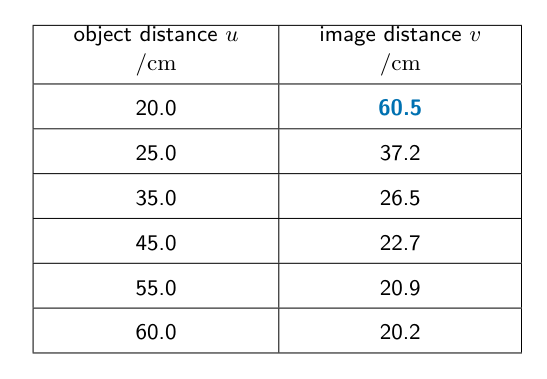
Calculate the actual image distance $v$ from the lens and record your value in Table 3.1.
Table 3.1
| object distance $u$ / cm | image distance $v$ / cm |
| 20.0 | |
| 25.0 | 37.2 |
| 35.0 | 26.5 |
| 45.0 | 22.7 |
| 55.0 | 20.9 |
| 60.0 | 20.2 |
[1]
The diagram in Fig. 3.2 shows the illuminated object and its image drawn full size when $u = 20.0\text{ cm}$.

State two ways in which the image differs from the object.
1
2 [1]
The magnification $m$ of the image can be calculated using the equation shown.
Use your answer to (a)(ii) to calculate the magnification $m$ of the image.
$m =$ [1]
The student repeats the procedure in (a)(i) for values of $u = 25.0\text{ cm}$, $u = 35.0\text{ cm}$, $u = 45.0\text{ cm}$, $u = 55.0\text{ cm}$ and $u = 60.0\text{ cm}$.
The student’s results are shown in Table 3.1.
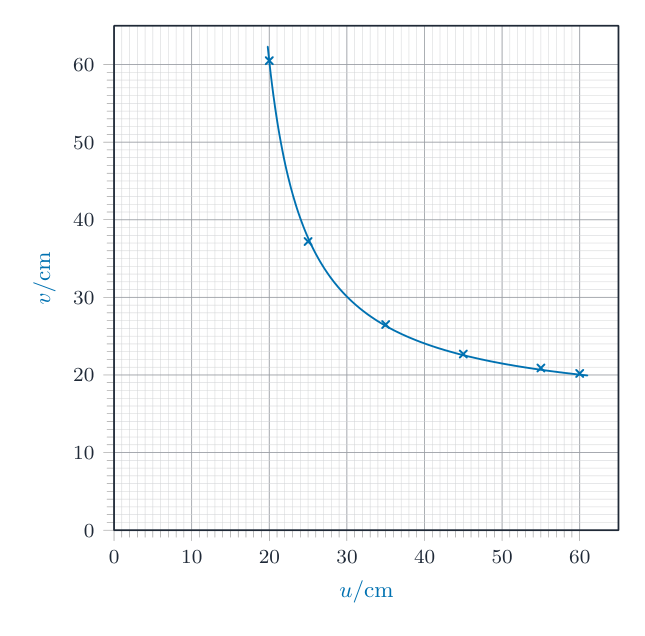
Plot a graph of $v\text{/cm}$ ($y$-axis) against $u/\text{ cm}$ ($x$-axis).
Draw the best-fit curve.[3]

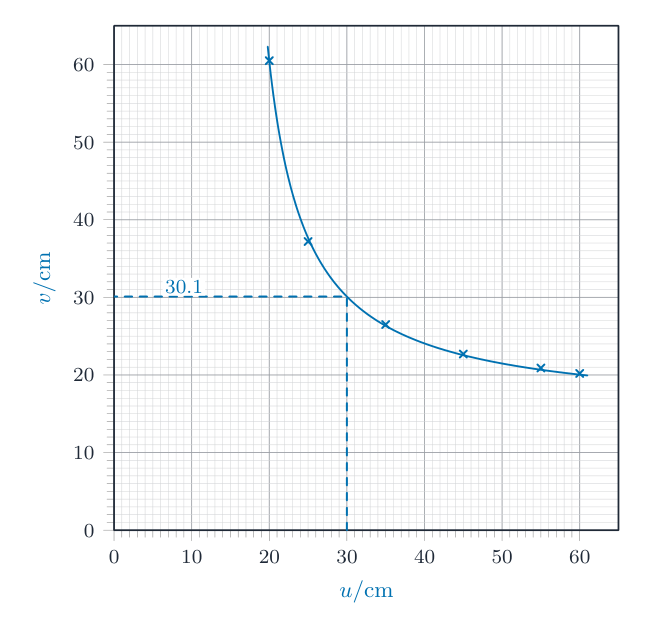
Use your graph to find the value of $v$ when $u = 30.0\text{ cm}$. Show clearly on the graph how you obtained the necessary information.
$v =$ $\text{cm}$[2]
The focal length $f$ of the lens can be found using the equation $f = \frac{uv}{(u + v)}$.
Use the values of $u$ and $v$ from (d) to calculate the focal length of the lens.
$f =$ $\text{cm}$[1]
State one technique you use when doing the experiment to ensure that the image on the screen is as clearly focussed as possible.
[1]
[Total: 11]