Skip to content

IGCSE Physics · November 2024 · Paper 61 · Difficulty 3 · Standard

Question 1

1

A student investigates the period of a pendulum. Fig. 1.1 shows the set up.

(a)

The student adjusts the length of the pendulum until the distance $d$ measured from the bottom of the support to the centre of the bob is 90.0 cm.

He displaces the bob slightly and releases it so that it swings.

He measures, and records in Table 1.1, the time $t$ for 10 complete oscillations.

Calculate, and record in Table 1.1, the period $T$ of the pendulum. The period is the time for 1 complete oscillation.

Calculate a value for $T^{2}$ and record in Table 1.1.[2]

Table 1.1

$d$/cm$t$/$T$/$T^{2}$/
90.019.1
45.013.5
(b)

The student repeats the procedure in (a) using a distance $d = 45.0$ cm.

Calculate, and record in Table 1.1, the period $T$ of the pendulum.

Calculate a value for $T^{2}$ and record in Table 1.1.[1]

(c)

Complete the column headings in Table 1.1.[2]

(d)

Explain why timing 10 oscillations gives a more accurate result for the period $T$ than timing 1 oscillation.[1]

(e)

Describe one technique that you use to improve accuracy when measuring the distance $d$. You may draw a diagram to help your description.[1]

(f)

Describe one technique that you use to improve accuracy when measuring the time $t$ for 10 oscillations.[1]

(g)

The pendulum support is 40 cm above the bench. Estimate the distance $x$ between the bottom of the pendulum support and the floor.

$x$ = cm[1]

(h)

A student plans to plot a graph of $T^{2}$ against $d$. Suggest suitable values of $d$ that the student can use to obtain measurements that are sufficient for this task.[2]

[Total: 11]
Show the mark scheme

These are the official mark-scheme rows. Each point that matches your answer earns a mark.

Tap the mark scheme to open it full size.

Show a worked answer

How to reach each mark, step by step. Try the question yourself first.

1(a)

  • Use $T = t/10$ because the time is for ten oscillations.
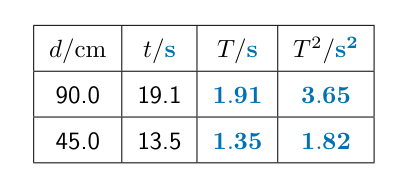
  • $T = 19.1\,\mathrm{s}/10 = \mathbf{1.91}\,\mathrm{s}$.
  • $T^2 = (1.91\,\mathrm{s})^2 = \mathbf{3.65}\,\mathrm{s^2}$ to three significant figures.

1(b)

  • Use $T = t/10$ for ten oscillations: $T = 13.5\,\mathrm{s}/10 = \mathbf{1.35}\,\mathrm{s}$.
  • $T^2 = (1.35\,\mathrm{s})^2 = \mathbf{1.82}\,\mathrm{s^2}$ to three significant figures.

1(c)

  • The completed headings are $\mathbf{t/\mathrm{s}}$, $\mathbf{T/\mathrm{s}}$ and $\mathbf{T^2/\mathrm{s^2}}$, as shown below.
Worked answer drawing

1(d)

  • The reaction-time error is a smaller fraction of the longer measured time, so the period is more accurate.

1(e)

  • Use a set square to line up the centre of the bob with the ruler and read the distance more accurately.

1(f)

  • Start and stop timing as the bob passes the same fixed reference point in the same direction.

1(g)

  • A reasonable estimate for the bench height is $80\,\mathrm{cm}$, giving $x = 40\,\mathrm{cm} + 80\,\mathrm{cm} = \mathbf{120}\,\mathrm{cm}$.

1(h)

  • Use at least three more lengths, for example $30.0\,\mathrm{cm}$, $60.0\,\mathrm{cm}$ and $75.0\,\mathrm{cm}$. These are all below the estimated distance to the floor.
Original question

Log in or create account

IGCSE, A-Level & AP