Skip to content

IGCSE Physics · November 2024 · Paper 42 · Difficulty 4 · Challenging

Question 6

6

A student plays the violin near the doorway to a large room. Fig. 6.1 shows a young teacher standing where he can hear the sound but cannot see the student.

(a)
(i)

State the wave effect that allows the young teacher to hear sounds from the violin at the position he is standing in Fig. 6.1.

[1]

(ii)

Calculate the frequency of sound with a wavelength of 0.75 m.

The speed of sound in air is 340 m/s.

frequency = [2]

(iii)

A violin produces sounds in the frequency range 200 Hz–3800 Hz. The width of the open doorway is 0.75 m.

Explain why the young teacher hears the frequency calculated in (a)(ii) clearly but finds a frequency of 3500 Hz much harder to hear.

[2]

(b)

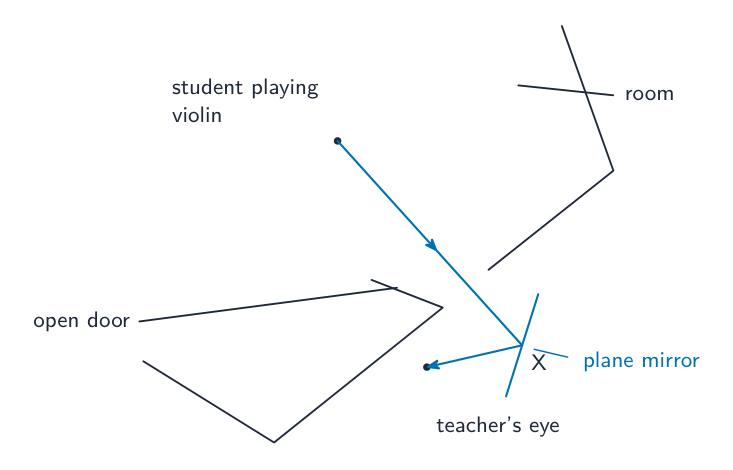
A plane mirror is placed at point X so that the teacher can see the student.

On Fig. 6.1:

  • draw a light ray from the violin to point X and from point X to the teacher
  • draw and label the mirror
  • add an arrow to the ray to show how the teacher sees the student.

Use a ruler and sharp pencil for this drawing.[3]

[Total: 8]
Show the mark scheme

These are the official mark-scheme rows. Each point that matches your answer earns a mark.

Tap the mark scheme to open it full size.

Show a worked answer

How to reach each mark, step by step. Try the question yourself first.

6(a)(i)

  • The wave effect is diffraction.

6(a)(ii)

  • Use $v = f\lambda$, so $f = v/\lambda$.
  • $f = 340\,\mathrm{m/s}/0.75\,\mathrm{m} = \mathbf{450}\,\mathrm{Hz}$.

6(a)(iii)

  • The $0.75\,\mathrm{m}$ wavelength is similar to the doorway width, so the sound diffracts strongly.
  • The $3500\,\mathrm{Hz}$ sound has a shorter wavelength and diffracts less through the doorway.

6(b)

  • The completed ray diagram is shown below. The plane mirror at X gives equal angles of incidence and reflection; the arrows point from the violin towards the teacher.
Worked answer drawing
Original question

Log in or create account

IGCSE, A-Level & AP