A student determines the focal length of a converging lens.
She uses the apparatus shown in Fig. 3.1.

The student sets the distance $u$ between the illuminated object and the lens to 20.0 cm. She moves the screen until a sharp image of the illuminated object is seen on the screen. She then measures, and records in Table 3.1, the distance $v$ between the lens and the screen.
Describe a technique to obtain an image on the screen that is as sharp as possible in this experiment.
Include in your description:
- where the screen should be placed initially
- how an accurate position for the sharp image is obtained. [2]
The student repeats the procedure for $u = 30.0$ cm, 40.0 cm, 50.0 cm and 60.0 cm.
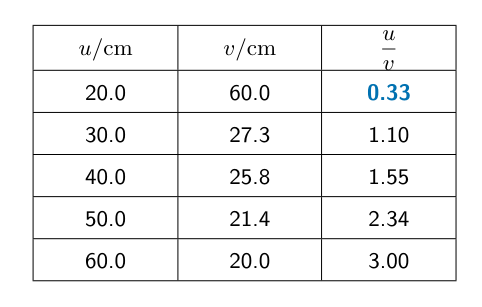
Her readings are shown in Table 3.1.
| u/cm | v/cm | u/v |
| 20.0 | 60.0 | |
| 30.0 | 27.3 | 1.10 |
| 40.0 | 25.8 | 1.55 |
| 50.0 | 21.4 | 2.34 |
| 60.0 | 20.0 | 3.00 |
For distance $u = 20.0$ cm, calculate, and record in Table 3.1, the value of $u/v$.[1]
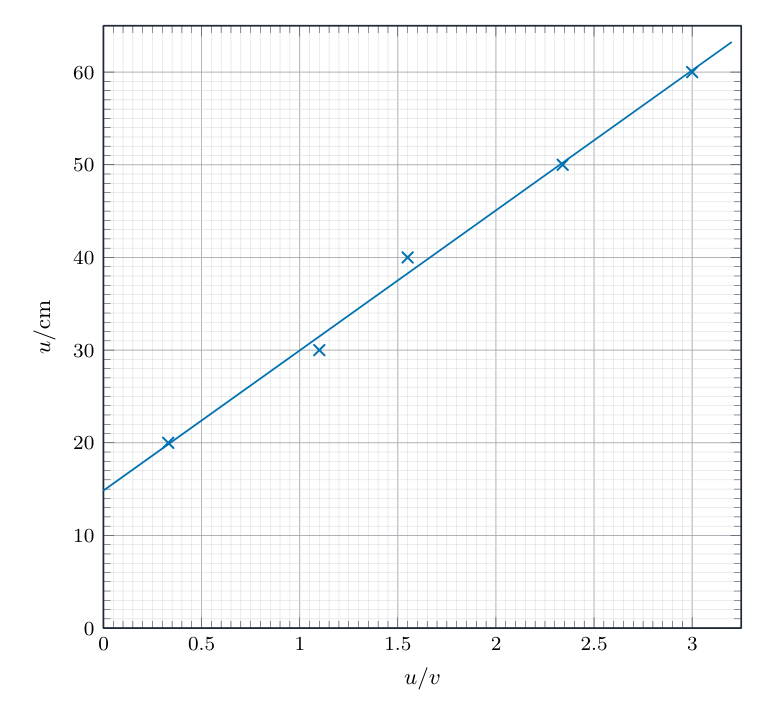
Plot a graph of $u$/cm ($y$-axis) against $u/v$ ($x$-axis). Start your graph at the origin (0,0).
Draw the best-fit line.[4]

Determine the value $u_0$ of $u$ when $u/v = 0$.
$u_0$ = [1]
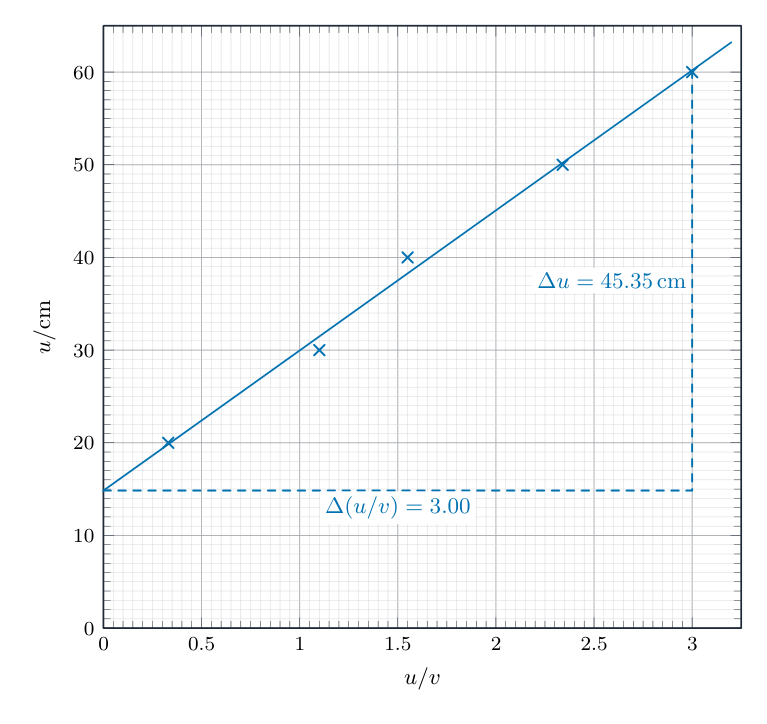
The gradient of the graph is numerically equal to the focal length $f$ of the lens.
Determine the value of $f$ for this experiment.
Show clearly on the graph how you obtained the necessary information to determine the gradient.
$f$ = [2]
Suggest one precaution that can be taken to ensure measurements are accurate in this experiment.[1]
[Total: 11]