1

In this experiment, you will investigate the period of a pendulum.
Complete the following instructions, referring to Fig. 1.1 and Fig. 1.2.
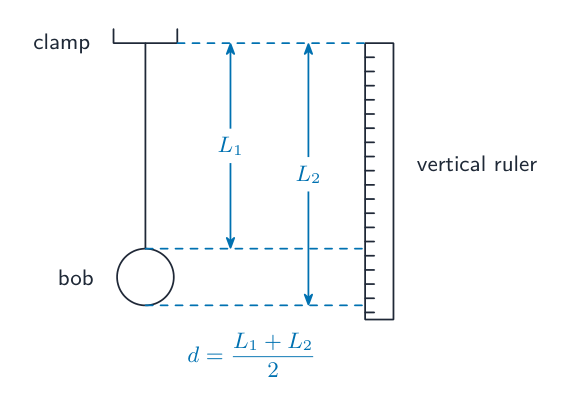
A pendulum has been set up for you as shown in Fig. 1.1.
(a)
The distance $d$ is measured from the bottom of the clamp to the centre of the bob.
- Adjust the length of the pendulum until $d = 50.0\text{ cm}$.
- Displace the bob slightly and release it so that it swings. Fig. 1.2 shows one complete oscillation of the pendulum.
- Measure, and record in Table 1.1, the time $t$ for 10 complete oscillations.
- Calculate, and record in Table 1.1, the period $T$ of the pendulum. The period is the time for one complete oscillation.
- Calculate $T^{2}$ and record the value in Table 1.1.
- Write the unit for $T^{2}$ in the column heading. [3]
Table 1.1
| $d/\text{cm}$ | $t/\text{s}$ | $T/\text{s}$ | $T^{2}/$ |
| 50.0 | |||
| 100.0 |
(b)
Repeat the procedure in (a) using $d = 100.0\text{ cm}$.[3]
(c)
A student suggests that $T^{2}$ is directly proportional to $d$.
Explain briefly how to test the suggestion using the results in Table 1.1.[2]
(d)
Describe how you measure the distance $d$ as accurately as possible. Draw a diagram to help your explanation.[2]
(e)
Explain why timing 10 oscillations gives a more accurate result for the period $T$ than timing one oscillation.[1]
[Total: 11]