In this experiment, you will investigate the resistance of a resistance wire.
Carry out the following instructions, referring to Fig. 2.1.

Close the switch.
Measure the current $I$ in the circuit.
$I$ = [2]
Place the sliding contact C at a distance $l$ = 20.0 cm from B.
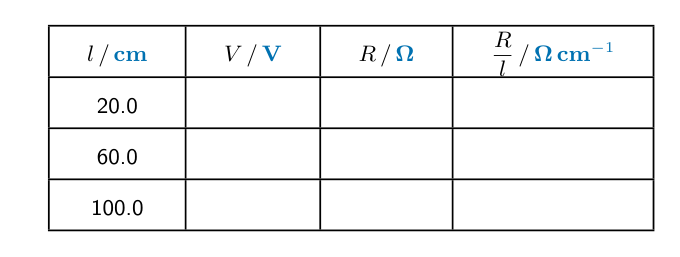
Measure, and record in Table 2.1, the potential difference (p.d.) $V$ across length $l$ of the resistance wire.
Calculate, and record in Table 2.1, the resistance $R$ of 20.0 cm of the resistance wire. Use the equation $R = \frac{V}{I}$.
Repeat the procedure using $l$ = 60.0 cm and $l$ = 100.0 cm.
Open the switch.[2]
Calculate, and record in Table 2.1, $\frac{R}{l}$ for each value of $l$.[1]
Complete the column headings in Table 2.1.
| $l$/ | $V$/ | $R$/ | $\frac{R}{l}$/ |
| 20.0 | |||
| 60.0 | |||
| 100.0 |
[2]
Look carefully at the values of $\frac{R}{l}$ in Table 2.1.
Write a conclusion about the relationship between $R$ and $l$.
[1]
Justify your conclusion by reference to your results.
[1]
Use the values in Table 2.1 to estimate the resistance $R_2$ of 2.000 m of the resistance wire.
Show your working.
$R_2$ = [2]
[Total: 11]