The mass of a solid metal cylinder is 400g and its volume is 52cm$^{3}$.
(a)
Calculate the density of the metal. Include the unit.
density = [4]
(b)
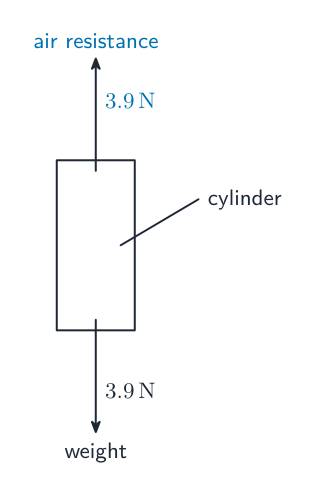
The cylinder is falling at constant speed through the air. Fig. 2.1 shows the vertical forces acting on the cylinder.
On Fig. 2.1, write the name and the size of the upward force on the cylinder.[2]
(c)
The student balances a beam on a pivot. On the beam, he positions the cylinder and a block so that the beam remains balanced. The arrangement is shown in Fig. 2.2.
Calculate the weight of the block.
weight of block = N[4]
[Total: 10]
Show the mark scheme
These are the official mark-scheme rows. Each point that matches your answer earns a mark.
Tap the mark scheme to open it full size.
Show a worked answer
How to reach each mark, step by step. Try the question yourself first.
The speed is constant, so the forces balance: $F_D = F_W = \mathbf{3.9}\,\mathrm{N}$.
2(c)
For a balanced beam, clockwise moment equals anticlockwise moment: $F_{W,\mathrm{block}}d_{\mathrm{block}}=F_{W,\mathrm{cylinder}}d_{\mathrm{cylinder}}$.