In this experiment, you will determine the internal diameter $d$ of a boiling tube.
You are provided with an empty boiling tube held vertically in the clamp of a retort stand.
The apparatus is assembled as shown in Fig. 1.1.

• Add water from the beaker to the measuring cylinder up to the 100 cm$^{3}$ mark.
- Add water from the measuring cylinder to the boiling tube until the boiling tube is approximately one-sixth full.
Measure the height $h$ of the water in the boiling tube in centimetres to the nearest millimetre.
Record your result in the top row of Table 1.1.[1]
Table 1.1
| $h$/cm | $R$/cm$^{3}$ | $V$/cm$^{3}$ |
Take the reading $R$ of the volume of water remaining in the measuring cylinder.
Record your answer in the top row of Table 1.1.[1]
• Add approximately a further 10 cm$^{3}$ of water from the measuring cylinder into the boiling tube.
- Measure the new height $h$ of the water in the boiling tube and the reading $R$ of the water remaining in the measuring cylinder.
Record your results in the second row of Table 1.1.[1]
Repeat (b)(i) three more times, so that you have five sets of readings in Table 1.1.[1]
Calculate the volume $V$ of water poured into the boiling tube for each different height $h$ of water.
Use the equation $V = (100 \text{ cm}^{3} - R)$.
Record your results in Table 1.1.[1]
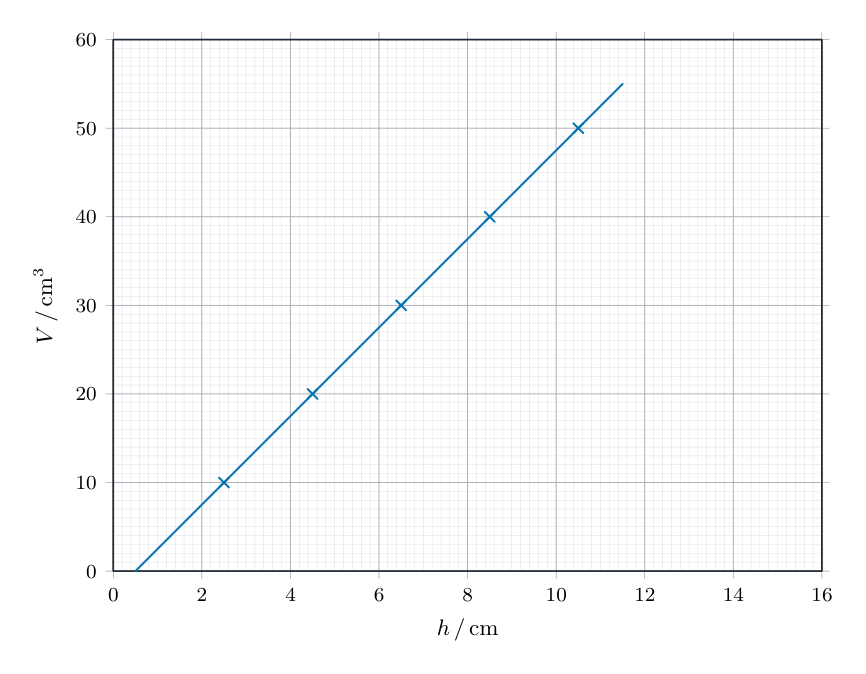
Plot a graph of $V$/cm$^{3}$ ($y$-axis) against $h$/cm ($x$-axis). Start your axes at the origin (0,0).
Draw the best-fit straight line.

[3]
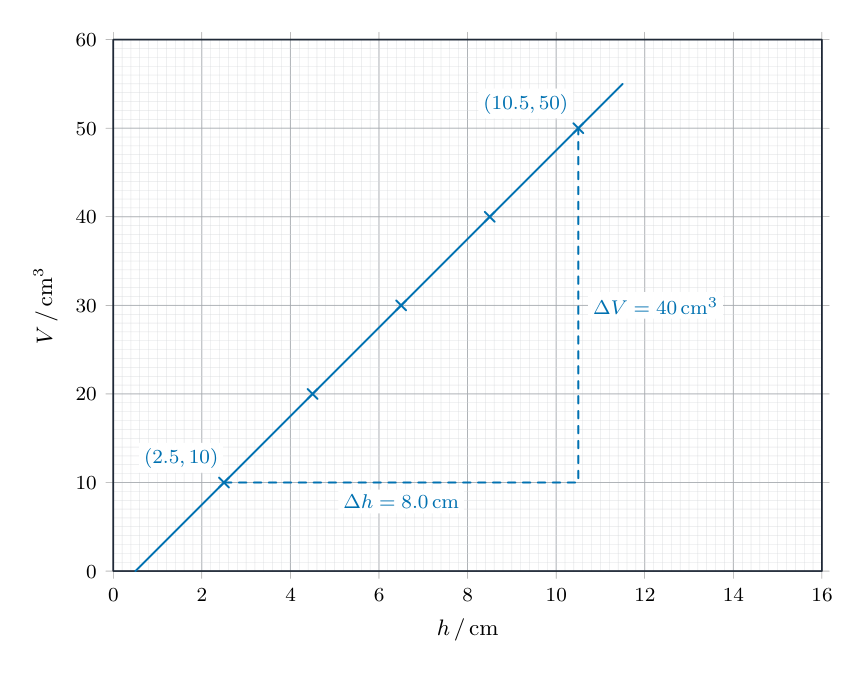
Determine the gradient $G$ of your line. Show all working and indicate on the graph the values you use.
$G$ = [1]
The internal diameter $d$ of a cylinder is given by the equation $d = k\sqrt{G}$, where $k = 1.13 \text{ cm}$.
Calculate $d$ for the boiling tube.
$d$ = cm[1]
Suggest one reason why your calculated value for $d$ is only approximate.
[1]
It is important to avoid line-of-sight (parallax) errors when reading the scale of the measuring cylinder.
Describe how such errors are avoided. You may draw a diagram.
[1]
[Total: 12]