State and explain which one of these planets is closest to the Sun.[2]
(ii)
Calculate the surface temperature of planet D in °C. surface temperature = °C[1]
(iii)
An object falls through a height of 2m on each of the planets in Table 10.1. State and explain on which planet the object falls 2m in the shortest time. Ignore any effect due to the atmosphere.[2]
(b)
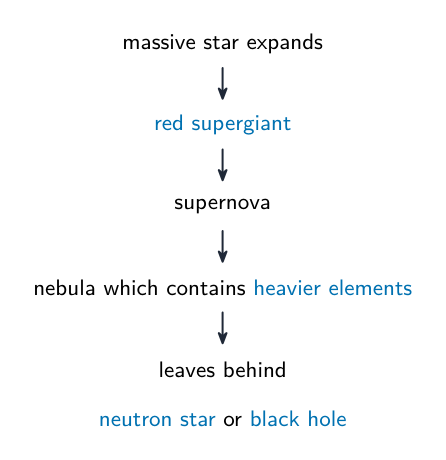
Fig. 10.1 shows some of the stages in the life cycle of a massive star.
(i)
Complete Fig. 10.1 by adding the correct terms.[4]
(ii)
State the quantity that the brightness of a supernova in a galaxy can be used to determine.[1]
[Total: 10]
Show the mark scheme
These are the official mark-scheme rows. Each point that matches your answer earns a mark.
Tap the mark scheme to open it full size.
Show a worked answer
How to reach each mark, step by step. Try the question yourself first.
10(a)(i)
Planet B is closest: it has the highest surface temperature.
10(a)(ii)
Convert kelvin to degrees Celsius using $\theta/{}^\circ\mathrm{C}=T/\mathrm{K}-273$.