Skip to content

IGCSE Physics · June 2025 · Paper 33 · Difficulty 3 · Standard

Question 11

11

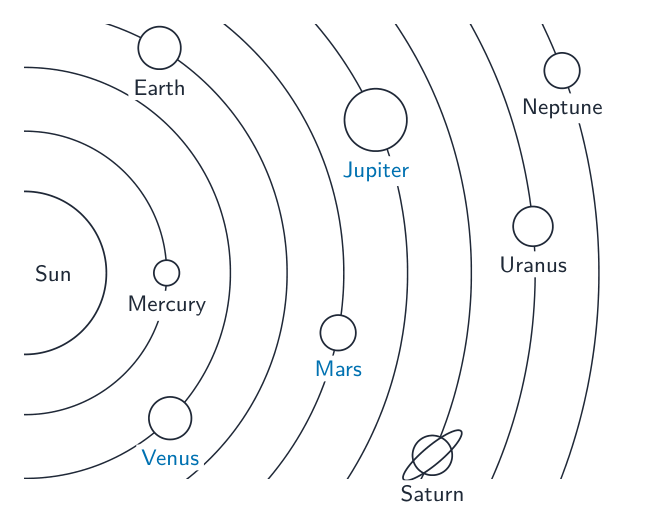
Fig. 11.1 represents the Solar System. The Sun and five of the eight planets are labelled.

(a)

Complete the three missing labels on Fig. 11.1 by writing the name of each planet on its dotted line.[2]

(b)
(i)

The Sun consists mainly of two elements.

Name the two elements.

and [2]

(ii)

The Sun radiates energy mainly in three regions of the electromagnetic spectrum. Ultraviolet is one of the three regions.

State the name of one of the other two regions.

[1]

(c)
(i)

Scientists use the Big Bang Theory to explain the way the Universe began.

State one piece of evidence that supports the Big Bang Theory.

[1]

(ii)

Scientists use the accretion model to explain the formation of the Solar System.

Complete the following sentences about the accretion model.

In space, there are clouds of dust and

The material spins around and moves closer together due to the force of

This forms an accretion [3]

[Total: 9]
Show the mark scheme

These are the official mark-scheme rows. Each point that matches your answer earns a mark.

Tap the mark scheme to open it full size.

Show a worked answer

How to reach each mark, step by step. Try the question yourself first.

11(a)

  • The $\textbf{completed planet labels}$ are shown below.
Worked answer drawing

11(b)(i)

  • The Sun consists mainly of $\textbf{hydrogen}$ and $\textbf{helium}$.

11(b)(ii)

  • One other region is $\textbf{visible light}$.

11(c)(i)

  • The $\textbf{redshift}$ of light from distant galaxies supports the Big Bang Theory.

11(c)(ii)

  • The clouds contain dust and $\textbf{gas}$.
  • The material moves together due to $\textbf{gravity}$, forming an accretion $\textbf{disc}$.
Original question

Log in or create account

IGCSE, A-Level & AP