In this experiment, you will investigate the refraction of light by a transparent block.
Use the separate ray-trace sheet provided.
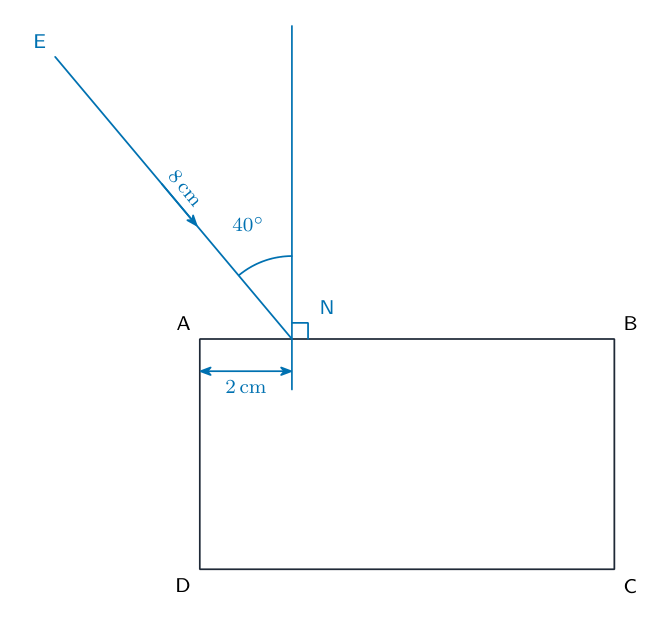
You may refer to Fig. 3.1 for guidance.

Place the transparent block approximately in the centre of the ray-trace sheet.
Carefully draw round the block and label the corners A, B, C and D as indicated by Fig. 3.1.
Remove the block from the ray-trace sheet.
Draw a normal to line AB at a point N, 2 cm from A.
Draw a line EN, as indicated by Fig. 3.1, 8 cm long and at an angle $\theta = 40^{\circ}$ to the normal.[2]
Replace the block in exactly the same position as in (a).
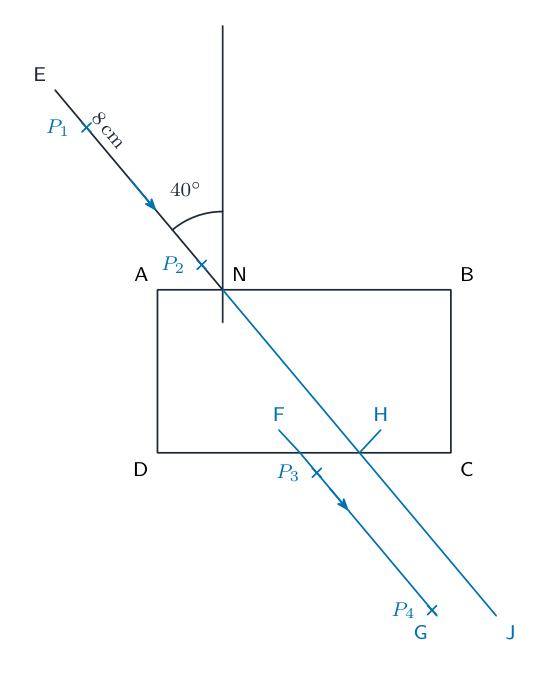
Place two pins $P_1$ and $P_2$ on line EN, a suitable distance apart for accurate ray tracing.
Mark with crosses and label the positions of $P_1$ and $P_2$.
View the images of $P_1$ and $P_2$ through the block, from the direction indicated by the eye in Fig. 3.1. Place two pins $P_3$ and $P_4$ so that pins $P_3$ and $P_4$ and the images of $P_1$ and $P_2$ all appear exactly one behind the other.
Mark with crosses and label the positions of $P_3$ and $P_4$.
Remove the block and pins from the ray-trace sheet.
Draw a line through $P_3$ and $P_4$. Extend this line to meet line CD.
Label the point at which this line meets CD with the letter F. Label the lower end of this line with the letter G.
Extend line EN to approximately 5 cm below line CD.
Label the point at which this line crosses CD with the letter H. Label the lower end of this line with the letter J.[2]
Measure the acute angle $\alpha$ between lines CD and GF.
An acute angle is an angle less than $90^{\circ}$.
$\alpha = .......................................^{\circ}$
Measure the acute angle $\beta$ between lines CD and JH.
$\beta = .......................................^{\circ}$[1]
A student suggests that angle $\alpha$ should be equal to angle $\beta$.
State whether your results support this suggestion. Justify your answer by reference to values from your results.
statement
justification [2]
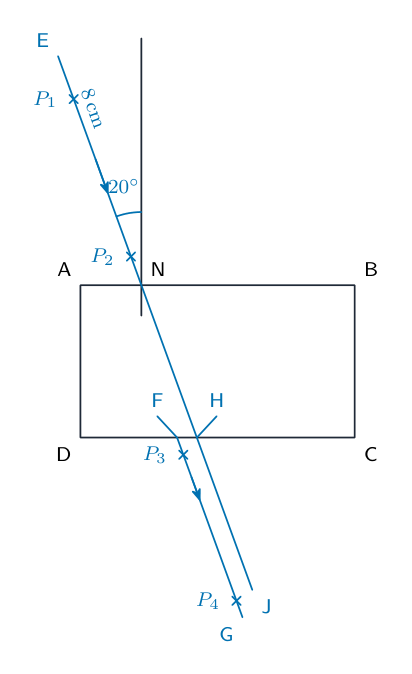
Draw a new line EN, as indicated by Fig. 3.1, 8 cm long and at an angle $\theta = 20^{\circ}$ to the normal.
Repeat the steps in (b).[2]
Describe one technique to use in this type of experiment to ensure accurate results.
[1]
Suggest one reason why different students, all doing this experiment carefully, may not obtain identical results.
[1]
[Total: 11]
Write your name, centre number and candidate number on your ray-trace sheet.
Tie your ray-trace sheet into this booklet between pages 8 and 9.