7
(a)
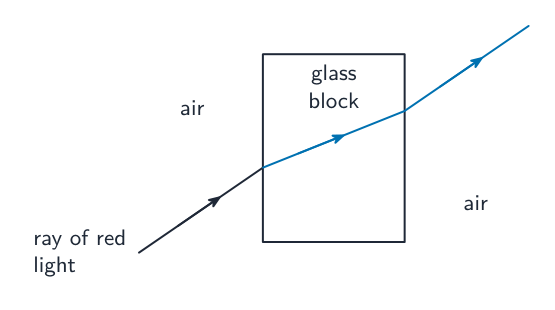
Fig. 7.1
Fig. 7.1 represents a ray of red light entering one side of a glass block.
On Fig. 7.1 draw the path of the ray of red light through the glass block and into the air.[2]
(b)
Fig. 7.2
Fig. 7.2 represents the dispersion of white light by a glass prism.
Two of the colours of the visible spectrum are shown in Fig. 7.2.
State the other five colours of the visible spectrum in the correct order.
red
violet[1]
(c)
Fig. 7.3 represents the regions of the electromagnetic spectrum.
| radio waves | microwaves | infrared waves | visible light | X-rays | gamma rays |
Fig. 7.3
(i)
In Fig. 7.3, one region is unlabelled.
State the name of the unlabelled region.[1]
(ii)
Describe one use of gamma rays.[1]
(iii)
Describe one harmful effect on people of excessive exposure to gamma rays.[1]