In this experiment, you will use a balancing method to determine the mass of a metre ruler.
Refer to Fig. 1.1.

Place the metre ruler on the pivot. Place load U on the metre ruler with its centre at the 5.0 cm mark. Keep load U at the 5.0 cm mark and adjust the position of the metre ruler on the pivot until the metre ruler is as near to being balanced as possible.
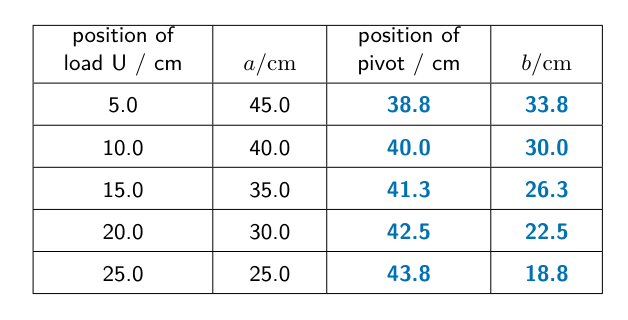
The distance a between the centre of load U and the 50.0 cm mark on the metre ruler is recorded in Table 1.1.
In Table 1.1, record the position of the pivot.
Calculate and record in Table 1.1, the distance b between the centre of load U and the pivot. Use the formula b = (position of pivot – position of load U).
Repeat the procedure for positions of load U at the 10.0 cm, 15.0 cm, 20.0 cm and 25.0 cm marks.
Table 1.1
| position of load U/ cm | a/ cm | position of pivot/cm | b/ cm |
| 5.0 | 45.0 | ||
| 10.0 | 40.0 | ||
| 15.0 | 35.0 | ||
| 20.0 | 30.0 | ||
| 25.0 | 25.0 |
[2]
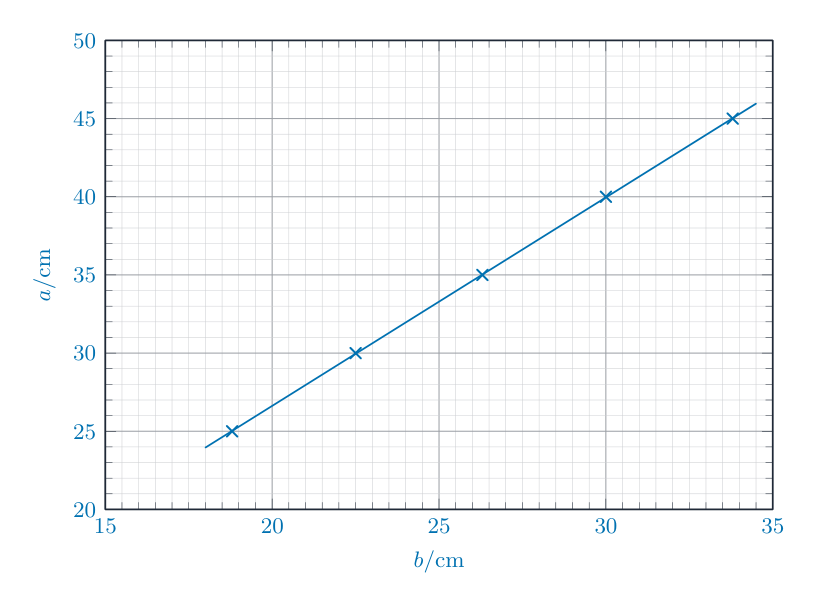
Plot a graph of a/cm (y-axis) against b/cm (x-axis).
You do not need to start your axes at the origin (0,0).
Draw the best-fit, straight line.

[4]
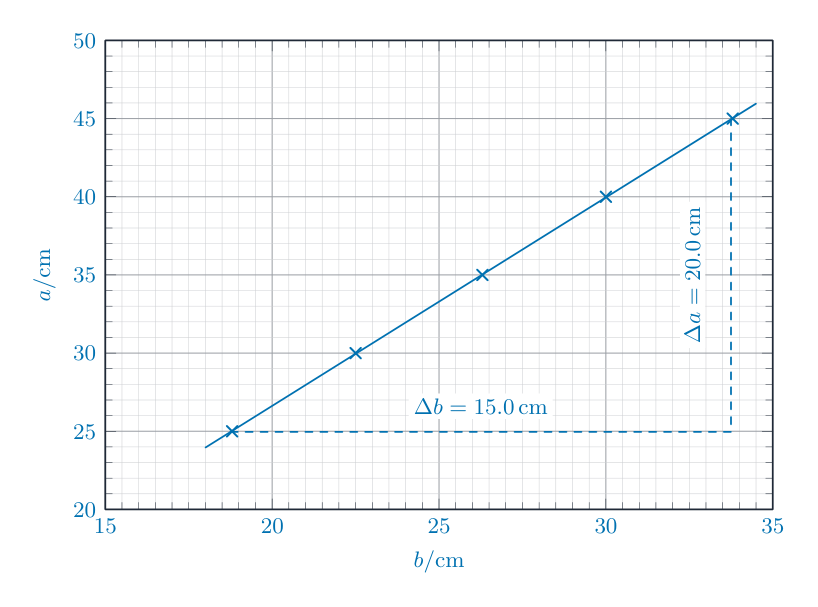
Determine the gradient G of the graph. Show clearly on the graph how you obtained the necessary information.
G = [1]
Calculate the mass M of the metre ruler. Use the equation $M = \frac{k}{G - 1}$, where k = 25 g.
Give an appropriate unit.
M = [1]
Explain how you accurately place the centre of load U on the correct mark of the metre ruler each time. You may draw a diagram.
[2]
The accuracy of the result obtained by this procedure depends on the metre ruler, without a load, balancing with the pivot at the 50.0 cm mark.
A student finds that this does not happen. He adds a small piece of modelling clay to one end of the metre ruler to correct it.
Suggest if this is a suitable change for this experiment. Explain your answer.
[1]