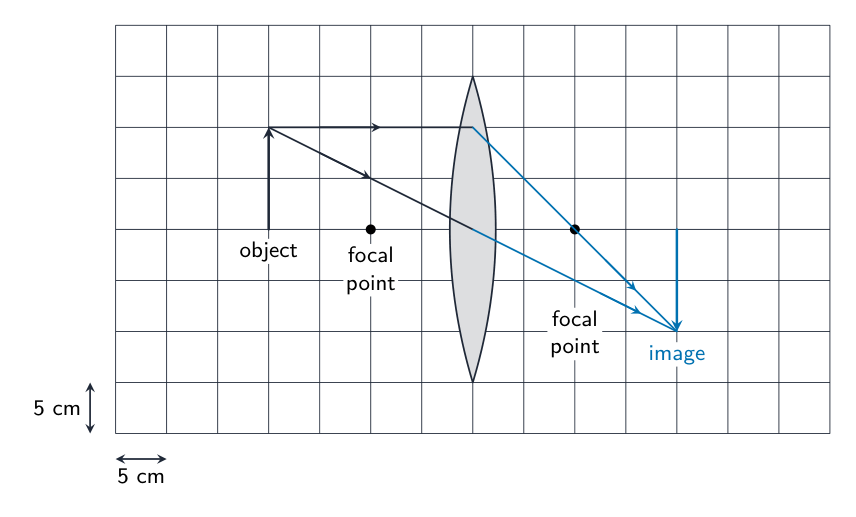
Fig. 7.1 represents an object placed close to a thin converging lens. The scale for the grid is shown.
Fig. 7.1
(a)
(i)
Determine the focal length of the converging lens. Use the information in Fig. 7.1.
focal length = $\text{cm}$[2]
(ii)
On Fig. 7.1, determine the position of the image formed by the lens, by continuing the path of each ray beyond the lens. Use an arrow to indicate the position of the image.[3]
(b)
Fig. 7.2 shows the regions of the electromagnetic spectrum.
radio waves
microwaves
infrared light
visible light
ultraviolet light
gamma rays
Fig. 7.2
(i)
In Fig. 7.2, one region is unlabelled.
State the name of the unlabelled region.
[1]
(ii)
Describe one use of ultraviolet light.
[1]
(iii)
Describe one harmful effect on people due to excessive exposure to ultraviolet light.
[1]
[Total: 8]
Show the mark scheme
These are the official mark-scheme rows. Each point that matches your answer earns a mark.
Tap the mark scheme to open it full size.
Show a worked answer
How to reach each mark, step by step. Try the question yourself first.
7(a)(i)
The focal length is the distance from the lens to the focal point. The diagram gives two $5\,\mathrm{cm}$ intervals: $f = 2(5\,\mathrm{cm}) = \mathbf{10}\,\mathrm{cm}$.
7(a)(ii)
The image is $\mathbf{20\,cm}$ to the right of the lens: real, inverted and the same size as the object.
7(b)(i)
The missing region is X-rays, between ultraviolet light and gamma rays in the electromagnetic spectrum.
7(b)(ii)
Ultraviolet light can be used to sterilise water.
7(b)(iii)
Too much ultraviolet exposure can cause skin cancer.