Skip to content

IGCSE Physics · March 2024 · Paper 32 · Difficulty 3 · Standard

Question 2

2
(a)

A student determines the volume of a piece of metal. The student pours 30 cm$^{3}$ of water into a measuring cylinder. The piece of metal is submerged in the water and the new volume reading on the measuring cylinder is 42 cm$^{3}$.

Calculate the volume of the piece of metal.

volume = cm$^{3}$[1]

(b)

The mass of another piece of metal is 320 g. The volume of the piece of metal is 40 cm$^{3}$.

Calculate the density of the metal. Give the correct unit.

density =

unit [4]

(c)

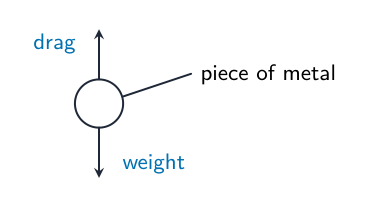
The student drops the piece of metal into a tank of water. Two vertical forces act on the piece of metal as it falls through the water in the tank.

On Fig. 2.1, each arrow represents a vertical force.

(i)

Complete the diagram in Fig. 2.1 by labelling the two forces.[2]

(ii)

The upward force is the same size as the downward force.

Describe the motion of the piece of metal as it falls through the water.

[1]

[Total: 8]
Show the mark scheme

These are the official mark-scheme rows. Each point that matches your answer earns a mark.

Tap the mark scheme to open it full size.

Show a worked answer

How to reach each mark, step by step. Try the question yourself first.

2(a)

  • Use $V = V_{\mathrm{final}}-V_{\mathrm{initial}}$ for the displaced water.
  • $V = 42\,\mathrm{cm^3}-30\,\mathrm{cm^3} = \mathbf{12}\,\mathrm{cm^3}$.

2(b)

  • Use $\rho = m/V$.
  • $\rho = 320\,\mathrm{g}/40\,\mathrm{cm^3} = \mathbf{8.0}\,\mathrm{g/cm^3}$.

2(c)(i)

  • Label the upward arrow drag, $F_D$, and the downward arrow weight, $F_W$.
Worked answer drawing

2(c)(ii)

  • The forces balance, so the metal falls at a constant speed.
Original question

Log in or create account

IGCSE, A-Level & AP