Skip to content

IGCSE Physics · November 2025 · Paper 53 · Difficulty 2 · Core

Question 1

1

In this experiment, you will determine the volume of a block of modelling clay by two methods.

Do not change the shape of the block of modelling clay or remove the thread from it.

Method 1

Refer to Fig. 1.1.

(a)
(i)

Measure the length $l$, width $w$ and height $h$ of Block A. Record your values in centimetres to the nearest millimetre.

$l$ = cm

$w$ = cm

$h$ = cm[1]

(ii)

Calculate a value $V_\text{A}$ for the volume of Block A. Use your measurements from (a)(i) and the equation:

$$V_\text{A} = l \times w \times h$$

$V_\text{A}$ = cm$^3$[1]

(b)

Suggest a possible source of inaccuracy in measuring the dimensions of Block A.

Describe how the accuracy of these measurements can be improved.

You are not required to carry out this improved procedure.

source of inaccuracy

improvement [2]

(c)

A student measures the dimensions of a block of clay which is much smaller than Block A. Suggest why these measurements may not be as accurate as yours, even if they are done carefully.[1]

Method 2

(d)
(i)

Pour approximately 150 cm$^3$ of water into the measuring cylinder.

Measure and record the actual volume $V_1$ of the water in the measuring cylinder.

$V_1$ = cm$^3$

Lower Block A into the water in the measuring cylinder using the thread, as shown in Fig. 1.2.

Measure and record the new reading $V_2$ shown on the measuring cylinder scale.

$V_2$ = cm$^3$[1]

(ii)

Calculate another value $V_\text{B}$ for the volume of Block A.

Use your measurements from (d)(i) and the equation:

$$V_\text{B} = (V_2 - V_1)$$

$V_\text{B}$ = cm$^3$[2]

(iii)

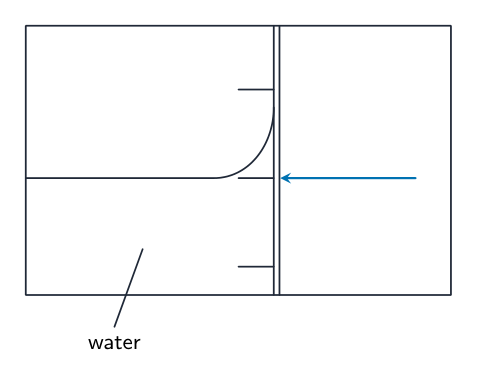
Draw an arrow on the enlarged section of Fig. 1.3 to show the correct line of sight to obtain the value for the volume of water in the measuring cylinder.

[2]

(e)

Suggest one possible source of inaccuracy in Method 2.[1]

[Total: 11]
Show the mark scheme

These are the official mark-scheme rows. Each point that matches your answer earns a mark.

Tap the mark scheme to open it full size.

Show a worked answer

How to reach each mark, step by step. Try the question yourself first.

1(a)(i)

  • Measure the actual block, not the diagram. For example, $l = \mathbf{5.0}\,\mathrm{cm}$, $w = \mathbf{4.0}\,\mathrm{cm}$ and $h = \mathbf{3.0}\,\mathrm{cm}$.

1(a)(ii)

  • Use $V_A = lwh$.
  • For example, $V_A = (5.0\,\mathrm{cm})(4.0\,\mathrm{cm})(3.0\,\mathrm{cm}) = \mathbf{60}\,\mathrm{cm^3}$. Use your own measured dimensions.

1(b)

  • The block may have irregular dimensions, so one measurement may not represent its whole length, width or height.
  • Measure each dimension at several places and take the mean to reduce this effect.

1(c)

  • The same ruler uncertainty is a larger percentage of a smaller dimension, so the measurement is less precise.

1(d)(i)

  • Read the bottom of the meniscus at eye level before and after lowering the block fully into the water.
  • For example, $V_1 = \mathbf{150}\,\mathrm{cm^3}$ and $V_2 = \mathbf{210}\,\mathrm{cm^3}$. Use your actual readings; the block makes the water level rise.

1(d)(ii)

  • Use $V_B = V_2 - V_1$.
  • For example, $V_B = 210\,\mathrm{cm^3} - 150\,\mathrm{cm^3} = \mathbf{60}\,\mathrm{cm^3}$. Use your own readings.
  • This example agrees with $V_A = 60\,\mathrm{cm^3}$; real measurements should be within 10\% of each other.

1(d)(iii)

  • Draw the line of sight horizontally, perpendicular to the scale, at the level of the bottom of the meniscus.
Worked answer drawing

1(e)

  • The thread displaces water as well as the clay, making the measured volume too large.
Original question

Log in or create account

IGCSE, A-Level & AP