In this experiment, you will investigate the reflection of light by a plane mirror.
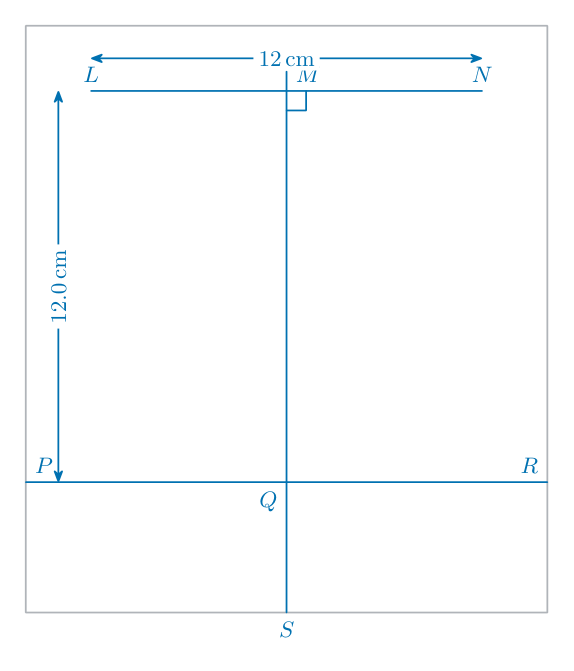
Use the separate ray-trace sheet provided. You may refer to Fig. 1.1 for guidance.
• Draw a line LN $12\text{ cm}$ long across the ray-trace sheet supplied, near to the top of the sheet.
- Label the mid-point of the line with the letter M.
- Draw a line PR parallel to line LN at a distance $12.0\text{ cm}$ below it across the full width of the page.
- Draw a normal to LN at the point M.
- Extend the normal downwards to the bottom of the page and label the end of the line S.
- Label the point where the normal line crosses PR with the letter Q. [1]
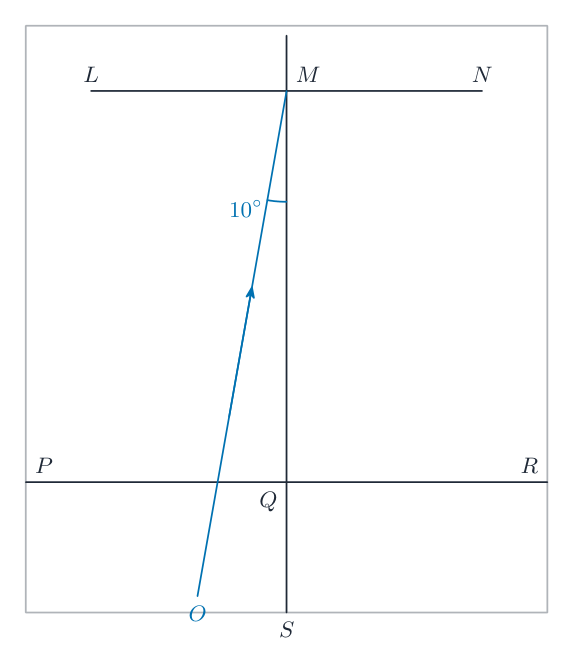
• Draw a line from point M at an angle $\theta = 10^\circ$, as shown in Fig. 1.1.

- Extend the line downwards towards the bottom of the page and label the end of the line O. [1]
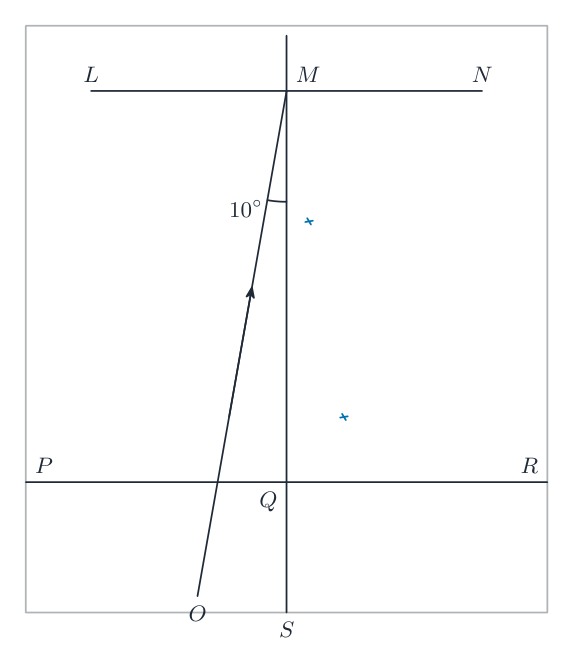
• Place the reflecting surface of the mirror along the line LN, facing the bottom of the page, and with the centre of the mirror at M.
- Position the light source and slit so that a ray of light passes along the line OM towards M.
- Mark two small crosses (x), a suitable distance apart on the ray reflected from the mirror.
- Remove the mirror and the illuminated slit. [1]
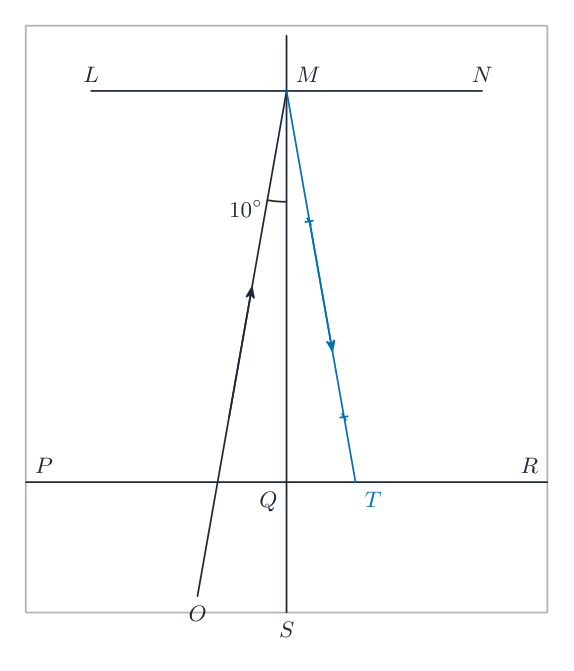
• Draw a line through the crosses and continue the line back to the mirror.
- Extend the line until it crosses line PR.
- Label the point at which the line meets PR with the letter T.
Measure the length $a$ of the line QT in centimetres to the nearest millimetre and the length $b$ of the line MT in centimetres to the nearest millimetre. Record your measurements below and in Table 1.1.
$a =$ cm
$b =$ cm[1]
Calculate the ratio $r = \frac{a}{b}$. Record your answer in Table 1.1.
Give your answer to 2 significant figures.
Table 1.1
| $\theta / ^\circ$ | $a / \text{cm}$ | $b / \text{cm}$ | $r = \frac{a}{b}$ |
| 10 | |||
| 20 | |||
| 30 |
[2]
Repeat (b), (c) and (d) for values of $\theta = 20^\circ$ and $\theta = 30^\circ$.
Record your results in Table 1.1.[1]
A student says that $r$ is directly proportional to $\theta$.
State if you agree with the student’s statement.
Use values from Table 1.1 to justify your answer.
statement
justification [2]
Suggest what you can do to have more confidence in your answer to part (f).[1]
Suggest one source of inaccuracy in this experiment, even if it is carried out very carefully.[1]
[Total: 11]
Write your name, centre number and candidate number on your ray-trace sheet. Tie your ray-trace sheet into this Booklet between pages 2 and 3.