Skip to content

IGCSE Physics · November 2025 · Paper 33 · Difficulty 2 · Core

Question 3

3
(a)

A scientist determines the density of a sample of sea water.

Describe an experiment to determine the density of the sea water. You may draw a diagram as part of your answer.

Include any equations in your answer.[4]

(b)

Table 3.1 shows the density of four materials.

Table 3.1

materialdensity

$\text{g/cm}^3$
plastic0.905
wood0.720
sea water1.03
baby oil0.815

Predict whether solid objects made from plastic or wood float in sea water or baby oil.

Use the data in Table 3.1.

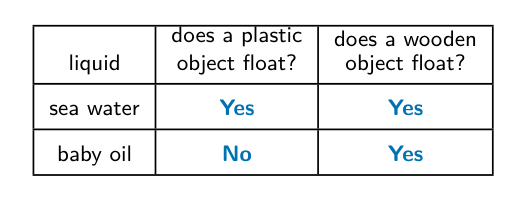
Complete Table 3.2 by writing Yes or No in each space.

Table 3.2

liquiddoes a plastic
object float?
does a wooden
object float?
sea water
baby oil

[2]

[Total: 6]

Show the mark scheme

These are the official mark-scheme rows. Each point that matches your answer earns a mark.

Tap the mark scheme to open it full size.

Show a worked answer

How to reach each mark, step by step. Try the question yourself first.

3(a)

  • Measure the mass $m_1$ of an empty measuring cylinder using a balance.
  • Pour sea water into the cylinder. Read its volume $V$ at eye level from the bottom of the meniscus.
  • Measure the mass $m_2$ of the cylinder and sea water. Subtract the empty cylinder mass: $m = m_2 - m_1$.
  • Calculate the density using $\rho = m/V = (m_2 - m_1)/V$. Mass in grams and volume in cubic centimetres give density in $\mathrm{g/cm^3}$.

3(b)

  • In sea water: plastic Yes; wood Yes. Both have a lower density than sea water, so both float.
  • In baby oil: plastic No; wood Yes. Plastic is denser than the oil, but wood is less dense than the oil.
Worked answer drawing
Original question

Log in or create account

IGCSE, A-Level & AP