Chinese course / HSK5 handouts
Sentence patterns — advanced
Printable paper with separate answer pages Step-by-step lessons
Original teaching practice. Read one pattern, cover its model and try the questions before checking the separate answer section. Examples adapted from Chinese Grammar Wiki (AllSet Learning, CC BY-NC-SA) retain the course-reference provenance.
Advanced (把: marks the object)把 ((把: marks the object)把 + Obj + Verb + result)
Editing a report
- Your manager hands back your draft with instructions.
- to ask请(把: marks the object)把第三段to change改(degree marker)得short短erhua variant of 一点一点儿,again / then再(把: marks the object)把chart图表放到final最后。 – "Please make the third paragraph a bit shorter, then move the chart to the end."
(把: marks the object)把 + Object + Verb + complex result
- At HSK 5, the part after the verb can be a (degree marker)得 complement, a to succeed成 / for为 change, a place or a direction: to change改(degree marker)得short短erhua variant of 一点一点儿, 翻译成Chinese language中文, 放到final最后, to send送to return home回家.
- The object must be specific and the verb must not stand alone.
please请把this这sentence句话translate翻译into成Chinese中文。

Change, place, manner
- Change: he / him他(把: marks the object)把drawing room (room for…客厅to change into变成(completed / change)了study (room)书房。 – "He turned the living room into a study."
- Manner with (degree marker)得: she / her她(把: marks the object)把room房间to clean打扫(degree marker)得干干净净。 – "She cleaned the room spotless."
she她把the room房间clean打扫得spotless干干净净。
Negatives and modals before (把: marks the object)把
- not / haven't没 / not不 / don't别 / can / be able to能 / want / will / need要 / should应该 go before (把: marks the object)把: you你should应该(把: marks the object)把question问题variant of 说说clear清楚, not you你(把: marks the object)把question问题should应该variant of 说说clear清楚.
- Perception and feeling verbs (to see看见, to know知道, to like喜欢) don't take (把: marks the object)把.
Why use (把: marks the object)把?
- (把: marks the object)把 puts the focus on what happens to a specific object: I / me我(把: marks the object)把purse钱包to lose丢(completed / change)了 – "I've lost my wallet."
- Without (把: marks the object)把, the same idea can sound unfinished or neutral: I / me我to lose丢(completed / change)了purse钱包.
I我把my wallet钱包lose丢了。
Recap
- (把: marks the object)把 + specific object + Verb + result ((degree marker)得 complement, to succeed成, to / arrive到 + place, direction).
- Negatives / modals before (把: marks the object)把; no (把: marks the object)把 with perception or feeling verbs.
Practise this pattern step by step.
N1 + unlike不比 + N2 + Adj (no more … than)
Not so different
- Your friend thinks the expensive brand is much better. You think it's no better than the cheap one.
- this这个sign牌子unlike不比that那个good好。 – "This brand is no better than that one."
A unlike不比 B + Adj = A is no more … than B
- A unlike不比 B + Adj rejects the claim that A is more Adj than B: they are about the same, or A may be less.
- It usually answers or corrects someone: he / him他not不than / compared to比I / me我high高 – "He isn't taller than me (we're about the same)."
he他not不than比me我tall高。

Correcting an assumption
- today今天unlike不比yesterday昨天cold冷,你别to wear穿like that那么many多。 – "Today is no colder than yesterday; don't wear so much."
- I / me我(modifier / structural particle)的Chinese language中文unlike不比you你used in 参差差。 – "My Chinese is no worse than yours."
my我的Chinese中文not不than比yours你worse差。
Not the same as not have / haven't没有
- A not have / haven't没有 B high高 = A is less tall than B (clearly shorter).
- A unlike不比 B high高 denies that A is taller. A may be equally tall or shorter; the phrase does not establish equality.
Side by side
- younger brother弟弟not have / haven't没有older brother哥哥high高 – the younger brother is shorter.
- younger brother弟弟unlike不比older brother哥哥high高 – the younger brother isn't taller (perhaps the same height).
younger brother弟弟not as没有older brother哥哥tall高。
Recap
- A unlike不比 B + Adj denies that A exceeds B on that scale. A can be equal or lower; exact equality needs additional information.
- A not have / haven't没有 B + Adj = A is less Adj than B.
Practise this pattern step by step.
want / will / need要 + Verb + then / just就 + Verb (if you're going to, do it right)
Five minutes of guitar a week
- Your friend wants to learn the guitar but only practises five minutes a week.
- 要学then / just就好好学,don't别三天打鱼两天晒网。 – "If you're going to learn, learn properly – don't do it in fits and starts."
want / will / need要 + Verb + then / just就 + Verb (+ properly)
- want / will / need要 V then / just就 V = "if you're going to do it, do it (properly / now)": want / will / need要to go去then / just就to go去, want / will / need要to buy买then / just就to ingratiate oneself买好(modifier / structural particle)的.
- The same verb repeats; the second often has a modifier: 好好学, 早点儿to go去.
if going to要go去then就early早a bit点儿go去。

Encouraging decisiveness
- want / will / need要to buy买then / just就to buy买quality质量good好(modifier / structural particle)的。 – "If you're going to buy one, buy a good-quality one."
- as for要说then / just就variant of 说说clear清楚。 – "If you're going to say it, say it clearly."
if going to要buy买then就buy买quality质量good好(one)的。
Same verb, firm tone
- Repeat the same verb: 要学then / just就好好学, not 要学then / just就well好好to practice练 (unless you mean a different action).
- The tone is firm advice or impatience; it is spoken.
want / will / need要…then / just就… versus want / think / miss想…then / just就…
- want / think / miss想to go去then / just就to go去 = go if you want to (permission, freedom).
- want / will / need要to go去then / just就早点儿to go去 = if you're going, go early (advice about doing it well).
want to想go去then就go去吧。
Recap
- want / will / need要 V then / just就 (well好好 / 早点儿) V = if you're going to do it, do it properly.
- Spoken, firm; want / think / miss想 V then / just就 V = do it if you like.
Practise this pattern step by step.
cannot do without少不了 (can't do without)
A birthday essential
- Your family is planning grandma's 80th birthday party.
- birthday生日party聚会cannot do without少不了cake蛋糕。 – "A birthday party isn't complete without a cake."
cannot do without少不了 + noun = can't do without
- A cannot do without少不了 B = A can't do without B; B is essential: to celebrate the Chinese…过年cannot do without少不了dumpling饺子.
- The thing that is essential follows cannot do without少不了.
the New Year过年can't do without少不了dumplings饺子。

Certain to happen
- cannot do without少不了 can also mean "bound to, certain": so much这么to make做,cannot do without少不了want / will / need要to suffer挨to criticize批评。 – "Do it like that and you're bound to be criticised."
- he / him他to be / is是leading role主角,cannot do without少不了he / him他。 – "He's the lead; we can't manage without him."
he他is是the lead主角,can't do without少不了him他。
Read it liǎo
- (completed / change)了 in cannot do without少不了 is liǎo, as in variant of 吃吃(as a resultative verb…不了.
- The opposite is 少得(completed / change)了 (rare); for "not needed", say not不to need需要 or not need用不着.
cannot do without少不了 versus inseparable离不开
- inseparable离不开 = can't be separated from, depend on: child孩子inseparable离不开mama妈妈.
- cannot do without少不了 = can't be missing: this这顿饭cannot do without少不了wine (esp. rice wine)酒.
the child孩子can't be without离不开mum妈妈。
Recap
- A cannot do without少不了 B = A can't do without B; also "bound to (happen)".
- (completed / change)了 = liǎo; inseparable离不开 = depend on.
Practise this pattern step by step.
A to equal等于 B (equals / amounts to)
Saying nothing is saying yes
- Your friend didn't object when you suggested the plan.
- you你not不to speak说话then / just就to equal等于to agree同意(completed / change)了。 – "If you say nothing, that amounts to agreeing."
A to equal等于 B = A equals B
- In maths: 二加three三to equal等于five五。 – "Two plus three equals five."
- In argument: A amounts to B, is the same as B: not不to reply回答then / just就to equal等于to refuse拒绝.
two二plus加three三equals等于five五。

Drawing a strong conclusion
- 浪费时间then / just就to equal等于to waste浪费life (as the characteristic…生命。 – "Wasting time is the same as wasting your life."
- not不variant of 复习复习then / just就to go去to take an exam考试,to equal等于not / haven't没preparation准备。 – "Taking the exam without revising is as good as not preparing."
wasting浪费time时间(is)就equals等于wasting浪费life生命。
not不to equal等于 = doesn't mean
- not不to equal等于 = is not the same as: cheap便宜not不to equal等于no good不好 – "Cheap doesn't mean bad."
- In argument, to equal等于 often follows then / just就: not不variant of 说说then / just就to equal等于to agree同意.
to equal等于 versus to be / is是
- to be / is是 states identity: he / him他to be / is是I / me我(modifier / structural particle)的teacher老师.
- to equal等于 says one thing has the same effect or value as another: taciturn沉默to equal等于to agree同意.
cheap便宜not不equals等于bad不好。
Recap
- A to equal等于 B = A equals / amounts to B (maths or argument); then / just就to equal等于 adds force.
- not不to equal等于 = doesn't mean; to be / is是 states identity.
Practise this pattern step by step.
from从 … to hit (the mark)中 (from within)
Learning from mistakes
- Your coach talks to the team after a lost match.
- we / us我们want / will / need要from从to be defeated失败to hit (the mark)中to draw a lesson (from a…吸取教训。 – "We must learn lessons from failure."
from从 + noun + to hit (the mark)中 = from (within)
- from从 A to hit (the mark)中 + verb = get, learn or choose something out of A: from从to be defeated失败to hit (the mark)中to learn学习, from从三个person人to be chosen中选一个.
- to hit (the mark)中 can be replaced by li, ancient measure of…里 in speech: 从书里to learn (sth)学到.
I我from从this这(measure word)本book书(within)中learned学到了a lot很多。

Choosing and learning
- Choosing: from从these这些plan方案to be chosen中选一个best最好(modifier / structural particle)的。 – "Choose the best from these plans."
- Gaining: he / him他from从to work工作to hit (the mark)中to get得到(completed / change)了很多experience经验。 – "He gained a lot of experience from work."
he他from从work工作(within)中gained得到了much很多experience经验。
Keep both from从 and to hit (the mark)中
- Say from从to be defeated失败to hit (the mark)中to learn学习, not from从to be defeated失败to learn学习 (for "from within, through").
- The from从…to hit (the mark)中 phrase goes before the verb: from从to be chosen中选一个, not to choose选一个from within从中.
from within从中 = from it
- from within从中 = from it / from among them, referring back: he / him他to violate犯(completed / change)了mistaken错误,variant of 并并from从middle school中学to / arrive到(completed / change)了很多。 – "He made a mistake and learned a lot from it."
- Common in writing and reflections.
and并from it从中learned学到了a lot很多。
Recap
- from从 + noun + to hit (the mark)中 + verb = get / learn / choose from within: from从to be defeated失败to hit (the mark)中to draw a lesson (from a…吸取教训.
- from within从中 = from it (refers back); the phrase goes before the verb.
Practise this pattern step by step.
not to have无 … used in 可汗可 … (have no … to …)
Nothing left to say
- After a long argument, your friend shrugs and goes quiet.
- I / me我already已经to have nothing to say…无话可说(completed / change)了。 – "I have nothing more to say."
not to have无 + noun + used in 可汗可 + verb = have no … to …
- not to have无 X used in 可汗可 V = there is no X that can be V-ed: to have nothing to say…无话可说 (nothing to say), 无处可去 (nowhere to go), not to have无matter事used in 可汗可to make做 (nothing to do).
- It is concise and literary, often fixed as four-character phrases.
at the weekend周末he他has nothing to do无事可做。

Common fixed forms
- 无处可去 = nowhere to go: down下(ongoing -ing)着heavy rain大雨,we / us我们无处可去.
- homeless无家可归 = homeless (no home to return to); nowhere to go无路可走 = no way out.
heavy rain大雨in中they他们have nowhere to go无处可去。
Written and fixed
- In speech, say 没有话说 / not / haven't没area地方to go去; not to have无…used in 可汗可… is more formal.
- Keep the order not to have无 + noun + used in 可汗可 + verb; do not add (modifier / structural particle)的 or (completed / change)了 inside: to have nothing to say…无话可说, not not to have无old variant of 话话(modifier / structural particle)的used in 可汗可variant of 说说.
not to have无…used in 可汗可… versus not have / haven't没有…can / may可以…
- to have nothing to say…无话可说 = not have / haven't没有what什么old variant of 话话can / may可以variant of 说说.
- The not to have无…used in 可汗可… form is shorter and stronger, typical of writing and formal speech.
I我have no没有anything什么can可以say说的。
Recap
- not to have无 + noun + used in 可汗可 + verb = have no … to … (to have nothing to say…无话可说, 无处可去, not to have无matter事used in 可汗可to make做).
- Literary; spoken equivalent not have / haven't没有…can / may可以….
Practise this pattern step by step.
not only (... but also ...)不但 …,even甚至to link连 … also也 … (not only …, even …)
Forgot everything
- Your roommate had a terrible morning before the exam.
- he / him他not only (... but also ...)不但to forget忘(completed / change)了带笔,even甚至to link连(exam) admission ticket准考证also也to forget忘(completed / change)了。 – "He not only forgot his pen; he even forgot his admission ticket."
not only (... but also ...)不但 A,even甚至to link连 B also也 / all / both都 …
- not only (... but also ...)不但 A,even甚至to link连 B also也/all / both都 … = not only A, but even B: B is the most extreme, surprising item.
- even甚至 and to link连…also也 together make the climax very strong.
he他not only不但can会speak说English英语,even甚至even连Arabic阿拉伯语also也can speak会。

Building to a climax
- this这个question问题not only (... but also ...)不但student学生not不to understand懂,even甚至to link连teacher老师also也说不清楚。 – "Not only do the students not understand this question, even the teacher can't explain it clearly."
- The B item should be the one nobody would expect.
even甚至even连the teacher老师also也can't explain clearly说不清楚。
Keep the order
- even甚至 comes before to link连, and also也 / all / both都 after B: even甚至to link连he / him他also也…, not to link连even甚至he / him他also也….
- B should be stronger than A; a weaker B makes the sentence fall flat.
Versus not only (... but also ...)不但…moreover而且…
- not only (... but also ...)不但…moreover而且… adds a second point of similar weight.
- not only (... but also ...)不但…even甚至to link连…also也… adds a surprising, extreme case.
not only不但cheap便宜,but also而且tasty好吃。
Recap
- not only (... but also ...)不但 A,even甚至to link连 B also也 / all / both都 … = not only A, but even B (the extreme case).
- Order: even甚至 + to link连 + B + also也/all / both都; moreover而且 for ordinary additions.
Practise this pattern step by step.
with / and跟 / and / with和 … to have sth to do with有关(modifier / structural particle)的 + Noun (related to)
Research for an essay
- You are writing about air pollution and go to the library.
- I / me我variant of 借借(completed / change)了几本with / and跟environment环境to have sth to do with有关(modifier / structural particle)的book书。 – "I borrowed a few books related to the environment."
with / and跟 / and / with和 + X + to have sth to do with有关((modifier / structural particle)的) + Noun
- with / and跟 X to have sth to do with有关(modifier / structural particle)的 + noun = a noun related to X: with / and跟to work工作to have sth to do with有关(modifier / structural particle)的question问题, and / with和health健康to have sth to do with有关(modifier / structural particle)的news新闻.
- A with / and跟 B to have sth to do with有关 as a sentence = A is related to B.
this这(measure word)件matter事with跟him他is related有关。

Causes and topics
- he / him他(modifier / structural particle)的illness病with / and跟pressure压力to have sth to do with有关。 – "His illness is related to stress."
- to ask请only只to reply回答and / with和这次to take an exam考试to have sth to do with有关(modifier / structural particle)的question问题。 – "Please only answer questions related to this exam."
his他的illness病with跟stress压力is related有关。
Order before the noun
- The whole phrase comes before the noun with (modifier / structural particle)的: with / and跟environment环境to have sth to do with有关(modifier / structural particle)的book书, not book书with / and跟environment环境to have sth to do with有关(modifier / structural particle)的.
- Negative: with / and跟he / him他unrelated无关 / with / and跟he / him他not have / haven't没有variant of 关系关系 – "nothing to do with him".
to have sth to do with有关 versus pertaining to关于
- pertaining to关于 + topic introduces what something is about: pertaining to关于environment环境(modifier / structural particle)的book书.
- with / and跟…to have sth to do with有关 stresses a connection, including causes: with / and跟pressure压力to have sth to do with有关.
this这with跟me我has no没有connection关系。
Recap
- with / and跟 / and / with和 X to have sth to do with有关((modifier / structural particle)的) + noun = related to X; A with / and跟 B to have sth to do with有关 = A is related to B.
- Negative with / and跟…unrelated无关 / not have / haven't没有variant of 关系关系; pertaining to关于 = about (a topic).
Practise this pattern step by step.
so-called所谓 (the so-called …)
A shortcut that wasn’t
- Your friend promised a quick route home; it took twice as long.
- he / him他so-called所谓(modifier / structural particle)的shortcut近路,than / compared to比avenue大路还远。 – "His so-called shortcut was even longer than the main road."
so-called所谓((modifier / structural particle)的) + noun = so-called / what is called
- so-called所谓(modifier / structural particle)的 X can be doubtful or ironic: "the so-called X (which isn't really)".
- It can also be neutral, introducing a definition: so-called所谓"(attributive) low-carbon低碳",exactly就是to lessen减少carbon dioxide CO2二氧化碳to arrange in order排放。 – "What is called 'low-carbon' means reducing CO₂ emissions."
so-called所谓的expert专家。

Two uses
- Ironic: this这exactly就是you你so-called所谓(modifier / structural particle)的"degree / adjective linker很cheap便宜"? – "So this is what you call 'very cheap'?"
- Defining: so-called所谓happiness幸福,exactly就是to make做oneself自己to like喜欢(modifier / structural particle)的matter事。 – "Happiness is doing what you love."
what is called所谓happiness幸福,is just就是doing做one自己likes喜欢的things事。
Tone matters
- you你so-called所谓(modifier / structural particle)的friend朋友 can sound very critical; use it carefully about people.
- For a neutral definition, so-called所谓 X,exactly就是 … is the standard frame.
so-called所谓 versus to be called叫做
- to be called叫做 neutrally names something: this kind of这种flower花to be called叫做tree peony (Paeonia…牡丹 – "This flower is called a peony."
- so-called所谓 often signals doubt or sets up a definition for discussion.
this kind of这种flower花is called叫做peony牡丹。
Recap
- so-called所谓((modifier / structural particle)的) X = so-called X (often doubtful); so-called所谓 X,exactly就是 … = X means … (definition).
- Neutral naming uses to be called叫做.
Practise this pattern step by step.
at / in在 + Time + inside内 (within a span)
Within three days
- The online shop promises fast delivery in its advert.
- we / us我们guarantee保证三天inside内送到。 – "We guarantee delivery within three days."
(at / in在) + time span + inside内 = within
- at / in在 + time + inside内 = within that period: at / in在一个月inside内, at / in在两周inside内, 三天inside内.
- at / in在 can be dropped in short phrases; within以内 is a close synonym.
please请within在a week一周(inside)内hand in交the report报告。

Deadlines and rules
- passport护照to have to必须at / in在两周inside内to take care of (a matter)办好。 – "The passport must be sorted within two weeks."
- Space too: at / in在school学校inside内cannot不能to smoke吸烟。 – "No smoking within the school."
within在the school学校(inside)内not allowed不能smoke吸烟。
Formal register
- inside内 is formal; in chat, 三天inside之内 or 三天within以内 also work, and 三天li, ancient measure of…里 is casual.
- The phrase goes before the verb: at / in在三天inside内to complete完成, not to complete完成at / in在三天inside内.
inside内 versus after以后
- 三天inside内 = within three days (any time up to day three).
- 三天after以后 = after three days (not before).
three days三天after以后then再come来。
Recap
- (at / in在) + time / place + inside内 = within; formal, before the verb.
- within以内 / inside之内 are synonyms; after以后 = after.
Practise this pattern step by step.
preferably宁可 … ,also也 … (would rather)
The lesser evil
- Your friend suggests taking the crowded night bus. You'd rather walk an hour.
- I / me我preferably宁可to walk走路to return home回家,also也not不to sit坐like that那么to crowd in挤(modifier / structural particle)的war chariot (archaic)车。 – "I'd rather walk home than take such a crowded bus."
preferably宁可 A,also也not不 B = would rather A than B
- preferably宁可 A,also也not不 B = choose A (unpleasant) rather than B (even worse).
- Also preferably宁可 A,also也want / will / need要 B = would even do A in order to achieve B: preferably宁可少睡erhua variant of 一点一点儿,also也want / will / need要(把: marks the object)把to work工作to make做to finish完.
I我would rather宁可less少sleep睡a bit一点儿,(still)也must要把work工作finish做完。

Firm choices
- he / him他preferably宁可to be hungry饿(ongoing -ing)着,also也不吃trash垃圾foodstuff食品。 – "He'd rather go hungry than eat junk food."
- would rather ... (than ...)宁愿 is a close synonym: I / me我would rather ... (than ...)宁愿一个人去.
he他would rather宁可hungry饿(stay)着,(still)也not不eat吃junk垃圾food食品。
Read it nìng
- variant of 宁宁 here is nìng (fourth tone), as in preferably宁可 / would rather ... (than ...)宁愿.
- preferably宁可 goes after the subject: I / me我preferably宁可…, and the second clause needs also也: also也not不 / also也want / will / need要.
preferably宁可…also也not不 versus rather than...与其…not equal to不如
- preferably宁可 A also也not不 B: A is chosen firmly, often with sacrifice.
- rather than...与其 A not equal to不如 B: B is the better option: rather than...与其to be at home在家to wait for等,not equal to不如to go out出去to try to find找 – "Rather than wait at home, better go and look."
rather than与其wait等,better to不如go去look找。
Recap
- preferably宁可 A,also也not不 B = would rather A than B; preferably宁可 A,also也want / will / need要 B = would even A in order to B.
- variant of 宁宁 = nìng; would rather ... (than ...)宁愿 is a synonym; rather than...与其…not equal to不如… recommends B.
Practise this pattern step by step.
Verb + then / just就 + Verb (indifference / a shrug)
Whatever, it's fine
- Your friend apologises for being five minutes late. You really don't mind.
- evening晚(completed / change)了then / just就evening晚(completed / change)了,it doesn't matter没关系。 – "So you're late – it doesn't matter."
Verb / Adj + then / just就 + same Verb / Adj (+ (completed / change)了 / (suggestion)吧)
- X then / just就 X = "if it's X, so be it": the speaker accepts a fact or brushes it aside.
- (completed / change)了 / (suggestion)吧 often follows: to lose丢(completed / change)了then / just就to lose丢(completed / change)了, expensive贵then / just就expensive贵(suggestion)吧.
expensive贵(so be it)就expensive贵吧,I我like it喜欢。

Accepting and moving on
- to lose丢(completed / change)了then / just就to lose丢(completed / change)了,again / then再to buy买一个(suggestion)吧。 – "If it's lost, it's lost; just buy another."
- to go去then / just就to go去,who谁to be afraid怕who谁! – "Fine, let's go – who's afraid?"
lost丢了(so be it)就lost丢了,again再buy买one一个吧。
Tone: relaxed or defiant
- It can sound relaxed (it doesn't matter没关系) or defiant (who谁to be afraid怕who谁); context and voice tell which.
- Repeat exactly the same word: expensive贵then / just就expensive贵(suggestion)吧, not expensive贵then / just就cheap便宜(suggestion)吧.
Versus let it be算了
- let it be算了 = forget it, let it go: let it be算了,别生气(completed / change)了.
- X then / just就 X names the fact you are accepting: to lose输(completed / change)了then / just就to lose输(completed / change)了.
forget it算了,don't别be angry生气了。
Recap
- X then / just就 X ((completed / change)了 / (suggestion)吧) = if it's X, so be it: acceptance or defiance.
- Same word twice; let it be算了 = let it go.
Practise this pattern step by step.
Action,good好 + Purpose (so that)
Leave a note
- You are going out and your flatmate will come home later.
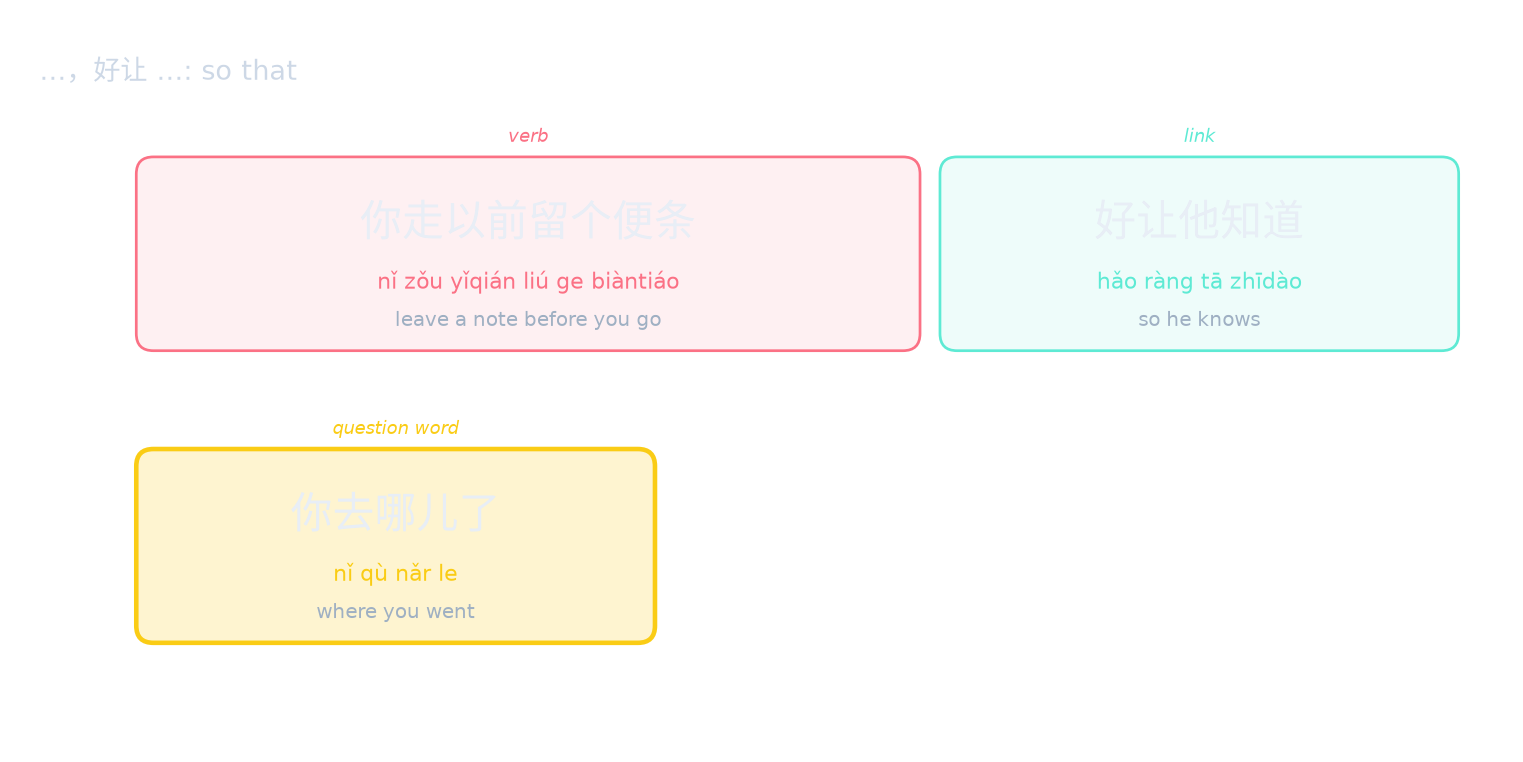
- you你to walk走before以前留个(informal) note便条,good好to let / make让he / him他to know知道you你to go去where哪儿(completed / change)了。 – "Leave a note before you go, so that he knows where you've gone."
Action,good好 + purpose
- A,good好 B = do A so that B can happen: good好 here means "so that, in order to (make it easier)".
- good好 starts the second clause, often with to let / make让 or can / be able to能: good好to let / make让he / him他to know知道.
early早a bit点儿sleep睡,so that好tomorrow明天early早get up起。
Practical preparations
- (把: marks the object)把电话号码to write写to come down下来,good好at any time随时connection联系。 – "Write down the number so we can get in touch any time."
- I / me我to take along with one带上damask silk伞,good好at / in在to rain下雨(modifier / structural particle)的time时候to use / with用。 – "I'll take an umbrella so I can use it if it rains."
把phone电话number号码write down写下来,so that好any time随时get in touch联系。
Purpose follows action
- The action comes first and good好 + purpose second; this good好 is not "good".
- It is spoken and practical; in writing, so that以便 is the formal equivalent.
good好 versus in order to为了 and so that以便
- in order to为了 + purpose usually comes first: in order to为了tomorrow明天to get up early早起,I / me我早点儿to sleep睡.
- good好 / so that以便 come after the action: I / me我早点儿to sleep睡,good好tomorrow明天to get up early早起.
in order to为了tomorrow明天early早get up起,I我early早a bit点儿sleep睡。
Recap
- Action,good好 (to let / make让 / can / be able to能) + purpose = do A so that B (spoken).
- Purpose after the action; in order to为了 puts it first; so that以便 is formal.
Practise this pattern step by step.
one side一面 … ,one side一面 … (two things at once)
Driving and chatting
- Your uncle is a taxi driver who loves to tell stories while he drives.
- he / him他one side一面to drive a car开车,one side一面with / and跟passenger乘客to chat聊天。 – "He chats with passengers while he drives."
one side一面 A,one side一面 B = doing A while doing B
- one side一面 A,one side一面 B = two actions at the same time by the same person, like one side一边…one side一边….
- It is a little more formal and written.
she她while一面working工作,(at the same time)一面studying读for a master's研究生。

Ongoing parallel activities
- Can describe long-term parallel activities: he / him他one side一面(bound form) up上university大学,one side一面to work a temporary or…打工。 – "He goes to university and works part-time."
- Also for two attitudes: one side一面to criticize批评,one side一面to encourage鼓励 – "criticising and encouraging at once."
he他while一面attending上university大学,(also)一面works part-time打工。
Same subject, actions
- Both actions belong to one subject: he / him他one side一面…one side一面….
- Use action verbs; for two qualities use already既…again又….
one side一面 versus one side一边 and on the one hand一方面
- one side一边…one side一边… is the everyday version: one side一边variant of 吃吃one side一边to see看.
- on the one hand一方面…on the one hand一方面… gives two aspects or reasons, not two simultaneous actions.
he他while一边eating吃饭(also)一边watches看the news新闻。
Recap
- one side一面 A,one side一面 B = doing A while doing B (same subject; a little formal).
- one side一边…one side一边… is everyday; on the one hand一方面…on the one hand一方面… gives aspects.
Practise this pattern step by step.
no不是 … ,exactly就是 … (either … or …)
Always one or the other
- You complain about the weather in your city in spring.
- here这里(modifier / structural particle)的spring (season)春天no不是to be windy刮风,exactly就是to rain下雨。 – "Spring here is either windy or rainy."
no不是 A,exactly就是 B = either A or B
- no不是 A,exactly就是 B = it is always one of the two: if not A, then B.
- It often describes a habit or a frustrating situation.
he他at weekends周末if not不是sleeping睡觉,then就是playing打games游戏。

Two possibilities, nothing else
- Guess: this这个(concept of) time时间he / him他no不是at / in在library图书馆,exactly就是at / in在dining hall食堂。 – "At this time he's either in the library or the canteen."
- Complaint: you你no不是to arrive late迟到,exactly就是to leave early (before the…早退! – "You're either late or leaving early!"
he他if not不是at在the library图书馆,then就是at在the canteen食堂。
Not "isn't … but is …"
- no不是 A,rather而是 B = not A but B (a correction): he / him他no不是teacher老师,rather而是doctor医生. Different meaning!
- no不是 A,exactly就是 B = either A or B (two options, one of them true).
Versus or或者…or或者…
- or或者…or或者… offers choices: or或者you你to come来,or或者I / me我to go去.
- no不是…exactly就是… describes a situation with only two outcomes, often habitual.
he他not不是a teacher老师,but而是a doctor医生。
Recap
- no不是 A,exactly就是 B = either A or B (one of the two).
- no不是 A,rather而是 B = not A but B (correction).
Practise this pattern step by step.
Practice without the models
Choose a pattern, cover its teaching examples, and attempt its questions. Use the labels to find feedback in the separate key.
Advanced (把: marks the object)把 ((把: marks the object)把 + Obj + Verb + result)
2001.1 Complete: “Please translate this sentence into English.” to ask请(把: marks the object)把这句old variant of 话话to translate翻译…………English (language)英文。
2001.2 Which sentence is correct?
- A. you你(把: marks the object)把question问题should应该variant of 说说clear清楚。
- B. you你(把: marks the object)把should应该question问题variant of 说说clear清楚。
- C. you你should应该variant of 说说(把: marks the object)把question问题clear清楚。
- D. you你should应该(把: marks the object)把question问题variant of 说说clear清楚。
2001.3 Build: “She cleaned the room spotless.”
Arrange all chunks: to clean打扫(degree marker)得 / she / her她 / 干干净净。 / (把: marks the object)把room房间
2001.4 I / me我(把: marks the object)把he / him他to see看见(completed / change)了 is a natural sentence.
True or false? Explain or repair the statement.
2001.5 Your manager hands back your draft with instructions. Close the examples. Say a Mandarin response, then write it in Chinese. Explain briefly in English what the lesson’s pattern adds. Compare with the model, then change one detail and try again.
Write or say your own response before reading the key.
N1 + unlike不比 + N2 + Adj (no more … than)
2002.1 Rebut: “My room is no smaller than yours.” I / me我(modifier / structural particle)的room房间…………than / compared to比you你(modifier / structural particle)的small小。
2002.2 Which says clearly that A is shorter than B?
- A. Awith / and跟Bsame一样high高。
- B. Athan / compared to比B不高。
- C. Anot have / haven't没有Bhigh高。
- D. Aunlike不比Bhigh高。
2002.3 Build: “Today is no colder than yesterday.”
Arrange all chunks: unlike不比 / yesterday昨天 / today今天 / cold冷。
2002.4 younger brother弟弟unlike不比older brother哥哥high高 means the younger brother is definitely shorter.
True or false? Explain or repair the statement.
2002.5 Your friend thinks the expensive brand is much better. You think it's no better than the cheap one. Close the examples. Say a Mandarin response, then write it in Chinese. Explain briefly in English what the lesson’s pattern adds. Compare with the model, then change one detail and try again.
Write or say your own response before reading the key.
want / will / need要 + Verb + then / just就 + Verb (if you're going to, do it right)
2003.1 Complete: “If you're going to learn, learn properly.” 要学…………好好学。
2003.2 Which gives permission rather than advice?
- A. want / think / miss想to walk走then / just就to walk走(suggestion)吧。
- B. want / will / need要to make做then / just就to make做to finish完。
- C. as for要说then / just就variant of 说说clear清楚。
- D. want / will / need要to buy买then / just就to ingratiate oneself买好(modifier / structural particle)的。
2003.3 Build: “If you're going to buy one, buy a good one.”
Arrange all chunks: then / just就to buy买 / want / will / need要to buy买 / quality质量good好(modifier / structural particle)的。
2003.4 want / will / need要…then / just就… is mainly used in formal writing.
True or false? Explain or repair the statement.
2003.5 Your friend wants to learn the guitar but only practises five minutes a week. Close the examples. Say a Mandarin response, then write it in Chinese. Explain briefly in English what the lesson’s pattern adds. Compare with the model, then change one detail and try again.
Write or say your own response before reading the key.
cannot do without少不了 (can't do without)
2004.1 Complete: “Chinese New Year isn't complete without dumplings.” to celebrate the Chinese…过年…………dumpling饺子。
2004.2 What does so much这么to make做,cannot do without少不了want / will / need要to suffer挨to criticize批评 mean?
- A. You're bound to be criticised.
- B. Criticise less.
- C. Criticism is missing.
- D. You won't be criticised.
2004.3 Build: “He's the lead; we can't do without him.”
Arrange all chunks: cannot do without少不了 / he / him他。 / he / him他to be / is是leading role主角 / ,
2004.4 child孩子inseparable离不开mama妈妈 means the child depends on its mother.
True or false? Explain or repair the statement.
2004.5 Your family is planning grandma's 80th birthday party. Close the examples. Say a Mandarin response, then write it in Chinese. Explain briefly in English what the lesson’s pattern adds. Compare with the model, then change one detail and try again.
Write or say your own response before reading the key.
A to equal等于 B (equals / amounts to)
2005.1 Complete: “Ten minus four equals six.” 十减four四…………six六。
2005.2 What does expensive贵not不to equal等于good好 mean?
- A. Expensive equals good.
- B. Expensive is not good.
- C. Expensive doesn't mean good.
- D. Good things are expensive.
2005.3 Build: “Wasting time is the same as wasting your life.”
Arrange all chunks: to waste浪费 / 浪费时间 / life (as the characteristic…生命。 / then / just就to equal等于
2005.4 to equal等于 can express that two things have the same effect.
True or false? Explain or repair the statement.
2005.5 Your friend didn't object when you suggested the plan. Close the examples. Say a Mandarin response, then write it in Chinese. Explain briefly in English what the lesson’s pattern adds. Compare with the model, then change one detail and try again.
Write or say your own response before reading the key.
from从 … to hit (the mark)中 (from within)
2006.1 Complete: “Learn from failure.” from从to be defeated失败…………to learn学习。
2006.2 Which sentence is correct?
- A. from从these这些书选一本to hit (the mark)中。
- B. to choose选一个from within从中。
- C. from从these这些book书to be chosen中选一本。
- D. 选从these这些书中一本。
2006.3 Build: “He gained a lot of experience from work.”
Arrange all chunks: 很多experience经验。 / to get得到(completed / change)了 / he / him他 / from从to work工作to hit (the mark)中
2006.4 from within从中 can refer back to something just mentioned.
True or false? Explain or repair the statement.
2006.5 Your coach talks to the team after a lost match. Close the examples. Say a Mandarin response, then write it in Chinese. Explain briefly in English what the lesson’s pattern adds. Compare with the model, then change one detail and try again.
Write or say your own response before reading the key.
not to have无 … used in 可汗可 … (have no … to …)
2007.1 Complete: “I have nothing to say.” 我无话…………variant of 说说。
2007.2 Match each phrase to its meaning.
-
- 无处可去
-
- not to have无matter事used in 可汗可to make做
-
- homeless无家可归
-
A. homeless
-
B. nothing to do
-
C. nowhere to go
2007.3 Which is the spoken equivalent of to have nothing to say…无话可说?
- A. not have / haven't没有what什么old variant of 话话variant of 说说can / may可以。
- B. 有话can / may可以variant of 说说(modifier / structural particle)的。
- C. not to have无what什么can / may可以variant of 说说。
- D. not have / haven't没有what什么can / may可以variant of 说说(modifier / structural particle)的。
2007.4 to have nothing to say…无话可说 is more formal than 没话说.
True or false? Explain or repair the statement.
2007.5 After a long argument, your friend shrugs and goes quiet. Close the examples. Say a Mandarin response, then write it in Chinese. Explain briefly in English what the lesson’s pattern adds. Compare with the model, then change one detail and try again.
Write or say your own response before reading the key.
not only (... but also ...)不但 …,even甚至to link连 … also也 … (not only …, even …)
2008.1 Complete: “He not only forgot his pen, he even forgot his ticket.” he / him他not only (... but also ...)不但to forget忘(completed / change)了带笔,even甚至…………(exam) admission ticket准考证also也to forget忘(completed / change)了。
2008.2 Which order is correct?
- A. teacher老师even甚至also也to link连not不to know知道。
- B. to link连even甚至teacher老师also也not不to know知道。
- C. even甚至teacher老师to link连also也not不to know知道。
- D. even甚至to link连teacher老师also也not不to know知道。
2008.3 Build: “Even the teacher can't explain it clearly.”
Arrange all chunks: 说不清楚。 / to link连teacher老师 / also也 / even甚至
2008.4 The B item in this pattern should be the most surprising one.
True or false? Explain or repair the statement.
2008.5 Your roommate had a terrible morning before the exam. Close the examples. Say a Mandarin response, then write it in Chinese. Explain briefly in English what the lesson’s pattern adds. Compare with the model, then change one detail and try again.
Write or say your own response before reading the key.
with / and跟 / and / with和 … to have sth to do with有关(modifier / structural particle)的 + Noun (related to)
2009.1 Complete: “This matter is related to him.” 这件matter事with / and跟he / him他…………。
2009.2 Which phrase is correct?
- A. book书with / and跟history历史to have sth to do with有关(modifier / structural particle)的
- B. to have sth to do with有关(modifier / structural particle)的with / and跟history历史book书
- C. with / and跟history历史to have sth to do with有关(modifier / structural particle)的book书
- D. with / and跟to have sth to do with有关history历史(modifier / structural particle)的book书
2009.3 Build: “His illness is related to stress.”
Arrange all chunks: with / and跟pressure压力 / to have sth to do with有关。 / he / him他(modifier / structural particle)的illness病
2009.4 this这with / and跟I / me我not have / haven't没有variant of 关系关系 means “This has nothing to do with me.”
True or false? Explain or repair the statement.
2009.5 You are writing about air pollution and go to the library. Close the examples. Say a Mandarin response, then write it in Chinese. Explain briefly in English what the lesson’s pattern adds. Compare with the model, then change one detail and try again.
Write or say your own response before reading the key.
so-called所谓 (the so-called …)
2010.1 Complete the definition: “What is called 'low-carbon' means reducing emissions.” …………(attributive) low-carbon低碳,exactly就是to lessen减少to arrange in order排放。
2010.2 What does this这exactly就是you你so-called所谓(modifier / structural particle)的“good好plan主意”? suggest?
- A. The speaker admires the idea.
- B. The speaker is asking for an idea.
- C. The speaker is defining a term.
- D. The speaker doubts the idea is good.
2010.3 Build: “Happiness is doing what you love.”
Arrange all chunks: to like喜欢(modifier / structural particle)的matter事。 / to make做oneself自己 / so-called所谓happiness幸福 / ,exactly就是
2010.4 to be called叫做 is the neutral way to name something.
True or false? Explain or repair the statement.
2010.5 Your friend promised a quick route home; it took twice as long. Close the examples. Say a Mandarin response, then write it in Chinese. Explain briefly in English what the lesson’s pattern adds. Compare with the model, then change one detail and try again.
Write or say your own response before reading the key.
at / in在 + Time + inside内 (within a span)
2011.1 Complete (formal notice): “Pay within thirty days.” to ask请at / in在三十天…………to pay a sum of money付款。
2011.2 Which means “after a week” (not before)?
- A. one week一周within以内
- B. one week一周inside内
- C. one week一周after以后
- D. at / in在one week一周inside内
2011.3 Build: “No smoking within the school.”
Arrange all chunks: at / in在school学校inside内 / to smoke吸烟。 / cannot不能
2011.4 to complete完成at / in在三天inside内 is the normal word order.
True or false? Explain or repair the statement.
2011.5 The online shop promises fast delivery in its advert. Close the examples. Say a Mandarin response, then write it in Chinese. Explain briefly in English what the lesson’s pattern adds. Compare with the model, then change one detail and try again.
Write or say your own response before reading the key.
preferably宁可 … ,also也 … (would rather)
2012.1 Complete: “I'd rather stay at home than go out in this rain.” I / me我preferably宁可待在家里,…………not不at / in在so much这么see 大夫大(modifier / structural particle)的雨里to go out出去。
2012.2 How is variant of 宁宁 read in preferably宁可?
- A. nìng
- B. nīng
- C. nǐng
- D. níng
2012.3 Build: “He'd rather go hungry than eat junk food.”
Arrange all chunks: also也不吃 / he / him他preferably宁可to be hungry饿(ongoing -ing)着 / trash垃圾foodstuff食品。 / ,
2012.4 rather than...与其 A not equal to不如 B recommends B.
True or false? Explain or repair the statement.
2012.5 Your friend suggests taking the crowded night bus. You'd rather walk an hour. Close the examples. Say a Mandarin response, then write it in Chinese. Explain briefly in English what the lesson’s pattern adds. Compare with the model, then change one detail and try again.
Write or say your own response before reading the key.
Verb + then / just就 + Verb (indifference / a shrug)
2013.1 Accept it: “If it's expensive, so be it – I like it.” expensive贵then / just就…………(suggestion)吧,I / me我to like喜欢。
2013.2 What does to lose输(completed / change)了then / just就to lose输(completed / change)了,next time下次again / then再to come来 express?
- A. A plan to cheat
- B. Surprise at winning
- C. Great disappointment
- D. Accepting the loss and moving on
2013.3 Build: “If it's lost, it's lost; buy another one.”
Arrange all chunks: 一个(suggestion)吧。 / to lose丢(completed / change)了 / ,again / then再to buy买 / then / just就to lose丢(completed / change)了
2013.4 to go去then / just就to go去,who谁to be afraid怕who谁! sounds defiant.
True or false? Explain or repair the statement.
2013.5 Your friend apologises for being five minutes late. You really don't mind. Close the examples. Say a Mandarin response, then write it in Chinese. Explain briefly in English what the lesson’s pattern adds. Compare with the model, then change one detail and try again.
Write or say your own response before reading the key.
Action,good好 + Purpose (so that)
2014.1 Complete: “Write down the address so you don't forget.” (把: marks the object)把address地址to write写to come down下来,…………improbable不会to forget忘。
2014.2 In 早点儿to sleep睡,good好tomorrow明天to get up early早起, what does good好 mean?
- A. very
- B. so that
- C. finished
- D. good
2014.3 Build: “Leave a note so that he knows.”
Arrange all chunks: he / him他to know知道。 / , / good好to let / make让 / 留个(informal) note便条
2014.4 so that以便 is a formal equivalent of this good好.
True or false? Explain or repair the statement.
2014.5 You are going out and your flatmate will come home later. Close the examples. Say a Mandarin response, then write it in Chinese. Explain briefly in English what the lesson’s pattern adds. Compare with the model, then change one detail and try again.
Write or say your own response before reading the key.
one side一面 … ,one side一面 … (two things at once)
2015.1 Complete: “She works while studying for a master's.” she / her她one side一面to work工作,…………to read out读graduate student研究生。
2015.2 Which describes two reasons, not two simultaneous actions?
- A. one side一面…one side一面…
- B. one side一边…one side一边…
- C. on the one hand一方面…on the one hand一方面…
- D. again又…again又…
2015.3 Build: “He goes to university and works part-time.”
Arrange all chunks: ,one side一面 / (bound form) up上university大学 / he / him他one side一面 / to work a temporary or…打工。
2015.4 one side一面…one side一面… is more formal than one side一边…one side一边….
True or false? Explain or repair the statement.
2015.5 Your uncle is a taxi driver who loves to tell stories while he drives. Close the examples. Say a Mandarin response, then write it in Chinese. Explain briefly in English what the lesson’s pattern adds. Compare with the model, then change one detail and try again.
Write or say your own response before reading the key.
no不是 … ,exactly就是 … (either … or …)
2016.1 Complete: “At weekends he either sleeps or plays games.” he / him他weekend周末no不是to go to bed睡觉,…………打游戏。
2016.2 What does he / him他no不是teacher老师,rather而是doctor医生 mean?
- A. He isn't a teacher; he's a doctor.
- B. He is either a teacher or a doctor.
- C. He is neither.
- D. He is both a teacher and a doctor.
2016.3 Build: “He's either in the library or the canteen.”
Arrange all chunks: , / exactly就是 / at / in在dining hall食堂。 / he / him他no不是at / in在library图书馆
2016.4 no不是…exactly就是… often describes a habit or a frustrating pattern.
True or false? Explain or repair the statement.
2016.5 You complain about the weather in your city in spring. Close the examples. Say a Mandarin response, then write it in Chinese. Explain briefly in English what the lesson’s pattern adds. Compare with the model, then change one detail and try again.
Write or say your own response before reading the key.
A fresh situation
R1. Interpret and repair. A learner reports I / me我(把: marks the object)把this这本书to see看 as a complete disposal/result statement. Add an outcome suitable for the context.
R2. Use it yourself. Choose walking over waiting, then state that the waiting time exceeded an expectation without inventing a total.
Write your responses before opening the key. Compare meaning as well as form; a different valid answer need not copy the model.
Open the answers after your attempt
Answers and explanations
Check after your attempt. For open tasks, compare the message and the stated criteria, then revise one detail.
Advanced (把: marks the object)把 ((把: marks the object)把 + Obj + Verb + result)
2001.1 to succeed成
翻译成 = translate into (a change).
2001.2 D. you你should应该(把: marks the object)把question问题variant of 说说clear清楚。
you你should应该(把: marks the object)把question问题variant of 说说clear清楚 is right: modal verbs and negatives (should应该, want / will / need要, not不) go before (把: marks the object)把, not between (把: marks the object)把 and the verb.
2001.3 she / her她(把: marks the object)把room房间to clean打扫(degree marker)得干干净净。
(把: marks the object)把 + object + verb + (degree marker)得 + result.
2001.4 False.
Perception verbs like to see看见 don't take (把: marks the object)把.
2001.5 One possible response: to ask请(把: marks the object)把第三段to change改(degree marker)得short短erhua variant of 一点一点儿,again / then再(把: marks the object)把chart图表放到final最后。
Check meaning and form:
- My response conveys a message that fits the opening situation.
- I can explain the meaning of the pattern, rather than only naming it.
- not / haven't没 / not不 / don't别 / can / be able to能 / want / will / need要 / should应该 go before (把: marks the object)把: you你should应该(把: marks the object)把question问题variant of 说说clear清楚, not you你(把: marks the object)把question问题should应该variant of 说说clear清楚.
- Perception and feeling verbs (to see看见, to know知道, to like喜欢) don't take (把: marks the object)把.
- I tried a second response with a name, time, place, or description changed.
This is supported productive practice. Compare meaning and structure; your answer need not copy the model. A partner or teacher must hear the spoken response to comment on pronunciation.
N1 + unlike不比 + N2 + Adj (no more … than)
2002.1 not不
A unlike不比 B + Adj.
2002.2 C. Anot have / haven't没有Bhigh高。
not have / haven't没有 gives the lower degree here; unlike不比 denies a higher degree and can allow equality or a lower degree.
2002.3 today今天unlike不比yesterday昨天cold冷。
A unlike不比 B + Adj.
2002.4 False.
It only says he isn't taller; they may be the same height.
2002.5 One possible response: this这个sign牌子unlike不比that那个good好。
Check meaning and form:
- My response conveys a message that fits the opening situation.
- I can explain the meaning of the pattern, rather than only naming it.
- A not have / haven't没有 B high高 = A is less tall than B (clearly shorter).
- A unlike不比 B high高 denies that A is taller. A may be equally tall or shorter; the phrase does not establish equality.
- I tried a second response with a name, time, place, or description changed.
This is supported productive practice. Compare meaning and structure; your answer need not copy the model. A partner or teacher must hear the spoken response to comment on pronunciation.
want / will / need要 + Verb + then / just就 + Verb (if you're going to, do it right)
2003.1 then / just就
want / will / need要 V then / just就 V.
2003.2 A. want / think / miss想to walk走then / just就to walk走(suggestion)吧。
want / think / miss想 V then / just就 V gives permission: want / think / miss想to walk走then / just就to walk走(suggestion)吧 “Feel free to leave if you want.” want / will / need要 V then / just就 V gives firm advice: if you do it, do it properly.
2003.3 want / will / need要to buy买then / just就to buy买quality质量good好(modifier / structural particle)的。
want / will / need要 V then / just就 V + object.
2003.4 False.
False. want / will / need要…then / just就… is spoken and firm (want / will / need要to buy买then / just就to ingratiate oneself买好(modifier / structural particle)的 “If you're buying, buy a good one”). It is not a formal written pattern.
2003.5 One possible response: 要学then / just就好好学,don't别三天打鱼两天晒网。
Check meaning and form:
- My response conveys a message that fits the opening situation.
- I can explain the meaning of the pattern, rather than only naming it.
- Repeat the same verb: 要学then / just就好好学, not 要学then / just就well好好to practice练 (unless you mean a different action).
- The tone is firm advice or impatience; it is spoken.
- I tried a second response with a name, time, place, or description changed.
This is supported productive practice. Compare meaning and structure; your answer need not copy the model. A partner or teacher must hear the spoken response to comment on pronunciation.
cannot do without少不了 (can't do without)
2004.1 cannot do without少不了
A cannot do without少不了 B = B is essential.
2004.2 A. You're bound to be criticised.
cannot do without少不了 can mean “bound to, can't avoid”: so much这么to make做,cannot do without少不了want / will / need要to suffer挨to criticize批评 “Do it this way and you're bound to be criticised.” Its other sense is “can't do without”.
2004.3 he / him他to be / is是leading role主角,cannot do without少不了he / him他。
cannot do without少不了 + essential person.
2004.4 True.
True. inseparable离不开 means “can't be without, depends on”: child孩子inseparable离不开mama妈妈 “The child can't be without its mother.”
2004.5 One possible response: birthday生日party聚会cannot do without少不了cake蛋糕。
Check meaning and form:
- My response conveys a message that fits the opening situation.
- I can explain the meaning of the pattern, rather than only naming it.
- (completed / change)了 in cannot do without少不了 is liǎo, as in variant of 吃吃(as a resultative verb…不了.
- The opposite is 少得(completed / change)了 (rare); for "not needed", say not不to need需要 or not need用不着.
- I tried a second response with a name, time, place, or description changed.
This is supported productive practice. Compare meaning and structure; your answer need not copy the model. A partner or teacher must hear the spoken response to comment on pronunciation.
A to equal等于 B (equals / amounts to)
2005.1 to equal等于
to equal等于 = equals.
2005.2 C. Expensive doesn't mean good.
not不to equal等于 = is not the same as.
2005.3 浪费时间then / just就to equal等于to waste浪费life (as the characteristic…生命。
A then / just就to equal等于 B.
2005.4 True.
taciturn沉默to equal等于to agree同意 – silence amounts to consent.
2005.5 One possible response: you你not不to speak说话then / just就to equal等于to agree同意(completed / change)了。
Check meaning and form:
- My response conveys a message that fits the opening situation.
- I can explain the meaning of the pattern, rather than only naming it.
- not不to equal等于 = is not the same as: cheap便宜not不to equal等于no good不好 – "Cheap doesn't mean bad."
- In argument, to equal等于 often follows then / just就: not不variant of 说说then / just就to equal等于to agree同意.
- I tried a second response with a name, time, place, or description changed.
This is supported productive practice. Compare meaning and structure; your answer need not copy the model. A partner or teacher must hear the spoken response to comment on pronunciation.
from从 … to hit (the mark)中 (from within)
2006.1 to hit (the mark)中
from从 + noun + to hit (the mark)中.
2006.2 C. from从these这些book书to be chosen中选一本。
from从these这些book书to be chosen中选一本 is right: the from从…to hit (the mark)中 phrase comes before the verb, and to hit (the mark)中 closes the phrase directly after the noun.
2006.3 he / him他from从to work工作to hit (the mark)中to get得到(completed / change)了很多experience经验。
Subject + from从…to hit (the mark)中 + verb + object.
2006.4 True.
variant of 并并from从middle school中学to / arrive到(completed / change)了很多 – learned a lot from it.
2006.5 One possible response: we / us我们want / will / need要from从to be defeated失败to hit (the mark)中to draw a lesson (from a…吸取教训。
Check meaning and form:
- My response conveys a message that fits the opening situation.
- I can explain the meaning of the pattern, rather than only naming it.
- Say from从to be defeated失败to hit (the mark)中to learn学习, not from从to be defeated失败to learn学习 (for "from within, through").
- The from从…to hit (the mark)中 phrase goes before the verb: from从to be chosen中选一个, not to choose选一个from within从中.
- I tried a second response with a name, time, place, or description changed.
This is supported productive practice. Compare meaning and structure; your answer need not copy the model. A partner or teacher must hear the spoken response to comment on pronunciation.
not to have无 … used in 可汗可 … (have no … to …)
2007.1 used in 可汗可
not to have无 + noun + used in 可汗可 + verb.
2007.2 1–C: 无处可去 = nowhere to go; 2–B: not to have无matter事used in 可汗可to make做 = nothing to do; 3–A: homeless无家可归 = homeless
not to have无 X used in 可汗可 V = no X to V.
2007.3 D. not have / haven't没有what什么can / may可以variant of 说说(modifier / structural particle)的。
not have / haven't没有…can / may可以… is the everyday form.
2007.4 True.
True. not to have无…used in 可汗可… comes from literary Chinese (to have nothing to say…无话可说, homeless无家可归), so it is more formal than everyday 没话说.
2007.5 One possible response: I / me我already已经to have nothing to say…无话可说(completed / change)了。
Check meaning and form:
- My response conveys a message that fits the opening situation.
- I can explain the meaning of the pattern, rather than only naming it.
- In speech, say 没有话说 / not / haven't没area地方to go去; not to have无…used in 可汗可… is more formal.
- Keep the order not to have无 + noun + used in 可汗可 + verb; do not add (modifier / structural particle)的 or (completed / change)了 inside: to have nothing to say…无话可说, not not to have无old variant of 话话(modifier / structural particle)的used in 可汗可variant of 说说.
- I tried a second response with a name, time, place, or description changed.
This is supported productive practice. Compare meaning and structure; your answer need not copy the model. A partner or teacher must hear the spoken response to comment on pronunciation.
not only (... but also ...)不但 …,even甚至to link连 … also也 … (not only …, even …)
2008.1 to link连
even甚至to link连 B also也….
2008.2 D. even甚至to link连teacher老师also也not不to know知道。
The order is even甚至 + to link连 + B + also也/all / both都: even甚至to link连teacher老师also也not不to know知道 “Even the teacher didn't know.” even甚至 comes first and to link连 directly before the surprising item.
2008.3 even甚至to link连teacher老师also也说不清楚。
even甚至to link连 B also也 + verb.
2008.4 True.
True. B is the climax, the least expected case: if even the teacher didn't know, nobody would.
2008.5 One possible response: he / him他not only (... but also ...)不但to forget忘(completed / change)了带笔,even甚至to link连(exam) admission ticket准考证also也to forget忘(completed / change)了。
Check meaning and form:
- My response conveys a message that fits the opening situation.
- I can explain the meaning of the pattern, rather than only naming it.
- even甚至 comes before to link连, and also也 / all / both都 after B: even甚至to link连he / him他also也…, not to link连even甚至he / him他also也….
- B should be stronger than A; a weaker B makes the sentence fall flat.
- I tried a second response with a name, time, place, or description changed.
This is supported productive practice. Compare meaning and structure; your answer need not copy the model. A partner or teacher must hear the spoken response to comment on pronunciation.
with / and跟 / and / with和 … to have sth to do with有关(modifier / structural particle)的 + Noun (related to)
2009.1 to have sth to do with有关
A with / and跟 B to have sth to do with有关.
2009.2 C. with / and跟history历史to have sth to do with有关(modifier / structural particle)的book书
The whole with / and跟…to have sth to do with有关(modifier / structural particle)的 phrase comes before the noun.
2009.3 he / him他(modifier / structural particle)的illness病with / and跟pressure压力to have sth to do with有关。
A with / and跟 B to have sth to do with有关.
2009.4 True.
not have / haven't没有variant of 关系关系 negates the connection.
2009.5 One possible response: I / me我variant of 借借(completed / change)了几本with / and跟environment环境to have sth to do with有关(modifier / structural particle)的book书。
Check meaning and form:
- My response conveys a message that fits the opening situation.
- I can explain the meaning of the pattern, rather than only naming it.
- The whole phrase comes before the noun with (modifier / structural particle)的: with / and跟environment环境to have sth to do with有关(modifier / structural particle)的book书, not book书with / and跟environment环境to have sth to do with有关(modifier / structural particle)的.
- Negative: with / and跟he / him他unrelated无关 / with / and跟he / him他not have / haven't没有variant of 关系关系 – "nothing to do with him".
- I tried a second response with a name, time, place, or description changed.
This is supported productive practice. Compare meaning and structure; your answer need not copy the model. A partner or teacher must hear the spoken response to comment on pronunciation.
so-called所谓 (the so-called …)
2010.1 so-called所谓
so-called所谓 X,exactly就是 … introduces a definition.
2010.2 D. The speaker doubts the idea is good.
so-called所谓 can be ironic, “so-called”: this这exactly就是you你so-called所谓(modifier / structural particle)的“good好plan主意”? “So this is your so-called good idea?” The speaker doubts it is good.
2010.3 so-called所谓happiness幸福,exactly就是to make做oneself自己to like喜欢(modifier / structural particle)的matter事。
so-called所谓 X,exactly就是 ….
2010.4 True.
so-called所谓 often adds doubt or sets up a definition.
2010.5 One possible response: he / him他so-called所谓(modifier / structural particle)的shortcut近路,than / compared to比avenue大路还远。
Check meaning and form:
- My response conveys a message that fits the opening situation.
- I can explain the meaning of the pattern, rather than only naming it.
- you你so-called所谓(modifier / structural particle)的friend朋友 can sound very critical; use it carefully about people.
- For a neutral definition, so-called所谓 X,exactly就是 … is the standard frame.
- I tried a second response with a name, time, place, or description changed.
This is supported productive practice. Compare meaning and structure; your answer need not copy the model. A partner or teacher must hear the spoken response to comment on pronunciation.
at / in在 + Time + inside内 (within a span)
2011.1 inside内
at / in在 + time + inside内 = within.
2011.2 C. one week一周after以后
one week一周after以后 means “after a week”. one week一周inside内, one week一周within以内 and at / in在one week一周inside内 all mean “within a week”, i.e. before the week is over.
2011.3 at / in在school学校inside内cannot不能to smoke吸烟。
at / in在 + place + inside内 + rule.
2011.4 False.
The time phrase goes before the verb: at / in在三天inside内to complete完成.
2011.5 One possible response: we / us我们guarantee保证三天inside内送到。
Check meaning and form:
- My response conveys a message that fits the opening situation.
- I can explain the meaning of the pattern, rather than only naming it.
- inside内 is formal; in chat, 三天inside之内 or 三天within以内 also work, and 三天li, ancient measure of…里 is casual.
- The phrase goes before the verb: at / in在三天inside内to complete完成, not to complete完成at / in在三天inside内.
- I tried a second response with a name, time, place, or description changed.
This is supported productive practice. Compare meaning and structure; your answer need not copy the model. A partner or teacher must hear the spoken response to comment on pronunciation.
preferably宁可 … ,also也 … (would rather)
2012.1 also也
preferably宁可 A,also也not不 B.
2012.2 A. nìng
In preferably宁可 (“would rather”) variant of 宁宁 is read nìng, fourth tone: nìngkě. The second-tone níng is used in peaceful安宁 and the name Nanning, prefecture-level…南宁.
2012.3 he / him他preferably宁可to be hungry饿(ongoing -ing)着,also也不吃trash垃圾foodstuff食品。
preferably宁可 A,also也not不 B.
2012.4 True.
True. rather than...与其 A not equal to不如 B means “rather than A, better B”: rather than...与其等车,not equal to不如to walk走路. The speaker recommends B.
2012.5 One possible response: I / me我preferably宁可to walk走路to return home回家,also也not不to sit坐like that那么to crowd in挤(modifier / structural particle)的war chariot (archaic)车。
Check meaning and form:
- My response conveys a message that fits the opening situation.
- I can explain the meaning of the pattern, rather than only naming it.
- variant of 宁宁 here is nìng (fourth tone), as in preferably宁可 / would rather ... (than ...)宁愿.
- preferably宁可 goes after the subject: I / me我preferably宁可…, and the second clause needs also也: also也not不 / also也want / will / need要.
- I tried a second response with a name, time, place, or description changed.
This is supported productive practice. Compare meaning and structure; your answer need not copy the model. A partner or teacher must hear the spoken response to comment on pronunciation.
Verb + then / just就 + Verb (indifference / a shrug)
2013.1 expensive贵
The same word repeats: expensive贵then / just就expensive贵.
2013.2 D. Accepting the loss and moving on
X then / just就 X accepts a fact and moves on: to lose输(completed / change)了then / just就to lose输(completed / change)了,next time下次again / then再to come来 “If we lost, we lost; we'll try again next time.” It is not disappointment or surprise.
2013.3 to lose丢(completed / change)了then / just就to lose丢(completed / change)了,again / then再to buy买一个(suggestion)吧。
X then / just就 X, then the next step.
2013.4 True.
The tone can be relaxed or defiant.
2013.5 One possible response: evening晚(completed / change)了then / just就evening晚(completed / change)了,it doesn't matter没关系。
Check meaning and form:
- My response conveys a message that fits the opening situation.
- I can explain the meaning of the pattern, rather than only naming it.
- It can sound relaxed (it doesn't matter没关系) or defiant (who谁to be afraid怕who谁); context and voice tell which.
- Repeat exactly the same word: expensive贵then / just就expensive贵(suggestion)吧, not expensive贵then / just就cheap便宜(suggestion)吧.
- I tried a second response with a name, time, place, or description changed.
This is supported productive practice. Compare meaning and structure; your answer need not copy the model. A partner or teacher must hear the spoken response to comment on pronunciation.
Action,good好 + Purpose (so that)
2014.1 good好
Action,good好 + purpose.
2014.2 B. so that
Here good好 introduces the purpose.
2014.3 留个(informal) note便条,good好to let / make让he / him他to know知道。
Action,good好to let / make让 + person + verb.
2014.4 True.
Both introduce a purpose after the action.
2014.5 One possible response: you你to walk走before以前留个(informal) note便条,good好to let / make让he / him他to know知道you你to go去where哪儿(completed / change)了。
Check meaning and form:
- My response conveys a message that fits the opening situation.
- I can explain the meaning of the pattern, rather than only naming it.
- The action comes first and good好 + purpose second; this good好 is not "good".
- It is spoken and practical; in writing, so that以便 is the formal equivalent.
- I tried a second response with a name, time, place, or description changed.
This is supported productive practice. Compare meaning and structure; your answer need not copy the model. A partner or teacher must hear the spoken response to comment on pronunciation.
one side一面 … ,one side一面 … (two things at once)
2015.1 one side一面
one side一面 A,one side一面 B.
2015.2 C. on the one hand一方面…on the one hand一方面…
on the one hand一方面 gives aspects or reasons.
2015.3 he / him他one side一面(bound form) up上university大学,one side一面to work a temporary or…打工。
one side一面 A,one side一面 B.
2015.4 True.
True. one side一面…one side一面… is more formal and written; one side一边…one side一边… is the everyday form for doing two things at once.
2015.5 One possible response: he / him他one side一面to drive a car开车,one side一面with / and跟passenger乘客to chat聊天。
Check meaning and form:
- My response conveys a message that fits the opening situation.
- I can explain the meaning of the pattern, rather than only naming it.
- Both actions belong to one subject: he / him他one side一面…one side一面….
- Use action verbs; for two qualities use already既…again又….
- I tried a second response with a name, time, place, or description changed.
This is supported productive practice. Compare meaning and structure; your answer need not copy the model. A partner or teacher must hear the spoken response to comment on pronunciation.
no不是 … ,exactly就是 … (either … or …)
2016.1 exactly就是
no不是 A,exactly就是 B.
2016.2 A. He isn't a teacher; he's a doctor.
rather而是 corrects: not A but B.
2016.3 he / him他no不是at / in在library图书馆,exactly就是at / in在dining hall食堂。
no不是 A,exactly就是 B.
2016.4 True.
True. no不是 A exactly就是 B (“if it's not A, it's B”) often describes an annoying pattern: no不是to be windy刮风,exactly就是to rain下雨 “If it isn't windy, it's raining.”
2016.5 One possible response: here这里(modifier / structural particle)的spring (season)春天no不是to be windy刮风,exactly就是to rain下雨。
Check meaning and form:
- My response conveys a message that fits the opening situation.
- I can explain the meaning of the pattern, rather than only naming it.
- no不是 A,rather而是 B = not A but B (a correction): he / him他no不是teacher老师,rather而是doctor医生. Different meaning!
- no不是 A,exactly就是 B = either A or B (two options, one of them true).
- I tried a second response with a name, time, place, or description changed.
This is supported productive practice. Compare meaning and structure; your answer need not copy the model. A partner or teacher must hear the spoken response to comment on pronunciation.
Fresh-situation answers
R1. I / me我(把: marks the object)把this这本书to see看to finish完(completed / change)了。to finish完 supplies the completed result; (把: marks the object)把 introduces the identifiable affected object. Another result may fit a different intended message.
R2. One possible response. I / me我preferably宁可to walk走路,also也unwilling不愿again / then再to wait for等。we / us我们already已经to wait for等(completed / change)了degree / adjective linker很(long) time久。The preference contrasts two options; degree / adjective linker很(long) time久 is imprecise and cannot be converted into a precise number of minutes.
Recall later. Tomorrow, produce one affected-result sentence and one explicit preference contrast.