Chinese course / HSK4 handouts
Verbs
Printable paper with separate answer pages Step-by-step lessons
Original teaching practice. Read one pattern, cover its model and try the questions before checking the separate answer section. Examples adapted from Chinese Grammar Wiki (AllSet Learning, CC BY-NC-SA) retain the course-reference provenance.
to let / make让 / variant of 叫叫 / to ask请 / to make使 (causative)
The boss's request
- Your manager wants the report by Friday and tells you to inform the team.
- manager经理to let / make让I / me我to notify通知everyone大家Friday星期五to hand over交to inform报告。 – "The manager asked me to tell everyone to hand in their reports on Friday."
A + to let / make让 / variant of 叫叫 / to ask请 / to make使 + B + Verb
- to let / make让 = let / make / ask; variant of 叫叫 = tell (spoken); to ask请 = invite / ask politely; to make使 = cause (written).
- B is the object of the first verb and the doer of the second: to let / make让I / me我to notify通知.
the teacher老师told叫us我们a bit earlier早点儿come来。

Causing feelings and changes
- he / him他if (coming after a…的话to let / make让I / me我degree / adjective linker很to move (sb)感动。 – "What he said moved me deeply."
- Written: this这个news消息to make使everyone大家very非常to be startled吃惊。 – "The news greatly surprised everyone."
this这个news消息made使everyone大家very非常surprised吃惊。
Choosing the verb
- to ask请 is for polite invitations; to your teacher, to ask请you (polite)您… sounds right, variant of 叫叫you (polite)您… sounds rude.
- to make使 needs a cause and a change of state, usually in writing; do not use it for permission: mama妈妈to let / make让I / me我to go去, not mama妈妈to make使I / me我to go去.
Negating the cause
- 不让 / not / haven't没to let / make让 = not allow / didn't ask: doctor医生不让he / him他to drink (alcohol)喝酒 – "The doctor won't let him drink."
- to let / make让…don't别… = tell someone not to: mama妈妈to let / make让我别Taiwan pr.玩cell phone手机.
the doctor医生not不let让him他drink喝alcohol酒。
Recap
- A to let / make让/variant of 叫叫/to ask请/to make使 B + Verb: let/make, tell, invite, cause (written).
- to ask请 is polite; to make使 is formal and causes a change; 不让 = not allow.
Practise this pattern step by step.
want / will / need要to see看 / (degree marker)得to see看 (it depends on)
Are we going or not?
- Your friend asks if the hike is still on for Saturday.
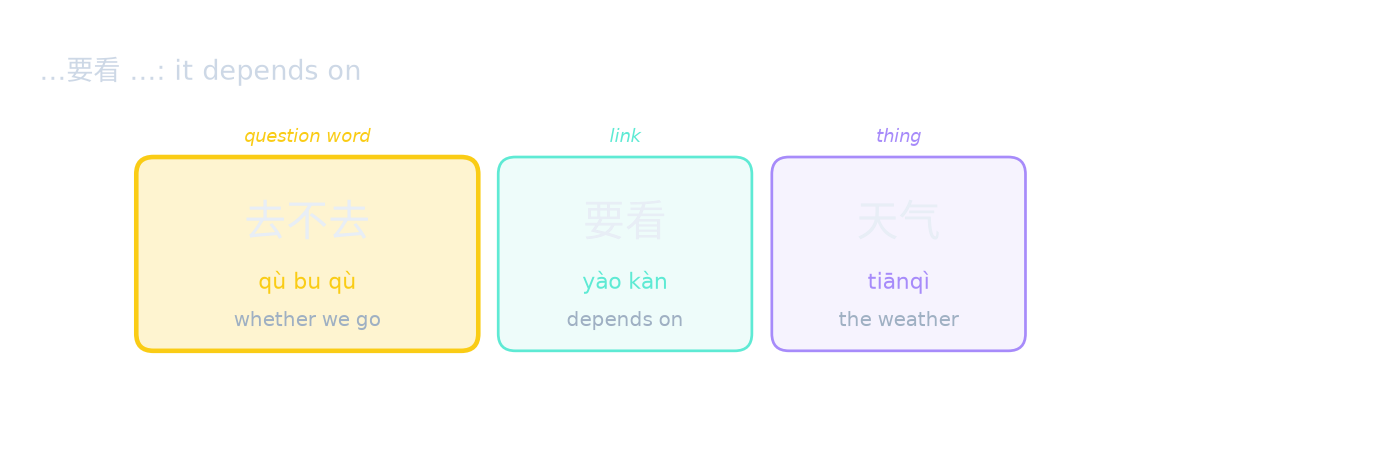
- 去不去want / will / need要to see看weather天气。 – "Whether we go depends on the weather."
… want / will / need要to see看 / (degree marker)得to see看 + deciding factor
- want / will / need要to see看 / (degree marker)得to see看 (děi kàn) + X = "it depends on X": what is undecided comes first, then the factor.
- The undecided part is often A-not-A or a question word: 去不去, what什么time时候, how about怎么样.
buy买or not不buy买depends on要看the price价格。
Short answers
- A: you你tomorrow明天to come来(yes/no ?)吗? B: (degree marker)得to see看circumstances情况。 – "It depends."
- achievement成绩(coll.) all right?好不好,main主要to see看you你to make an effort努力not不to make an effort努力。 – "Whether your results are good mainly depends on whether you work hard."
depends on得看the situation情况。
Order and reading
- Put the undecided matter first, then want / will / need要to see看 + factor: 去不去want / will / need要to see看weather天气, not want / will / need要to see看weather天气去不去 in most speech.
- In (degree marker)得to see看, (degree marker)得 is read děi ("must"), not de.
want / will / need要to see看 versus to decide (to do something)决定(of time or place) in于 / to hinge on取决于
- to hinge on取决于 is the formal written form: outcome结果to hinge on取决于everyone大家(modifier / structural particle)的to make an effort努力 – "The result depends on everyone's effort."
- want / will / need要to see看 / (degree marker)得to see看 is the everyday spoken form.
the result结果depends on取决于everyone's大家的effort努力。
Recap
- Undecided matter + want / will / need要to see看 / (degree marker)得to see看 + factor = it depends on ….
- (degree marker)得to see看circumstances情况 = it depends; formal to hinge on取决于. (degree marker)得 here = děi.
Practise this pattern step by step.
as if好像 (it seems / as if)
Something seems wrong
- Your roommate has been quiet all evening and didn't eat dinner.
- he / him他as if好像not不太高兴。 – "He seems a bit unhappy."
as if好像 + guess = it seems
- as if好像 = "it seems, apparently": a guess based on what you notice, not a fact you have checked.
- It goes after the subject or at the start: as if好像want / will / need要to rain下雨(completed / change)了.
it seems好像going to要rain下雨了。

as if好像…same一样 = as if, like
- he / him他happy高兴(degree marker)得as if好像(measure word)个child孩子same一样。 – "He was as happy as a child."
- here这儿(modifier / structural particle)的winter冬天as if好像spring (season)春天same一样warm暖和。 – "Winter here is as warm as spring."
here这儿的winter冬天is like好像spring春天(as)一样warm暖和。
A guess, so stay tentative
- as if好像 softens what you say; do not pair it with definitely一定 (certainly): he / him他as if好像illness病(completed / change)了, not he / him他as if好像definitely一定illness病(completed / change)了.
- For a looks-based impression, seemingly看起来 is also possible: he / him他seemingly看起来很累.
as if好像 versus apparently看来
- as if好像 is a soft guess: I / me我as if好像to appear见(experienced)过he / him他 – "I think I've seen him somewhere."
- apparently看来 draws a conclusion from evidence: he / him他not / haven't没to come来,apparently看来to be / is是to fall ill生病(completed / change)了.
I我seem to好像have met见过him他。
Recap
- as if好像 + guess = it seems / apparently; as if好像…same一样 = as if / like.
- Tentative, so not with definitely一定; apparently看来 = conclusion from evidence.
Practise this pattern step by step.
to rest with在于 (lies in / consists in)
The secret of success
- In an interview, a famous athlete is asked why she keeps winning.
- success成功(modifier / structural particle)的关键在于to persevere with坚持。 – "The key to success lies in perseverance."
A to rest with在于 B = A lies in B
- to rest with在于 = "lies in, consists in, depends on": it names where the key point, problem or reason is.
- The subject is usually abstract: question问题, crucial point关键, cause原因, difference区别.
the problem问题lies in在于time时间not enough不够。

Explaining a difference or a reason
- this这两个method方法(modifier / structural particle)的difference区别to rest with在于speed速度。 – "The difference between the two methods lies in speed."
- to follow good examples学好foreign language外语to rest with在于many多to practice练习。 – "Learning a language well comes down to plenty of practice."
these这two两个methods'方法的difference区别lies in在于speed速度。
Abstract subjects, formal style
- to rest with在于 needs an abstract subject (key, problem, difference); not he / him他to rest with在于Beijing, capital of the…北京 for "he is in Beijing".
- It is formal; in speech, main主要to be / is是… often replaces it: question问题main主要to be / is是(concept of) time时间not enough不够.
to rest with在于 versus at / in在 and to be / is是
- at / in在 + place = be located: he / him他at / in在Beijing, capital of the…北京.
- to be / is是 states identity: crucial point关键to be / is是to persevere with坚持. to rest with在于 stresses that the point lies there: 关键在于to persevere with坚持.
the key关键is是perseverance坚持。
Recap
- Abstract A + to rest with在于 + B = A lies in / comes down to B (formal).
- Not for location (at / in在); in speech, main主要to be / is是 / to be / is是 also work.
Practise this pattern step by step.
to think (i.e. to take it…以为 (mistakenly think)
I thought it was tomorrow
- You arrive at the cinema and the staff tell you your film was yesterday.
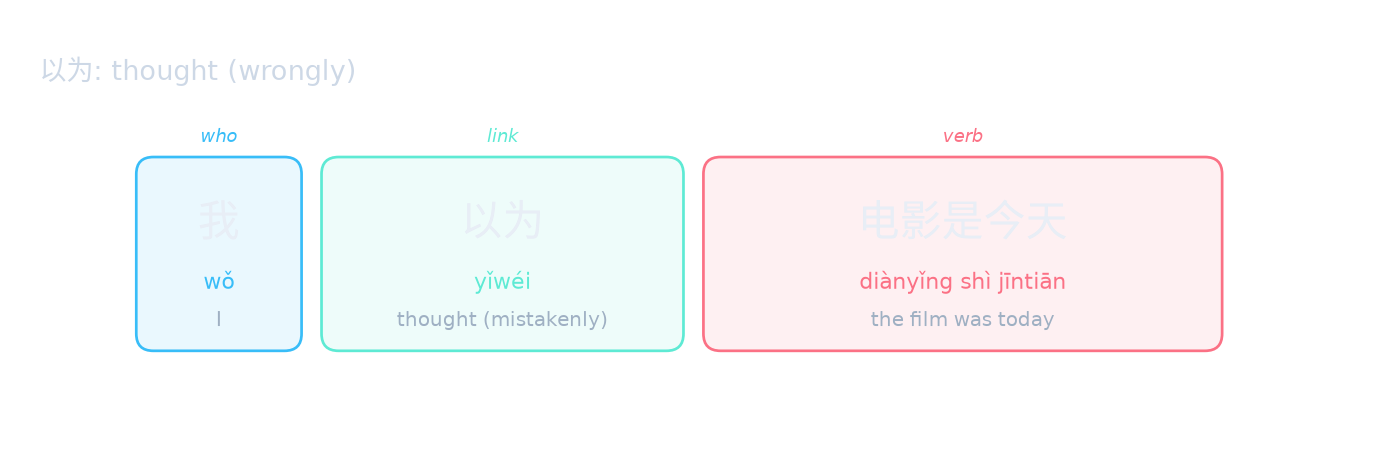
- I / me我to think (i.e. to take it…以为movie电影to be / is是today今天! – "I thought the film was today!" (but I was wrong)
to think (i.e. to take it…以为 = mistakenly think
- to think (i.e. to take it…以为 = "thought (wrongly), assumed": the belief turned out to be false.
- Often a second clause gives the truth: I / me我to think (i.e. to take it…以为he / him他to be / is是China中国person人,original原来he / him他to be / is是Japan日本person人.
I我thought以为he他was是Chinese中国人。
The belief and the truth
- I / me我to think (i.e. to take it…以为you你already已经to walk走(completed / change)了,didn't expect没想到you你still / also还at / in在。 – "I thought you'd already left – I didn't expect you'd still be here."
- With still / also还 for emphasis: I / me我still / also还to think (i.e. to take it…以为you你not不to come来(completed / change)了 – "And here I was thinking you weren't coming."
I我(even)还thought以为you你not不come来了。
to think (i.e. to take it…以为 versus to think / believe认为
- For a considered opinion, use to think / believe认为: I / me我to think / believe认为this这个means办法degree / adjective linker很good好 – "I think this method is good." to think (i.e. to take it…以为 suggests the belief was wrong.
- Do not use to think (i.e. to take it…以为 for a correct belief that you are stating as fact.
to think (i.e. to take it…以为 versus to feel / think觉得
- to feel / think觉得 = feel, think (neutral, everyday): I / me我to feel / think觉得slightly有点儿cold冷.
- to think (i.e. to take it…以为 usually comes with the realisation that it wasn't so.
I我think认为this这个method办法very很good好。
Recap
- to think (i.e. to take it…以为 = thought (wrongly), assumed; often followed by the truth (original原来 / didn't expect没想到).
- Opinion = to think / believe认为; feeling or everyday "think" = to feel / think觉得.
Practise this pattern step by step.
to pass through通过 (through / by means of)
How did you find the job?
- A friend asks how you got your new job so quickly.
- I / me我to be / is是to pass through通过friend朋友to introduce (sb to sb)介绍to find找到这份to work工作(modifier / structural particle)的。 – "I found this job through a friend's introduction."
to pass through通过 + means,result
- to pass through通过 + means / channel = "through, by means of": how a result is reached.
- It goes before the verb or at the start: to pass through通过这次to exercise活动,everyone大家each other互相to understand了解(completed / change)了.
through通过this这次event活动,everyone大家each other互相got to know了解了。

to pass through通过 the verb: pass
- As a verb, to pass through通过 = pass (an exam, a test, a vote): he / him他to pass through通过(completed / change)了to take an exam考试。 – "He passed the exam."
- Also "go through" a place: car or other vehicle…车子to pass through通过(completed / change)了Da Qiao, one of the Two…大桥 – "The car crossed the bridge."
he他passed通过了the exam考试。
Keep a subject in the result
- A sentence starting with to pass through通过… still needs a subject in the result: to pass through通过to learn学习,I / me我progress进步(completed / change)了, not to pass through通过to learn学习,to make使I / me我progress进步(completed / change)了.
- That missing-subject error is a classic exam trap; check for a subject after the comma.
to pass through通过 versus to pass经过
- to pass through通过 stresses the means: to pass through通过network (computing…网络to buy tickets买票 – "buy tickets online".
- to pass经过 stresses a process gone through: to pass经过三年(modifier / structural particle)的to make an effort努力 – "after three years of effort".
after经过three years三年的effort努力,he他succeeded成功了。
Recap
- to pass through通过 + means = through, by means of; as a verb, to pass through通过 = pass.
- Keep a subject in the result clause. to pass经过 = after going through a process.
Practise this pattern step by step.
to come from (a place)来自 (come from)
Where are they from?
- Your summer camp has students from all over the world.
- these这些student学生to come from (a place)来自十多个country国家。 – "These students come from more than ten countries."
Subject + to come from (a place)来自 + place
- to come from (a place)来自 = "come from", a formal alternative to from从…to come来: he / him他to come from (a place)来自Shanghai municipality…上海 = he / him他是从Shanghai municipality…上海to come来(modifier / structural particle)的.
- The place follows directly, with no from从.
he他comes from来自Shanghai上海。

Sources, not just places
- this这个news消息to come from (a place)来自the whole family一家newspaper报纸。 – "This news comes from a newspaper."
- he / him他(modifier / structural particle)的pressure压力main主要to come from (a place)来自to work工作。 – "His stress comes mainly from work."
his他的stress压力mainly主要comes from来自work工作。
No from从, no to come来 at the end
- Say to come from (a place)来自China中国, not to come from (a place)来自from从China中国 or to come from (a place)来自China中国to come来.
- to come from (a place)来自 is formal; in conversation, I / me我是从China中国to come来(modifier / structural particle)的 or I / me我to be / is是China中国person人 is more natural.
to come from (a place)来自 versus from从…to come来
- Written / introduction: she / her她to come from (a place)来自Peking University北京大学 – "She is from Peking University."
- Spoken: she / her她是从Beijing, capital of the…北京to come来(modifier / structural particle)的 – "She came from Beijing."
she她(it was)是from从Beijing北京came来的。
Recap
- to come from (a place)来自 + place / source = come from (formal); no from从 before the place.
- Spoken equivalent: 是从…to come来(modifier / structural particle)的.
Practise this pattern step by step.
to come来 as a dummy verb (I'll do it)
Let me do it
- Your grandmother is struggling with a heavy box. You step in.
- 我来(suggestion)吧! – "Let me do it!" to come来 stands in for the real action.
to come来 as a stand-in verb
- (I / me我)to come来 + (Verb) = "I'll do it, let me take care of it". to come来 replaces or introduces the action.
- With a verb after it: 我来to introduce (sb to sb)介绍(used after a verb) give it…一下 – "Let me introduce …".
I我(will)来introduce介绍briefly一下。

Ordering and serving
- In a restaurant: to come来一碗beef noodle soup牛肉面。 – "A bowl of beef noodles, please." to come来 = "bring / give me".
- 再来一个! – "One more!" (an encore, another dish).
bring来a bowl of一碗beef noodles牛肉面。
Casual and context-bound
- This to come来 is spoken; the real action must be clear from context (carrying, paying, ordering).
- It does not mean "come" here: 我来(suggestion)吧 is "let me (do it)", not "let me come".
to come来 versus to go去 before a verb
- 我来to make做 = I'll do it (here, I'm taking it on).
- I / me我to go去to buy买 = I'll go and buy it (moving away to do it).
I我go去buy买吧。
Recap
- 我来 (+ Verb) = let me do it; to come来 + item = bring me / I'll have (ordering).
- Spoken; the action is clear from context. to go去 + Verb = go and do it.
Practise this pattern step by step.
Practice without the models
Choose a pattern, cover its teaching examples, and attempt its questions. Use the labels to find feedback in the separate key.
to let / make让 / variant of 叫叫 / to ask请 / to make使 (causative)
1201.1 Complete: “His words moved me deeply.” he / him他if (coming after a…的话…………I / me我degree / adjective linker很to move (sb)感动。
1201.2 You invite your professor to give a talk. Which verb fits? we / us我们want / think / miss想___to rule王professor教授to come来to make做to inform报告。
- A. variant of 叫叫
- B. to make使
- C. to ask请
- D. to let / make让
1201.3 Build: “The doctor won't let him drink.”
Arrange all chunks: doctor医生 / to drink (alcohol)喝酒。 / he / him他 / 不让
1201.4 to make使 is the usual verb for giving permission in conversation.
True or false? Explain or repair the statement.
1201.5 Your manager wants the report by Friday and tells you to inform the team. Close the examples. Say a Mandarin response, then write it in Chinese. Explain briefly in English what the lesson’s pattern adds. Compare with the model, then change one detail and try again.
Write or say your own response before reading the key.
want / will / need要to see看 / (degree marker)得to see看 (it depends on)
1202.1 Complete: “Whether we go depends on the weather.” 去不去…………weather天气。
1202.2 How is (degree marker)得 read in (degree marker)得to see看circumstances情况?
- A. děi
- B. dé
- C. de
- D. dì
1202.3 Build: “Whether your results are good depends on whether you work hard.”
Arrange all chunks: achievement成绩(coll.) all right?好不好 / want / will / need要to see看you你 / to make an effort努力not不to make an effort努力。 / ,
1202.4 to hinge on取决于 is the formal written equivalent of want / will / need要to see看.
True or false? Explain or repair the statement.
1202.5 Your friend asks if the hike is still on for Saturday. Close the examples. Say a Mandarin response, then write it in Chinese. Explain briefly in English what the lesson’s pattern adds. Compare with the model, then change one detail and try again.
Write or say your own response before reading the key.
as if好像 (it seems / as if)
1203.1 Complete: “It seems the shop is closed.” store商店…………to close a door关门(completed / change)了。
1203.2 Which sentence is natural?
- A. he / him他as if好像to fall ill生病(completed / change)了。
- B. as if好像he / him他definitely一定to fall ill生病。
- C. he / him他as if好像definitely一定to fall ill生病(completed / change)了。
- D. he / him他to fall ill生病as if好像(completed / change)了。
1203.3 Build: “Winter here is as warm as spring.”
Arrange all chunks: here这儿(modifier / structural particle)的winter冬天 / as if好像spring (season)春天 / warm暖和。 / same一样
1203.4 I / me我as if好像to appear见(experienced)过he / him他 means “I think I've seen him before.”
True or false? Explain or repair the statement.
1203.5 Your roommate has been quiet all evening and didn't eat dinner. Close the examples. Say a Mandarin response, then write it in Chinese. Explain briefly in English what the lesson’s pattern adds. Compare with the model, then change one detail and try again.
Write or say your own response before reading the key.
to rest with在于 (lies in / consists in)
1204.1 Complete: “The problem lies in a lack of money.” question问题…………coin钱not enough不够。
1204.2 Which sentence is correct?
- A. I / me我(modifier / structural particle)的home家to rest with在于Shanghai municipality…上海。
- B. he / him他to rest with在于school学校to learn学习。
- C. to rest with在于he / him他to be / is是teacher老师。
- D. success成功(modifier / structural particle)的关键在于to make an effort努力。
1204.3 Build: “The difference lies in speed.”
Arrange all chunks: to rest with在于 / speed速度。 / difference区别
1204.4 crucial point关键to be / is是to persevere with坚持 and 关键在于to persevere with坚持 have similar meanings.
True or false? Explain or repair the statement.
1204.5 In an interview, a famous athlete is asked why she keeps winning. Close the examples. Say a Mandarin response, then write it in Chinese. Explain briefly in English what the lesson’s pattern adds. Compare with the model, then change one detail and try again.
Write or say your own response before reading the key.
to think (i.e. to take it…以为 (mistakenly think)
1205.1 Complete: “I thought you were a teacher (but you're not).” I / me我…………you你to be / is是teacher老师。
1205.2 In a debate: “I think this plan is reasonable.” Which verb fits?
- A. original原来
- B. to think / believe认为
- C. to think (i.e. to take it…以为
- D. as if好像
1205.3 Build: “I thought you'd already left.”
Arrange all chunks: you你 / already已经 / I / me我to think (i.e. to take it…以为 / to walk走(completed / change)了。
1205.4 I / me我still / also还to think (i.e. to take it…以为you你not不to come来(completed / change)了 suggests the speaker was wrong.
True or false? Explain or repair the statement.
1205.5 You arrive at the cinema and the staff tell you your film was yesterday. Close the examples. Say a Mandarin response, then write it in Chinese. Explain briefly in English what the lesson’s pattern adds. Compare with the model, then change one detail and try again.
Write or say your own response before reading the key.
to pass through通过 (through / by means of)
1206.1 Complete: “Through this event, everyone got to know each other.” …………这次to exercise活动,everyone大家each other互相to understand了解(completed / change)了。
1206.2 Which sentence is correct?
- A. to pass through通过to learn学习,to make使I / me我progress进步(completed / change)了很多。
- B. I / me我to pass through通过to learn学习to make使progress进步(completed / change)了。
- C. to pass through通过to learn学习,progress进步(completed / change)了很多to make使I / me我。
- D. to pass through通过to learn学习,I / me我progress进步(completed / change)了很多。
1206.3 Build: “He passed the exam.”
Arrange all chunks: to take an exam考试。 / to pass through通过(completed / change)了 / he / him他
1206.4 to pass经过 stresses a process; to pass through通过 stresses the means.
True or false? Explain or repair the statement.
1206.5 A friend asks how you got your new job so quickly. Close the examples. Say a Mandarin response, then write it in Chinese. Explain briefly in English what the lesson’s pattern adds. Compare with the model, then change one detail and try again.
Write or say your own response before reading the key.
to come from (a place)来自 (come from)
1207.1 Complete (formal introduction): “She comes from Canada.” she / her她…………Canada加拿大。
1207.2 Which is correct?
- A. he / him他from从to come from (a place)来自United Kingdom 联合王国英国。
- B. he / him他to come from (a place)来自United Kingdom 联合王国英国to come来。
- C. he / him他to come from (a place)来自from从United Kingdom 联合王国英国。
- D. he / him他to come from (a place)来自United Kingdom 联合王国英国。
1207.3 Build: “His stress comes mainly from work.”
Arrange all chunks: to come from (a place)来自 / main主要 / to work工作。 / he / him他(modifier / structural particle)的pressure压力
1207.4 to come from (a place)来自 sounds more formal than 是从…to come来(modifier / structural particle)的.
True or false? Explain or repair the statement.
1207.5 Your summer camp has students from all over the world. Close the examples. Say a Mandarin response, then write it in Chinese. Explain briefly in English what the lesson’s pattern adds. Compare with the model, then change one detail and try again.
Write or say your own response before reading the key.
to come来 as a dummy verb (I'll do it)
1208.1 Offer to pay: “Let me pay!” I / me我…………to pay money付钱!
1208.2 In a restaurant, what does to come来两瓶beer (loanword)啤酒 mean?
- A. Two bottles of beer are coming.
- B. Two bottles of beer, please.
- C. Beer comes in two bottles.
- D. Come and drink two beers.
1208.3 Build: “Let me introduce (him/her) briefly.”
Arrange all chunks: to come来 / to introduce (sb to sb)介绍 / I / me我 / (used after a verb) give it…一下。
1208.4 我来(suggestion)吧 here means “let me come”.
True or false? Explain or repair the statement.
1208.5 Your grandmother is struggling with a heavy box. You step in. Close the examples. Say a Mandarin response, then write it in Chinese. Explain briefly in English what the lesson’s pattern adds. Compare with the model, then change one detail and try again.
Write or say your own response before reading the key.
A fresh situation
R1. Interpret and repair. A notice reads to pass through通过这次to exercise活动,to make使student学生more更to have confidence in…自信(completed / change)了. Give two repairs that supply a complete main clause.
R2. Use it yourself. Say a choice depends on the weather and distinguish that uncertainty from a mistaken belief.
Write your responses before opening the key. Compare meaning as well as form; a different valid answer need not copy the model.
Open the answers after your attempt
Answers and explanations
Check after your attempt. For open tasks, compare the message and the stated criteria, then revise one detail.
to let / make让 / variant of 叫叫 / to ask请 / to make使 (causative)
1201.1 to let / make让
to let / make让/to make使 + person + feeling.
1201.2 C. to ask请
to ask请 is the polite invitation.
1201.3 doctor医生不让he / him他to drink (alcohol)喝酒。
A + 不让 + B + verb.
1201.4 False.
Permission is to let / make让; to make使 is formal and causes a change.
1201.5 One possible response: manager经理to let / make让I / me我to notify通知everyone大家Friday星期五to hand over交to inform报告。
Check meaning and form:
- My response conveys a message that fits the opening situation.
- I can explain the meaning of the pattern, rather than only naming it.
- to ask请 is for polite invitations; to your teacher, to ask请you (polite)您… sounds right, variant of 叫叫you (polite)您… sounds rude.
- to make使 needs a cause and a change of state, usually in writing; do not use it for permission: mama妈妈to let / make让I / me我to go去, not mama妈妈to make使I / me我to go去.
- I tried a second response with a name, time, place, or description changed.
This is supported productive practice. Compare meaning and structure; your answer need not copy the model. A partner or teacher must hear the spoken response to comment on pronunciation.
want / will / need要to see看 / (degree marker)得to see看 (it depends on)
1202.1 want / will / need要to see看
Undecided matter + want / will / need要to see看 + factor.
1202.2 A. děi
Here (degree marker)得 means “must, have to” and is read děi: (degree marker)得to see看circumstances情况 “It depends on the situation.” As a particle after a verb it is de; dé means “obtain”.
1202.3 achievement成绩(coll.) all right?好不好,want / will / need要to see看you你to make an effort努力not不to make an effort努力。
Undecided matter + want / will / need要to see看 + factor.
1202.4 True.
outcome结果to hinge on取决于… = the result depends on ….
1202.5 One possible response: 去不去want / will / need要to see看weather天气。
Check meaning and form:
- My response conveys a message that fits the opening situation.
- I can explain the meaning of the pattern, rather than only naming it.
- Put the undecided matter first, then want / will / need要to see看 + factor: 去不去want / will / need要to see看weather天气, not want / will / need要to see看weather天气去不去 in most speech.
- In (degree marker)得to see看, (degree marker)得 is read děi ("must"), not de.
- I tried a second response with a name, time, place, or description changed.
This is supported productive practice. Compare meaning and structure; your answer need not copy the model. A partner or teacher must hear the spoken response to comment on pronunciation.
as if好像 (it seems / as if)
1203.1 as if好像
as if好像 + guess.
1203.2 A. he / him他as if好像to fall ill生病(completed / change)了。
as if好像 is tentative and does not combine with definitely一定.
1203.3 here这儿(modifier / structural particle)的winter冬天as if好像spring (season)春天same一样warm暖和。
A + as if好像 + B + same一样 + Adj.
1203.4 True.
as if好像 softens the memory into a guess.
1203.5 One possible response: he / him他as if好像not不太高兴。
Check meaning and form:
- My response conveys a message that fits the opening situation.
- I can explain the meaning of the pattern, rather than only naming it.
- as if好像 softens what you say; do not pair it with definitely一定 (certainly): he / him他as if好像illness病(completed / change)了, not he / him他as if好像definitely一定illness病(completed / change)了.
- For a looks-based impression, seemingly看起来 is also possible: he / him他seemingly看起来很累.
- I tried a second response with a name, time, place, or description changed.
This is supported productive practice. Compare meaning and structure; your answer need not copy the model. A partner or teacher must hear the spoken response to comment on pronunciation.
to rest with在于 (lies in / consists in)
1204.1 to rest with在于
Abstract subject + to rest with在于 + where it lies.
1204.2 D. success成功(modifier / structural particle)的关键在于to make an effort努力。
success成功(modifier / structural particle)的关键在于to make an effort努力 is right: to rest with在于 means "lies in" and links an abstract subject (crucial point关键, question问题) to its cause. It does not mean "is in" a place, so it cannot replace at / in在.
1204.3 difference区别to rest with在于speed速度。
A + to rest with在于 + B.
1204.4 True.
to rest with在于 stresses that the point lies there; to be / is是 states it.
1204.5 One possible response: success成功(modifier / structural particle)的关键在于to persevere with坚持。
Check meaning and form:
- My response conveys a message that fits the opening situation.
- I can explain the meaning of the pattern, rather than only naming it.
- to rest with在于 needs an abstract subject (key, problem, difference); not he / him他to rest with在于Beijing, capital of the…北京 for "he is in Beijing".
- It is formal; in speech, main主要to be / is是… often replaces it: question问题main主要to be / is是(concept of) time时间not enough不够.
- I tried a second response with a name, time, place, or description changed.
This is supported productive practice. Compare meaning and structure; your answer need not copy the model. A partner or teacher must hear the spoken response to comment on pronunciation.
to think (i.e. to take it…以为 (mistakenly think)
1205.1 to think (i.e. to take it…以为
to think (i.e. to take it…以为 marks a mistaken belief.
1205.2 B. to think / believe认为
A considered opinion takes to think / believe认为; to think (i.e. to take it…以为 suggests a mistake.
1205.3 I / me我to think (i.e. to take it…以为you你already已经to walk走(completed / change)了。
to think (i.e. to take it…以为 + mistaken belief.
1205.4 True.
The person did come; the belief was mistaken.
1205.5 One possible response: I / me我to think (i.e. to take it…以为movie电影to be / is是today今天!
Check meaning and form:
- My response conveys a message that fits the opening situation.
- I can explain the meaning of the pattern, rather than only naming it.
- For a considered opinion, use to think / believe认为: I / me我to think / believe认为this这个means办法degree / adjective linker很good好 – "I think this method is good." to think (i.e. to take it…以为 suggests the belief was wrong.
- Do not use to think (i.e. to take it…以为 for a correct belief that you are stating as fact.
- I tried a second response with a name, time, place, or description changed.
This is supported productive practice. Compare meaning and structure; your answer need not copy the model. A partner or teacher must hear the spoken response to comment on pronunciation.
to pass through通过 (through / by means of)
1206.1 to pass through通过
to pass through通过 + means, then the result.
1206.2 D. to pass through通过to learn学习,I / me我progress进步(completed / change)了很多。
The result clause needs its own subject; to pass through通过…,to make使… has none.
1206.3 he / him他to pass through通过(completed / change)了to take an exam考试。
to pass through通过 as a verb = pass.
1206.4 True.
That is the key difference.
1206.5 One possible response: I / me我to be / is是to pass through通过friend朋友to introduce (sb to sb)介绍to find找到这份to work工作(modifier / structural particle)的。
Check meaning and form:
- My response conveys a message that fits the opening situation.
- I can explain the meaning of the pattern, rather than only naming it.
- A sentence starting with to pass through通过… still needs a subject in the result: to pass through通过to learn学习,I / me我progress进步(completed / change)了, not to pass through通过to learn学习,to make使I / me我progress进步(completed / change)了.
- That missing-subject error is a classic exam trap; check for a subject after the comma.
- I tried a second response with a name, time, place, or description changed.
This is supported productive practice. Compare meaning and structure; your answer need not copy the model. A partner or teacher must hear the spoken response to comment on pronunciation.
to come from (a place)来自 (come from)
1207.1 to come from (a place)来自
to come from (a place)来自 + place.
1207.2 D. he / him他to come from (a place)来自United Kingdom 联合王国英国。
to come from (a place)来自 takes the place directly.
1207.3 he / him他(modifier / structural particle)的pressure压力main主要to come from (a place)来自to work工作。
Subject + main主要 + to come from (a place)来自 + source.
1207.4 True.
to come from (a place)来自 suits introductions and writing.
1207.5 One possible response: these这些student学生to come from (a place)来自十多个country国家。
Check meaning and form:
- My response conveys a message that fits the opening situation.
- I can explain the meaning of the pattern, rather than only naming it.
- Say to come from (a place)来自China中国, not to come from (a place)来自from从China中国 or to come from (a place)来自China中国to come来.
- to come from (a place)来自 is formal; in conversation, I / me我是从China中国to come来(modifier / structural particle)的 or I / me我to be / is是China中国person人 is more natural.
- I tried a second response with a name, time, place, or description changed.
This is supported productive practice. Compare meaning and structure; your answer need not copy the model. A partner or teacher must hear the spoken response to comment on pronunciation.
to come来 as a dummy verb (I'll do it)
1208.1 to come来
我来 + verb = let me do it.
1208.2 B. Two bottles of beer, please.
to come来 + item = bring me / I'll have.
1208.3 我来to introduce (sb to sb)介绍(used after a verb) give it…一下。
我来 + verb + (used after a verb) give it…一下.
1208.4 False.
It means “let me (do it)”.
1208.5 One possible response: 我来(suggestion)吧!
Check meaning and form:
- My response conveys a message that fits the opening situation.
- I can explain the meaning of the pattern, rather than only naming it.
- This to come来 is spoken; the real action must be clear from context (carrying, paying, ordering).
- It does not mean "come" here: 我来(suggestion)吧 is "let me (do it)", not "let me come".
- I tried a second response with a name, time, place, or description changed.
This is supported productive practice. Compare meaning and structure; your answer need not copy the model. A partner or teacher must hear the spoken response to comment on pronunciation.
Fresh-situation answers
R1. school学校to pass through通过这次to exercise活动to make使student学生more更to have confidence in…自信(completed / change)了 adds an acting subject. to pass through通过这次to exercise活动,student学生more更to have confidence in…自信(completed / change)了 keeps the means phrase and makes student学生 the main subject. Do not leave both prepositional means and to make使 without a main subject.
R2. One possible response. 去不去want / will / need要to see看weather天气。I / me我to think (i.e. to take it…以为today今天can / will会to rain下雨,outcome结果not have / haven't没有down下。want / will / need要to see看 names the deciding factor; to think (i.e. to take it…以为 introduces the earlier belief that the later clause overturns.
Recall later. Tomorrow, check the main subject in a new sentence starting with to pass through通过.