Chinese course / HSK3 handouts
Particles, nouns & numbers
Printable paper with separate answer pages Step-by-step lessons
Original teaching practice. Read one pattern, cover its model and try the questions before checking the separate answer section. Examples adapted from Chinese Grammar Wiki (AllSet Learning, CC BY-NC-SA) retain the course-reference provenance.
Time / Verb + before以前 (before …)
Before you go to bed
- Your doctor gives you advice about a good night's sleep.
- to go to bed睡觉before以前don't be fooled by the fact…别看cell phone手机。 – "Don't look at your phone before going to bed."
Time / Verb phrase + before以前
- X + before以前 = "before X". Unlike English, before以前 comes after the time or action: 八点before以前, to go to class上课before以前.
- The whole phrase usually comes before the main verb: you你八点before以前to come来(suggestion)吧.
you你eight o'clock八点before以前come来吧。

Deadlines and order
- Friday星期五before以前要交school assignment作业。 – "The homework must be handed in before Friday."
- to have a meal吃饭before以前want / will / need要to wash one's hands洗手。 – "Wash your hands before you eat." front前 alone can replace before以前 in short phrases: 饭前, 睡前.
eat吃饭before以前must要wash hands洗手。
before以前 comes last
- Put before以前 after what it refers to: to go to class上课before以前, not before以前to go to class上课 (which means "in the past, I attended class").
- The before以前 phrase goes before the main verb, not at the end: I / me我十点before以前to return home回家, not I / me我to return home回家十点before以前.
before以前 versus front前
- before以前 works after any time or action: 三天before以前, to go abroad出国before以前.
- front前 is shorter and fixed in some phrases: 三天front前, 睡前, 饭前. Both mean "before" here.
I我three days三天ago前arrived in到Beijing北京。
Recap
- Time / action + before以前 = before …; it follows what it refers to.
- The phrase sits before the main verb. front前 is a shorter form: 三天front前, 睡前.
Practise this pattern step by step.
before以前,… (in the past, …)
How things used to be
- Your grandmother looks at old photos of her village with dirt roads and no cars.
- before以前here这儿not have / haven't没有road路,now现在to have / there is有很多war chariot (archaic)车(completed / change)了。 – "There used to be no road here; now there are lots of cars."
before以前,… = "in the past, …"
- before以前 at the start of the sentence (or after the subject) = "before, in the past", often contrasted with now现在.
- It describes a past habit or state: I / me我before以前to live住at / in在Shanghai municipality…上海 – "I used to live in Shanghai."
I我used to以前live住in在Shanghai上海。

Then and now
- he / him他before以前not不to like喜欢variant of 吃吃hot (spicy)辣(modifier / structural particle)的,now现在degree / adjective linker很to like喜欢。 – "He didn't use to like spicy food; now he loves it."
- The contrast with now现在 is very common; often no (completed / change)了 is needed for a past habit.
he他used to以前not不like喜欢eat吃spicy辣food的。
Which before以前 is it?
- Alone at the front or after the subject, before以前 = "in the past": before以前I / me我improbable不会to prepare a meal做饭.
- After a time or action, it = "before": to go to class上课before以前 – "before class". Check what comes before it.
before以前 versus (verb suffix)过去 and original原来
- (verb suffix)过去 also means "in the past", a little more formal: (verb suffix)过去here这里to be / is是一个小村子。
- original原来 = "originally", stressing that it later changed: he / him他original原来to be / is是teacher老师,afterwards后来at or in the very same...当(completed / change)了author作家。
he他originally原来was是a teacher老师。
Recap
- before以前,… = in the past, used to …; often contrasted with now现在.
- X + before以前 = before X. (verb suffix)过去 = in the past (formal); original原来 = originally.
Practise this pattern step by step.
just now (variant of 刚才)刚才 (a moment ago)
A missed call
- You come back from the shower and see your roommate pointing at your phone.
- just now (variant of 刚才)刚才someone有人to / for / give给you你to make a telephone call打电话(completed / change)了。 – "Someone called you a moment ago."
just now (variant of 刚才)刚才 is a time word
- just now (variant of 刚才)刚才 = "just now, a moment ago". Like yesterday昨天 or today今天, it can stand before or after the subject.
- just now (variant of 刚才)刚才I / me我at / in在to bathe洗澡 / I / me我just now (variant of 刚才)刚才at / in在to bathe洗澡 – "I was in the shower just now."
I我just now刚才(ongoing)在take a shower洗澡。

Actions, states and the negative
- Action: you你just now (variant of 刚才)刚才to go去where哪儿(completed / change)了? – "Where did you go just now?"
- State or negative: just now (variant of 刚才)刚才degree / adjective linker很quiet安静 – "It was quiet a moment ago." just now (variant of 刚才)刚才I / me我not / haven't没to hear听见 – "I didn't hear just now."
you你just now刚才go去where哪儿了?
just now (variant of 刚才)刚才 is only minutes ago
- Use just now (variant of 刚才)刚才 for a moment ago in the same situation; for "recently" over days, use recently最近 or just now刚.
- just now (variant of 刚才)刚才 can go first in the sentence; just now刚 cannot: just now (variant of 刚才)刚才他来(completed / change)了 ✓, just now刚he / him他to come来(completed / change)了 ✗.
just now (variant of 刚才)刚才 versus just now刚
- just now刚 is an adverb before the verb: he / him他just now刚to walk走 – "He has just left."
- just now (variant of 刚才)刚才 is a time word: he / him他just now (variant of 刚才)刚才to walk走(completed / change)了 – "He left a moment ago." Both are common; only just now (variant of 刚才)刚才 works with adjectives and not / haven't没.
he他just刚leave走。
Recap
- just now (variant of 刚才)刚才 = a moment ago; a time word that can start the sentence.
- It works with actions, adjectives and not / haven't没. just now刚 is the adverb "just" before a verb.
Practise this pattern step by step.
Time / Verb + o'clock时 (when …)
When I was little
- You are telling a friend a story from your childhood about learning to swim.
- I / me我small小(modifier / structural particle)的time时候often常常to go去river bank河边swimming游泳。 – "When I was little, I often went swimming by the river."
Time / Verb phrase + o'clock时 ((modifier / structural particle)的time时候)
- X + (modifier / structural particle)的time时候 = "when X". The spoken form is (modifier / structural particle)的time时候; the shorter o'clock时 is more written: 上课时, to rain下雨o'clock时.
- Like before以前, o'clock时 comes after what it refers to.
in class上课when时,please请turn off关your phone手机。

Spoken (modifier / structural particle)的time时候
- I / me我to / arrive到home家(modifier / structural particle)的time时候,he / him他already已经to sleep睡(completed / change)了。 – "When I got home, he was already asleep."
- you你to have time (to do sth)有空(modifier / structural particle)的time时候to / for / give给I / me我to make a telephone call打电话。 – "Call me when you have time."
I我arrive到home家when的时候,he他already已经sleep睡了。
Order and the right word
- o'clock时 / (modifier / structural particle)的time时候 goes after the clause: to rain下雨(modifier / structural particle)的time时候, not time时候to rain下雨.
- In a "when" clause, do not use what什么time时候 (that asks "when?"): I / me我to / arrive到home家(modifier / structural particle)的time时候, not I / me我what什么time时候perfect到家.
o'clock时 versus (modifier / structural particle)的time时候
- Use (modifier / structural particle)的time时候 in conversation: to have a meal吃饭(modifier / structural particle)的time时候don't别to speak说话.
- o'clock时 suits signs, writing and short fixed phrases: to eat a meal用餐o'clock时No smoking请勿吸烟 – "No smoking while dining."
eat吃饭when的时候don't别talk说话。
Recap
- X + (modifier / structural particle)的time时候 / o'clock时 = when X; it follows the clause it belongs to.
- (modifier / structural particle)的time时候 is spoken, o'clock时 is more written. what什么time时候 asks a question; it is not "when" in a statement.
Practise this pattern step by step.
after以后 (after / in the future)
After graduation
- A friend in her final year asks what you plan to do once you finish university.
- 大学毕业after以后,I / me我want / think / miss想to go去abroad国外to work工作。 – "After I graduate, I want to work abroad."
Time / Verb phrase + after以后
- X + after以后 = "after X": to finish class下课after以后, 吃了饭after以后, 三天after以后.
- Like before以前, it follows what it refers to, and the phrase comes before the main verb.
class ends下课after以后,we我们go to去the canteen食堂吧。

after以后 alone: from now on, in the future
- At the start of a sentence, after以后 = "in the future, from now on": after以后I / me我not不to arrive late迟到(completed / change)了。 – "I won't be late again from now on."
- after以后 here refers to time after now, not after a past event.
from now on以后I我not不be late迟到了。
After what?
- Put after以后 after the event: to have a meal吃饭after以后, not after以后to have a meal吃饭 (which would mean "eat in the future").
- For the next step in a past story, prefer afterwards后来 or then / after然后, not a bare after以后: I / me我early先to go去(completed / change)了bank银行,then / after然后to go去(completed / change)了supermarket (abbr. for 超级市场)超市.
after以后 versus back后
- back后 is the shorter form in fixed phrases: 饭后, 三天back后, graduation毕业back后.
- after以后 is more common in speech and after longer clauses: you你to / arrive到(completed / change)了after以后to / for / give给I / me我to make a telephone call打电话。
you你arrive到了after以后to给me我make打a call电话。
Recap
- X + after以后 = after X; after以后,… alone = in the future, from now on.
- For "and then" in a past story, use then / after然后 or afterwards后来.
Practise this pattern step by step.
… ,afterwards后来 … (afterwards / later – past)
How the story ended
- You are telling a friend about a classmate who moved to Shenzhen two years ago.
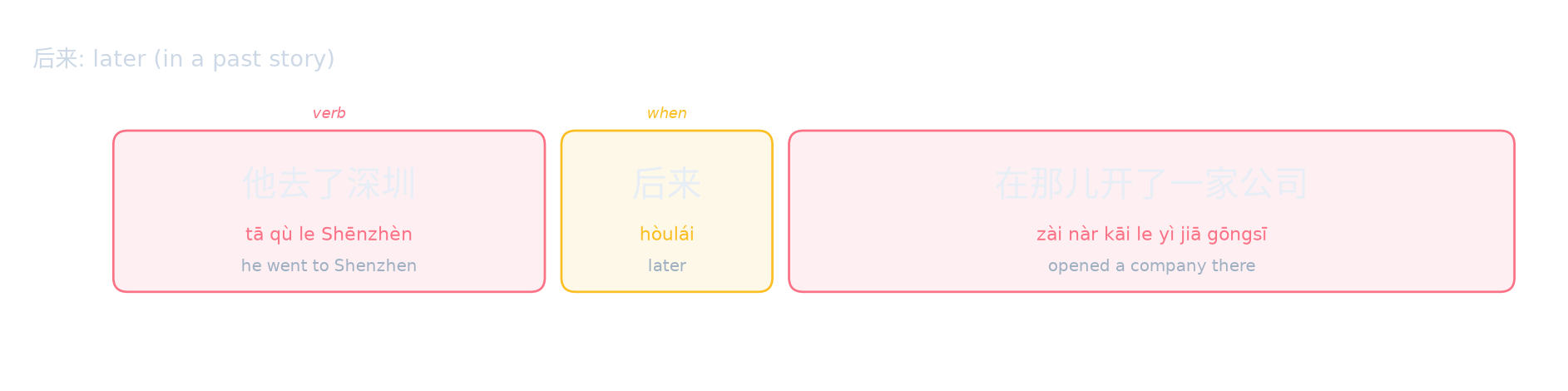
- he / him他to go去(completed / change)了Shenzhen subprovincial city…深圳,afterwards后来at / in在there那儿to open (transitive or…开(completed / change)了the whole family一家company公司。 – "He went to Shenzhen, and later he started a company there."
…,afterwards后来 … (afterwards, later on)
- afterwards后来 = "afterwards, later on", for what happened next in a past story.
- It starts the second clause, after a comma: we / us我们先是to study at the same school同学,afterwards后来to succeed成(completed / change)了good好friend朋友.
we我们first先were是classmates同学,later后来became成了good friends好朋友。
Asking what happened next
- afterwards后来(and …? / softener)呢? – "And then what happened?" A natural way to keep a story going.
- afterwards后来how about怎么样(completed / change)了? – "How did it turn out in the end?"
later后来how怎么样了?
Past stories only
- afterwards后来 is only for the past. For "later" in a plan, use after以后 or then / after然后: we / us我们after以后to say again再说.
- It stands alone as a time word; it is not added after an event: graduation毕业after以后, not graduation毕业afterwards后来.
afterwards后来 versus then / after然后
- then / after然后 links steps closely, one after another, in the past or future: early先to wash one's hands洗手,then / after然后to have a meal吃饭。
- afterwards后来 jumps forward in a story, often with a gap of time: he / him他in one's childhood小时候很瘦,afterwards后来长胖(completed / change)了。
he他as a child小时候very很thin瘦,later后来grow长fat胖了。
Recap
- …,afterwards后来 … = afterwards, later on, in a past story; afterwards后来(and …? / softener)呢? = And then?
- Not for plans (use after以后 / then / after然后), not after an event (graduation毕业after以后).
Practise this pattern step by step.
Approximating with sequential numbers
About how many?
- Your teacher asks how many people came to the club meeting. You did not count exactly.
- to come来(completed / change)了七八个person人。 – "Seven or eight people came."
Two neighbouring numbers
- Two numbers side by side = "about, roughly": 三四个, 五六天, 七八个person人. The measure word follows both.
- Use numbers that are next to each other, smaller first.
I我go去了three or four三四times次。

how many / a few几 and many多 for "-something" and "over"
- more than ten十几 / 几十: 十几个 = "a dozen or so (11–19)", 几十个 = "dozens".
- Number + many多: 二十多个person人 = "twenty-odd people", 一百多块 = "a hundred and something yuan".
this这(measure word)件clothes衣服a hundred一百and more多yuan块。
Where the measure word goes
- The measure word comes after both numbers: 三四个person人, not 三个四个person人.
- With many多 and round tens, many多 goes before the measure word: 二十多个, not 二十个many多 (for amounts under ten, many多 follows the measure word: 三个many多hour小时).
left and right左右 and about the same差不多
- left and right左右 after a number = "around": 三十岁left and right左右 – "around thirty years old".
- about the same差不多 before a number = "about, nearly": about the same差不多五十个person人.
he他thirty三十years old岁around左右。
Recap
- Neighbouring numbers (三四个, 七八天) = about; more than ten十几 = 11–19; 几十 = dozens; over 20二十多 = twenty-odd.
- The measure word follows; left and right左右 after or about the same差不多 before a number also mean "about".
Practise this pattern step by step.
Big numbers: ten thousand万 / 100 million亿
How many people live there?
- You read that the city of Chongqing has about thirty million people and wonder how to say it.
- Chongqing city (Chungking)…重庆to have / there is有三千多万person人。 – "Chongqing has over thirty million people."
Count in ten thousand万 (ten thousand)
- ten thousand万 = 10,000. Chinese groups big numbers in fours: 一万 (10,000), hundred thousand十万 (100,000), 一百万 (1,000,000), 一千万 (10,000,000).
- 两万五千 = 25,000; 三十万 = 300,000.
this这(measure word)辆car车150,000十五万yuan块。

100 million亿 (a hundred million)
- 100 million亿 = 100,000,000: China中国to have / there is有fourteen十四亿人 – "China has 1.4 billion people."
- one billion十亿 = one billion; 一百亿 = ten billion.
China中国has有1.4 billion十四亿people人。
Don't count in thousands
- 100,000 is hundred thousand十万, not one / a一百千: Chinese has no "hundred thousand" unit, so regroup by fours.
- A million is 一百万, not 一万万; 一万万 is an old word for 一亿.
Converting quickly
- Move four places for ten thousand万: 2,000,000 → 200|0000 → 两百万.
- Move eight places for 100 million亿: 300,000,000 → 3|0000|0000 → 三亿.
two million两百万people人。
Recap
- ten thousand万 = 10,000 and 100 million亿 = 100,000,000; group large numbers in fours.
- hundred thousand十万 = 100,000, 一百万 = a million, one billion十亿 = a billion.
Practise this pattern step by step.
Times to the minute (point点 … part分)
When does the train leave?
- You are buying a train ticket and the clerk tells you the departure time.
- train火车八点二十五to separate分开。 – "The train leaves at 8:25."
Number + point点 + Number + part分
- Xpoint点Ypart分 = X:Y. 八点二十五分 = 8:25. In speech part分 is often dropped after ten minutes: 八点二十五.
- For 1–9 minutes, add zero零 (líng): 八点零五分 = 8:05.
now现在is是three o'clock三点zero零five minutes五分。

half半, quarter (hour)刻 and used in 参差差
- half半 = half past: 七点half半 = 7:30. quarter (hour)刻 = quarter: 九点一刻 = 9:15, 九点三刻 = 9:45.
- used in 参差差 = "to": used in 参差差五分十点 = five to ten (9:55).
we我们half past seven七点半meet见面吧。
The time comes before the verb
- Put the clock time before the verb: I / me我七点to get out of bed起床, not I / me我to get out of bed起床七点.
- Say 两点 for 2:00, not 二点.
Morning, afternoon, evening
- Add the part of the day first: early morning早上六点, afternoon下午三点, evening晚上十点.
- afternoon下午两点一刻 – "2:15 p.m." The larger unit always comes first.
afternoon下午two o'clock两点a quarter一刻。
Recap
- Xpoint点Ypart分; zero零 for 1–9 minutes; half半 = :30, 一刻 = :15, 三刻 = :45; used in 参差差 = to.
- Part of the day first (afternoon下午两点), time before the verb, 两点 not 二点.
Practise this pattern step by step.
Telling the hour (Number + point点)
An early start
- Your new school timetable starts much earlier than you are used to.
- we / us我们early morning早上七点to go to class上课。 – "We start class at seven in the morning."
Number + point点 (o'clock)
- Number + point点 = o'clock: a bit一点, 三点, 十二点. Ask with what time?几点: now现在what time?几点? – "What time is it?"
- 2 o'clock is 两点, never 二点.
now现在what time几点?

Saying when something happens
- you你what time?几点to finish work下班? – "What time do you finish work?" I / me我六点to finish work下班。 – "I finish at six."
- Part of the day goes first: evening晚上九点, noon中午十二点.
I我in the evening晚上nine o'clock九点go to bed睡觉。
Order matters
- The time goes before the verb: I / me我六点to finish work下班, not I / me我to finish work下班六点.
- Use 两点 for 2 o'clock, not 二点.
point点 versus hour小时
- point点 is a point on the clock: 三点 = 3 o'clock.
- hour小时 is a length of time: 三个hour小时 = three hours. I / me我三点to start开始,学了三个hour小时。
I我study学了three三个hours小时。
Recap
- Number + point点 = o'clock; what time?几点 asks the time; 2:00 = 两点.
- Part of the day first, time before the verb; hour小时 measures a length of time.
Practise this pattern step by step.
Verb + (ongoing -ing)着 (ongoing state)
The door is open
- You come home and notice the door open and the lights on.
- 门开(ongoing -ing)着,lamp灯also也bright亮(ongoing -ing)着。 – "The door is open, and the lights are on too." (ongoing -ing)着 describes a state that continues.
Verb + (ongoing -ing)着 = an ongoing state
- Verb + (ongoing -ing)着 describes a state that lasts: 开着 (is open), attire穿着 (is wearing), to sit坐(ongoing -ing)着 (is sitting).
- Negate with not / haven't没: gate门not / haven't没to open (transitive or…开(ongoing -ing)着 – "The door isn't open."
she她wear穿(ongoing)着a一(measure word)件red红top衣服。

Doing one thing while in a state
- Verb1 + (ongoing -ing)着 + Verb2: the first state goes on while the second action happens: he / him他to laugh笑(ongoing -ing)着variant of 说说:"it doesn't matter没关系。" – "He said with a smile, 'It doesn't matter.'"
- we / us我们to sit坐(ongoing -ing)着to chat聊天。 – "We sat and chatted."
he他smile笑(while)着say说:it doesn't matter没关系。
State, not progress
- (ongoing -ing)着 describes a state; for an action in progress, use at / in在: he / him他at / in在to open a door (lit. and…开门 (he is opening the door) vs 门开(ongoing -ing)着 (the door is open).
- Negate with not / haven't没, not not不: lamp灯not / haven't没bright亮(ongoing -ing)着.
(ongoing -ing)着 versus at / in在
- at / in在 + Verb = in the middle of doing: he / him他at / in在穿衣服 – "He's getting dressed."
- Verb + (ongoing -ing)着 = the resulting state: he / him他attire穿着一件白衬衫 – "He's wearing a white shirt."
he他(in progress)在put on穿clothes衣服。
Recap
- Verb + (ongoing -ing)着 = an ongoing state (门开(ongoing -ing)着); V1(ongoing -ing)着 + V2 = do V2 while in state V1.
- at / in在 + Verb = action in progress. Negate (ongoing -ing)着 with not / haven't没.
Practise this pattern step by step.
Sentence-final (completed / change)了 (change of state)
It's started raining
- You were about to go out, but you look out of the window and see rain.
- to rain下雨(completed / change)了! – "It's raining (now)!" The final (completed / change)了 says the situation has changed.
Sentence + (completed / change)了 = something has changed
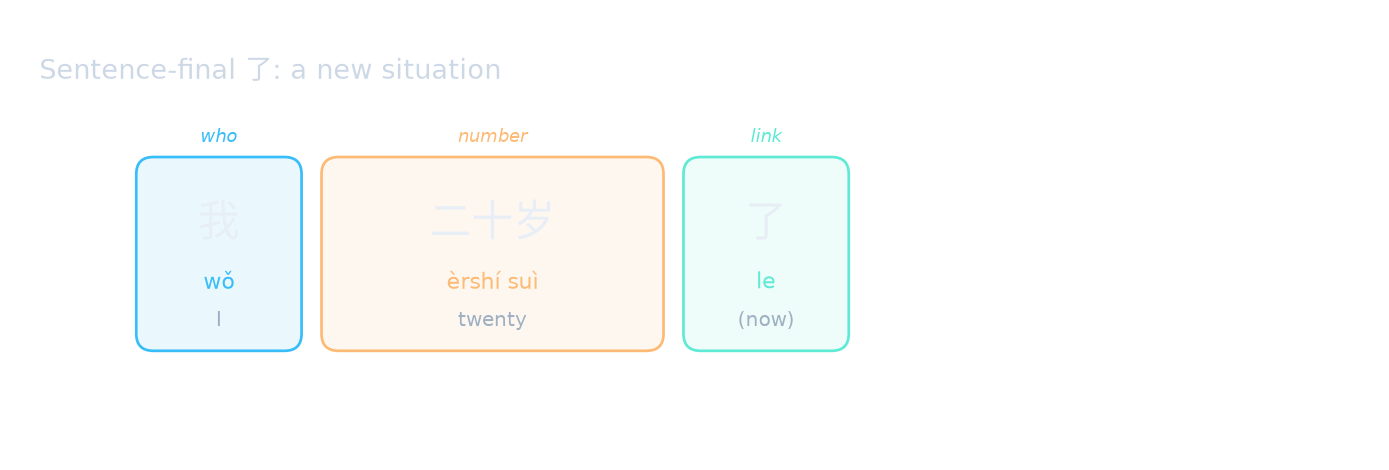
- (completed / change)了 at the end of a sentence announces a new situation: it's cold (weather)天冷(completed / change)了 (it has turned cold), I / me我to be hungry饿(completed / change)了 (I'm hungry now).
- It is not a past tense; it marks a change from before.
the weather天cold冷了。
New facts, new plans, new ages
- I / me我二十岁(completed / change)了。 – "I'm twenty now." he / him他not不to come来(completed / change)了。 – "He's not coming any more."
- With rapid快 or want / will / need要: 快到(completed / change)了。 – "We're almost there."
he他not不come来了。
Not just "past"
- A past habit with no change takes no (completed / change)了: I / me我before以前often常常to go去, not I / me我before以前often常常to go去(completed / change)了.
- not不…(completed / change)了 = no longer: I / me我not不喝咖啡(completed / change)了 means "I've stopped drinking coffee", not "I didn't drink coffee".
Final (completed / change)了 versus verb (completed / change)了
- Verb + (completed / change)了 marks a completed action: I / me我variant of 吃吃(completed / change)了一个apple苹果 – "I ate an apple."
- Final (completed / change)了 marks a change: I / me我not不to be hungry饿(completed / change)了 – "I'm not hungry any more." Some sentences have both.
I我eat吃了an一个apple苹果。
Recap
- Sentence-final (completed / change)了 = a new situation, a change: to rain下雨(completed / change)了, I / me我to be hungry饿(completed / change)了, he / him他not不to come来(completed / change)了.
- not不…(completed / change)了 = no longer; rapid快…(completed / change)了 = soon. It is not a simple past tense.
Practise this pattern step by step.
Questions with (and …? / softener)呢 (and you? / where?)
Meeting a new classmate
- A new classmate tells you she comes from Chengdu, then waits for you to say where you are from.
- I / me我to be / is是Chengdu subprovincial city…成都person人,you你(and …? / softener)呢? – "I'm from Chengdu. And you?"
Noun + (and …? / softener)呢? = "What about …?"
- X + (and …? / softener)呢? asks the same question again about X: I / me我degree / adjective linker很good好,you你(and …? / softener)呢? – "I'm fine, and you?"
- The question is understood from what was just said, so it can be very short.
I我very很well好,you你(and …?)呢?

Where is it? (and …? / softener)呢 on its own
- With no context, Noun + (and …? / softener)呢? asks where something is: I / me我(modifier / structural particle)的key钥匙(and …? / softener)呢? – "Where are my keys?"
- (and …? / softener)呢 also softens a question-word question: you你at / in在what are you doing?干什么(and …? / softener)呢? – "What are you up to?"
my我的keys钥匙(where?)呢?
(and …? / softener)呢 and (yes/no ?)吗 are different
- Do not put (and …? / softener)呢 on a yes-no question: you你to be / is是teacher老师(yes/no ?)吗?, not you你to be / is是teacher老师(and …? / softener)呢?
- Do not add (yes/no ?)吗 to a question-word question: you你to go去where哪儿? or you你to go去where哪儿(and …? / softener)呢?, not you你to go去where哪儿(yes/no ?)吗?
(and …? / softener)呢 for an ongoing action
- At the end of a statement, (and …? / softener)呢 can mark something still going on: he / him他at / in在to go to bed睡觉(and …? / softener)呢。 – "He's sleeping (right now)."
- It often goes with at / in在 or (ongoing -ing)着: outside (also pr. for this…外面下着雨(and …? / softener)呢 – "It's raining out."
he他(in progress)在sleep睡觉呢。
Recap
- X + (and …? / softener)呢? = and X? / what about X?; with no context, where is X?
- Not on yes-no questions (use (yes/no ?)吗). After at / in在 + verb, (and …? / softener)呢 marks an ongoing action.
Practise this pattern step by step.
(modifier / structural particle)的 / (degree marker)得 / (adverb -ly)地 (the three “de”)
Three characters, one sound
- A friend texts you about a classmate who runs fast, but writes the wrong "de" and the sentence looks odd.
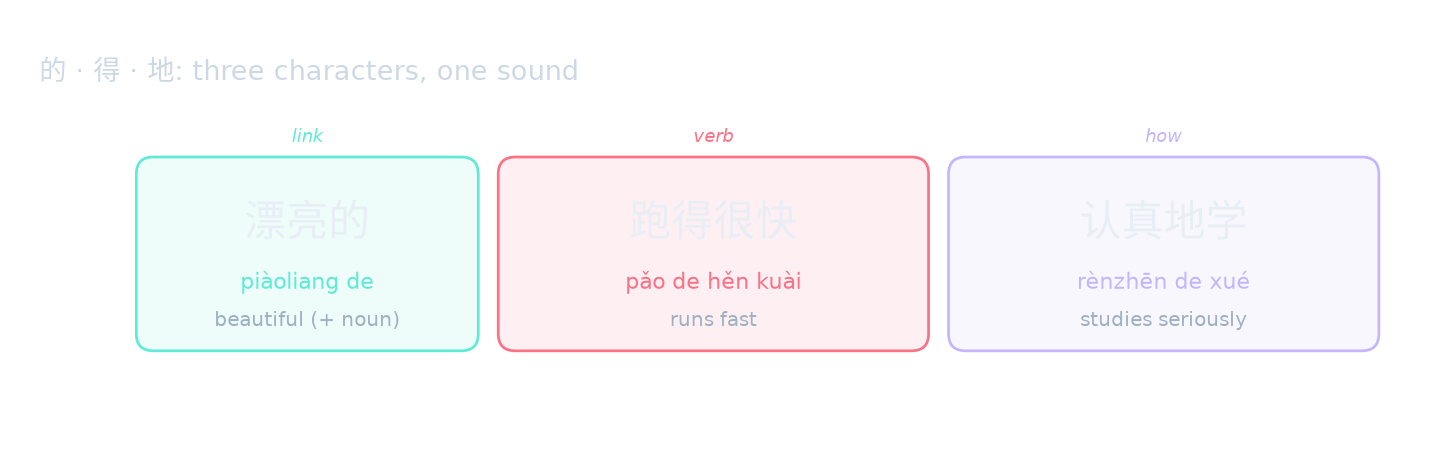
- he / him他to run跑(degree marker)得很快。 – "He runs fast." (modifier / structural particle)的, (degree marker)得 and (adverb -ly)地 are all read de, but each has its own job.
(modifier / structural particle)的 before a noun
- (modifier / structural particle)的 links a description or owner to a noun: I / me我(modifier / structural particle)的book书, pretty漂亮(modifier / structural particle)的clothes衣服, yesterday昨天to buy买(modifier / structural particle)的thing东西.
- Test: is the next word a noun (or is the noun left out)? Then it is (modifier / structural particle)的.
this这is是my我yesterday昨天bought买(that)的book书。
(adverb -ly)地 before a verb, (degree marker)得 after a verb
- (adverb -ly)地 links a manner to the verb that follows: conscientious认真(adverb -ly)地to learn学习, slowly慢慢(adverb -ly)地to walk走.
- (degree marker)得 follows a verb and introduces how well or how much: to run跑(degree marker)得很快, variant of 说说(degree marker)得degree / adjective linker很good好, rope累(degree marker)得unexpectedly不想(of sth) to move动.
she她speaks说得very很fluently流利。
The quick test
- Look at what follows: a noun → (modifier / structural particle)的; a verb → (adverb -ly)地; and after a verb, a description of the result → (degree marker)得.
- Typing tip: in to run跑(degree marker)得很快 the verb to run跑 is before the particle, so it must be (degree marker)得, not (modifier / structural particle)的.
One sentence, two particles
- he / him他happy高兴地说,he / him他考得degree / adjective linker很good好。 – "He said happily that he had done well in the exam."
- I / me我to like喜欢variant of 吃吃mama妈妈to make做(modifier / structural particle)的vegetable菜。 – "I love the food my mum makes." Here the (modifier / structural particle)的 phrase describes vegetable菜.
he他happily高兴地said说,he他test考得very很well好。
Recap
- (modifier / structural particle)的 + noun (I / me我(modifier / structural particle)的book书), (adverb -ly)地 + verb (conscientious认真地学), verb + (degree marker)得 + result (to run跑(degree marker)得很快).
- All are read de; choose by what comes before and after.
Practise this pattern step by step.
to have / there is有(modifier / structural particle)的 (some / some…, others…)
Not everyone agrees
- Your class votes on a trip. Some want the beach, others want the mountains.
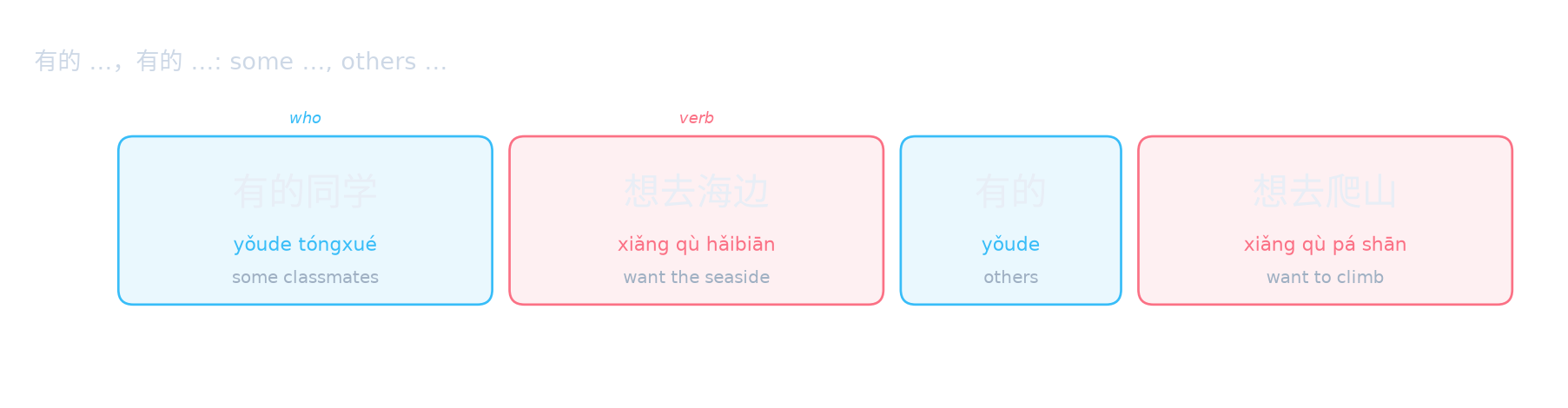
- to have / there is有(modifier / structural particle)的to study at the same school同学want / think / miss想to go去coast海边,to have / there is有(modifier / structural particle)的want / think / miss想to go去to climb a mountain爬山。 – "Some classmates want to go to the beach; others want to go hiking."
to have / there is有(modifier / structural particle)的 + Noun
- to have / there is有(modifier / structural particle)的 + noun = "some (of them)": to have / there is有(modifier / structural particle)的person人, to have / there is有(modifier / structural particle)的book书, to have / there is有(modifier / structural particle)的time时候. It stands before the subject noun.
- Repeat it to contrast groups: to have / there is有(modifier / structural particle)的…,to have / there is有(modifier / structural particle)的….
some有的people人like喜欢drinking喝tea茶。
to have / there is有(modifier / structural particle)的…,to have / there is有(modifier / structural particle)的… and to have / there is有(modifier / structural particle)的time时候
- these这些书有(modifier / structural particle)的degree / adjective linker很interesting有意思,to have / there is有(modifier / structural particle)的degree / adjective linker很bored无聊。 – "Some of these books are interesting; some are boring."
- to have / there is有(modifier / structural particle)的time时候 (often sometimes有时候) = sometimes: I / me我sometimes有时候to walk走路to go to work上班。
I我sometimes有时候walk走路to work上班。
to have / there is有(modifier / structural particle)的 goes before the subject
- Put to have / there is有(modifier / structural particle)的 in subject position: to have / there is有(modifier / structural particle)的person人not不to like喜欢, not I / me我not不to like喜欢to have / there is有(modifier / structural particle)的person人 for "some people don't like it".
- With an object you know, put the topic first: these这些vegetable菜,to have / there is有(modifier / structural particle)的I / me我没吃过 – "Some of these dishes I haven't tried."
to have / there is有(modifier / structural particle)的 versus some一些
- some一些 = "some, a few" and can go in object position: I / me我to buy买(completed / change)了some一些fruit水果.
- to have / there is有(modifier / structural particle)的 picks out part of a group, usually as the subject, often in contrast: to have / there is有(modifier / structural particle)的expensive贵,to have / there is有(modifier / structural particle)的cheap便宜.
I我bought买了some一些fruit水果。
Recap
- to have / there is有(modifier / structural particle)的 + noun = some (of a group), in subject position; to have / there is有(modifier / structural particle)的…,to have / there is有(modifier / structural particle)的… = some…, others….
- sometimes有时候 = sometimes. For "some" as an object, use some一些.
Practise this pattern step by step.
half半 (half / and a half)
Half a cake left
- After the party, your mum looks at the table and counts what is left.
- furthermore还有half of sth半个cake蛋糕and / with和one and a half一个半watermelon西瓜。 – "There's half a cake and one and a half watermelons left."
half半 + measure word (half a …)
- half半 + measure word + noun = half a …: half of sth半个apple苹果, 半杯water水, half a year半年.
- half半 comes before the measure word, with no one / a一 in front.
I我drank喝了half半a glass杯of milk牛奶。

Number + measure word + half半 (… and a half)
- Number + measure word + half半 = … and a half: one and a half一个半hour小时 (an hour and a half), 两年half半 (two and a half years).
- With time: 三点half半 = half past three.
I我waited等了one一个and a half半hours小时。
Where half半 goes
- Half a … : half半 before the measure word (half of sth半个hour小时). … and a half: half半 after it (one and a half一个半hour小时).
- Do not say half一半(measure word)个 or 一个hour小时half半: say half of sth半个 and one and a half一个半hour小时.
half一半 = half of something
- half一半 is a noun: half (of a whole): half一半(modifier / structural particle)的student学生to be / is是schoolgirl女生。 – "Half of the students are girls."
- I / me我only只variant of 吃吃(completed / change)了half一半 – "I only ate half (of it)."
half一半的students学生are是girls女生。
Recap
- half半 + MW = half a …; Number + MW + half半 = … and a half; X点半 = half past X.
- half一半 = half of something, a noun.
Practise this pattern step by step.
after以后 vs then / after然后 vs afterwards后来 (then / after)
Telling your day in order
- You describe last Saturday: shopping, then lunch, and much later a surprise phone call.
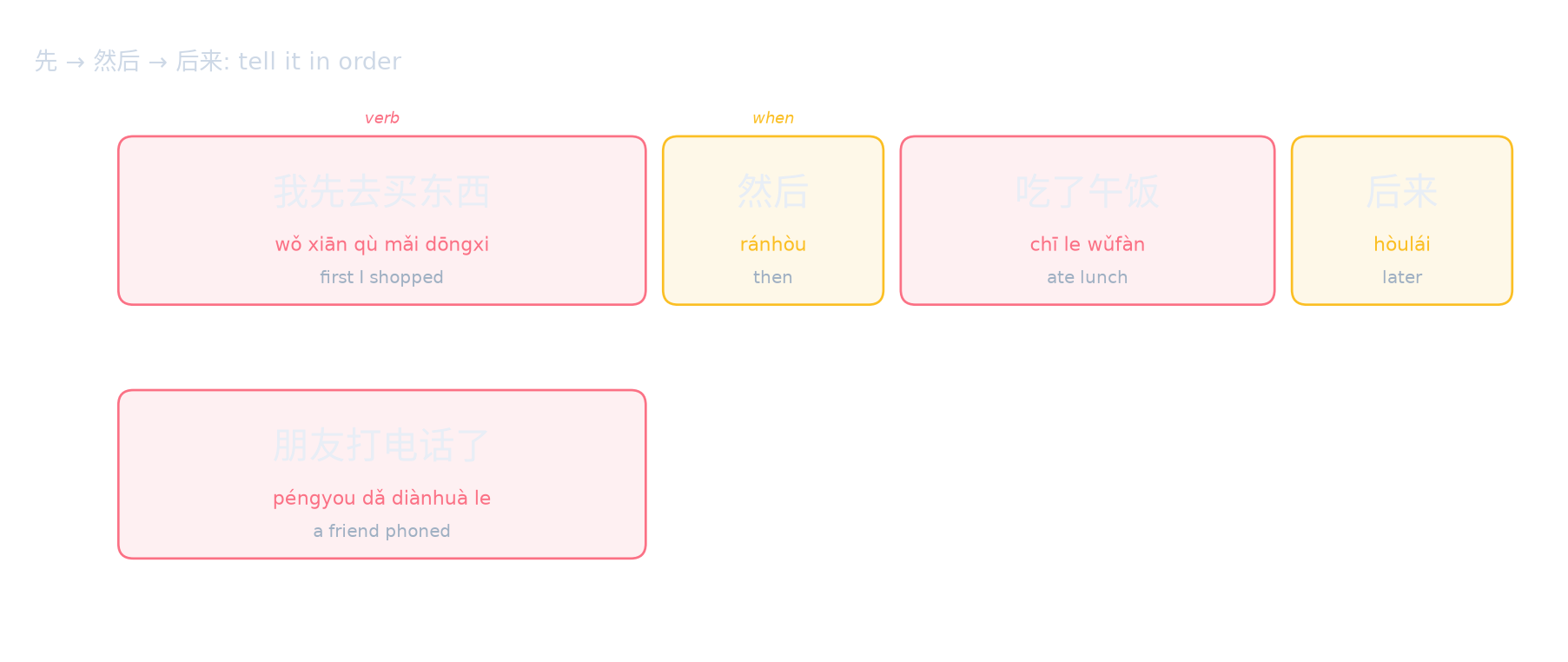
- I / me我early先to go去to buy买thing东西,then / after然后variant of 吃吃(completed / change)了lunch午饭。afterwards后来,I / me我(modifier / structural particle)的old friend老朋友to / for / give给I / me我to make a telephone call打电话(completed / change)了。 – "First I went shopping, then I had lunch. Later on, an old friend phoned me."
Three words for "after"
- after以后 follows an event (to have a meal吃饭after以后) or, alone, means "in the future" (after以后to say again再说).
- then / after然后 links the next step, in the past or future (early先to wash one's hands洗手,then / after然后to have a meal吃饭). afterwards后来 jumps forward in a past story only.
first先wash hands洗手,then然后eat吃饭。
Choosing by the situation
- Plan: we / us我们early先to have a meal吃饭,then / after然后to go去to see看movie电影。 – "Let's eat first, then see a film." (after以后 / then / after然后, not afterwards后来)
- Story: we / us我们to be / is是university大学to study at the same school同学,afterwards后来to marry结婚(completed / change)了。 – "We were classmates at university, and later we got married."
we我们were是university大学classmates同学,later后来marry结婚了。
Two common slips
- afterwards后来 is never for the future: we / us我们after以后to appear见, not we / us我们afterwards后来to appear见.
- afterwards后来 is never added after an event: to finish class下课after以后, not to finish class下课afterwards后来.
after以后 after a clause
- I / me我to / arrive到(completed / change)了after以后to / for / give给you你to make a telephone call打电话。 – "I'll call you after I arrive."
- then / after然后 cannot do this job: it starts the next clause instead: I / me我to / arrive到(completed / change)了,then / after然后to / for / give给you你to make a telephone call打电话。
I我arrive到了after以后to给you你make打a call电话。
Recap
- after以后 = after X / in the future; then / after然后 = and then (next step, any time); afterwards后来 = later on (past stories only).
- Plans use then / after然后 or after以后, never afterwards后来.
Practise this pattern step by step.
Practice without the models
Choose a pattern, cover its teaching examples, and attempt its questions. Use the labels to find feedback in the separate key.
Time / Verb + before以前 (before …)
0501.1 Complete: “Please come back before ten.” to ask请十点…………to return回来。
0501.2 Which says “Turn off the light before you leave.”?
- A. to walk走before以前关灯。
- B. to walk走关灯before以前。
- C. before以前to walk走关灯。
- D. 关灯to walk走before以前。
0501.3 Build: “The homework must be handed in before Friday.”
Arrange all chunks: before以前 / Friday星期五 / school assignment作业。 / 要交
0501.4 三天front前 and 三天before以前 both mean “three days ago”.
True or false? Explain or repair the statement.
0501.5 Your doctor gives you advice about a good night's sleep. Close the examples. Say a Mandarin response, then write it in Chinese. Explain briefly in English what the lesson’s pattern adds. Compare with the model, then change one detail and try again.
Write or say your own response before reading the key.
before以前,… (in the past, …)
0502.1 Complete: “I used to be very shy.” I / me我…………degree / adjective linker很shy害羞。
0502.2 Match each sentence to its meaning.
-
- before以前I / me我not不喝咖啡。
-
- 喝咖啡before以前,I / me我early先variant of 吃吃breakfast早饭。
-
A. Before drinking coffee I eat breakfast.
-
B. I didn't use to drink coffee.
0502.3 Build: “He didn't use to like spicy food.”
Arrange all chunks: not不to like喜欢 / variant of 吃吃hot (spicy)辣(modifier / structural particle)的。 / he / him他 / before以前
0502.4 original原来 stresses that the situation later changed.
True or false? Explain or repair the statement.
0502.5 Your grandmother looks at old photos of her village with dirt roads and no cars. Close the examples. Say a Mandarin response, then write it in Chinese. Explain briefly in English what the lesson’s pattern adds. Compare with the model, then change one detail and try again.
Write or say your own response before reading the key.
just now (variant of 刚才)刚才 (a moment ago)
0503.1 Complete: “It was raining just now; now it has stopped.” …………at / in在to rain下雨,now现在to stop停(completed / change)了。
0503.2 Which sentence is correct?
- A. just now (variant of 刚才)刚才he / him他degree / adjective linker很busy忙。
- B. he / him他degree / adjective linker很刚忙。
- C. he / him他busy忙just now (variant of 刚才)刚才degree / adjective linker很。
- D. just now刚he / him他degree / adjective linker很busy忙。
0503.3 Build: “Where did you go just now?”
Arrange all chunks: to go去where哪儿 / (completed / change)了? / just now (variant of 刚才)刚才 / you你
0503.4 just now (variant of 刚才)刚才 is a good choice for “I moved house recently.”
True or false? Explain or repair the statement.
0503.5 You come back from the shower and see your roommate pointing at your phone. Close the examples. Say a Mandarin response, then write it in Chinese. Explain briefly in English what the lesson’s pattern adds. Compare with the model, then change one detail and try again.
Write or say your own response before reading the key.
Time / Verb + o'clock时 (when …)
0504.1 Complete: “When I got home, he was already asleep.” I / me我to / arrive到home家…………,he / him他already已经to sleep睡(completed / change)了。
0504.2 Which says “Call me when you have time.”?
- A. you你what什么time时候to have time (to do sth)有空to / for / give给I / me我to make a telephone call打电话。
- B. you你to have time (to do sth)有空(modifier / structural particle)的time时候to / for / give给I / me我to make a telephone call打电话。
- C. you你to / for / give给I / me我to make a telephone call打电话to have time (to do sth)有空(modifier / structural particle)的time时候。
- D. time时候you你to have time (to do sth)有空to / for / give给I / me我to make a telephone call打电话。
0504.3 Build: “In class, please turn off your phone.”
Arrange all chunks: 请关 / cell phone手机。 / , / 上课时
0504.4 o'clock时 is more common than (modifier / structural particle)的time时候 in everyday conversation.
True or false? Explain or repair the statement.
0504.5 You are telling a friend a story from your childhood about learning to swim. Close the examples. Say a Mandarin response, then write it in Chinese. Explain briefly in English what the lesson’s pattern adds. Compare with the model, then change one detail and try again.
Write or say your own response before reading the key.
after以后 (after / in the future)
0505.1 Complete: “Call me after you arrive.” you你to / arrive到(completed / change)了…………to / for / give给I / me我to make a telephone call打电话。
0505.2 What does after以后我会早点儿to sleep睡 mean?
- A. I used to go to bed early.
- B. I went to bed early afterwards.
- C. From now on I'll go to bed earlier.
- D. I went to bed after eating.
0505.3 Build: “After I graduate from university, I want to work abroad.”
Arrange all chunks: 大学毕业 / to go去abroad国外to work工作。 / ,I / me我want / think / miss想 / after以后
0505.4 after以后to have a meal吃饭 means “after eating”.
True or false? Explain or repair the statement.
0505.5 A friend in her final year asks what you plan to do once you finish university. Close the examples. Say a Mandarin response, then write it in Chinese. Explain briefly in English what the lesson’s pattern adds. Compare with the model, then change one detail and try again.
Write or say your own response before reading the key.
… ,afterwards后来 … (afterwards / later – past)
0506.1 Complete the story: “At first I didn't like him, but later we became friends.” to start开始I / me我not不to like喜欢he / him他,…………we / us我们to succeed成(completed / change)了friend朋友。
0506.2 Which fits a plan? “Let's eat first, then go shopping.”
- A. we / us我们afterwards后来to have a meal吃饭,early先to go去to buy买thing东西。
- B. we / us我们early先to have a meal吃饭,then / after然后to go去to buy买thing东西。
- C. we / us我们early先to have a meal吃饭,afterwards后来to go去to buy买thing东西。
- D. we / us我们to have a meal吃饭afterwards后来,to go去to buy买thing东西。
0506.3 Ask to continue a story: “And how did it turn out?”
Arrange all chunks: how about怎么样 / afterwards后来 / (completed / change)了?
0506.4 he / him他in one's childhood小时候很瘦,afterwards后来长胖(completed / change)了 describes a change with a gap of time.
True or false? Explain or repair the statement.
0506.5 You are telling a friend about a classmate who moved to Shenzhen two years ago. Close the examples. Say a Mandarin response, then write it in Chinese. Explain briefly in English what the lesson’s pattern adds. Compare with the model, then change one detail and try again.
Write or say your own response before reading the key.
Approximating with sequential numbers
0507.1 Complete: “There are a dozen or so students in the class.” 班里to have / there is有…………(measure word)个student学生。
0507.2 Which says “five or six days”?
- A. 五个六天
- B. six六五天
- C. 五天六天
- D. 五六天
0507.3 Match each phrase to its meaning.
-
- 二十多个
-
- 几十个
-
- 三十岁left and right左右
-
- 七八个
-
A. seven or eight
-
B. twenty-odd
-
C. around thirty years old
-
D. dozens
0507.4 Build: “Seven or eight people came.”
Arrange all chunks: person人。 / to come来(completed / change)了 / (measure word)个 / 七八
0507.5 Your teacher asks how many people came to the club meeting. You did not count exactly. Close the examples. Say a Mandarin response, then write it in Chinese. Explain briefly in English what the lesson’s pattern adds. Compare with the model, then change one detail and try again.
Write or say your own response before reading the key.
Big numbers: ten thousand万 / 100 million亿
0508.1 Write 50,000 in Chinese: …………
0508.2 How do you say 100,000?
- A. 一万
- B. 一百万
- C. hundred thousand十万
- D. one / a一百千
0508.3 Match the numbers.
-
- 一万
-
- 一百万
-
- 一亿
-
- one billion十亿
-
A. 1,000,000,000
-
B. 1,000,000
-
C. 10,000
-
D. 100,000,000
0508.4 一千万 means ten million.
True or false? Explain or repair the statement.
0508.5 You read that the city of Chongqing has about thirty million people and wonder how to say it. Close the examples. Say a Mandarin response, then write it in Chinese. Explain briefly in English what the lesson’s pattern adds. Compare with the model, then change one detail and try again.
Write or say your own response before reading the key.
Times to the minute (point点 … part分)
0509.1 Write 10:30 with half半: 十点…………
0509.2 What time is used in 参差差very十分九点?
- A. 10:09
- B. 8:50
- C. 9:10
- D. 9:50
0509.3 Build: “I get up at a quarter past six.”
Arrange all chunks: early morning早上 / 六点一刻 / I / me我 / to get out of bed起床。
0509.4 8:05 is said 八点五分 with no zero零.
True or false? Explain or repair the statement.
0509.5 You are buying a train ticket and the clerk tells you the departure time. Close the examples. Say a Mandarin response, then write it in Chinese. Explain briefly in English what the lesson’s pattern adds. Compare with the model, then change one detail and try again.
Write or say your own response before reading the key.
Telling the hour (Number + point点)
0510.1 Ask: “What time is it now?” now现在…………point点?
0510.2 How do you say “2 o'clock in the afternoon”?
- A. afternoon下午两点
- B. afternoon下午二点
- C. afternoon下午两个hour小时
- D. 两点afternoon下午
0510.3 Build: “I go to bed at nine in the evening.”
Arrange all chunks: 九点 / evening晚上 / I / me我 / to go to bed睡觉。
0510.4 三点 and 三个hour小时 mean the same.
True or false? Explain or repair the statement.
0510.5 Your new school timetable starts much earlier than you are used to. Close the examples. Say a Mandarin response, then write it in Chinese. Explain briefly in English what the lesson’s pattern adds. Compare with the model, then change one detail and try again.
Write or say your own response before reading the key.
Verb + (ongoing -ing)着 (ongoing state)
0511.1 Complete: “The window is open.” window窗户to open (transitive or…开…………。
0511.2 Which says “He is opening the door” (the action in progress)?
- A. he / him他at / in在to open a door (lit. and…开门。
- B. 他开(ongoing -ing)着gate门(completed / change)了。
- C. gate门at / in在开着。
- D. 门开(ongoing -ing)着。
0511.3 Build: “He said with a smile...”
Arrange all chunks: to laugh笑(ongoing -ing)着 / variant of 说说。 / he / him他
0511.4 The negative of 门开(ongoing -ing)着 is 门不开(ongoing -ing)着.
True or false? Explain or repair the statement.
0511.5 You come home and notice the door open and the lights on. Close the examples. Say a Mandarin response, then write it in Chinese. Explain briefly in English what the lesson’s pattern adds. Compare with the model, then change one detail and try again.
Write or say your own response before reading the key.
Sentence-final (completed / change)了 (change of state)
0512.1 The light turns green: “It's green now, let's go.” green light (traffic signal)绿灯…………,to walk走(suggestion)吧。
0512.2 What does I / me我not不to smoke (a cigarette…抽烟(completed / change)了 mean?
- A. I've quit smoking.
- B. I don't want to smoke.
- C. I'm smoking now.
- D. I didn't smoke.
0512.3 Build: “We're almost there.”
Arrange all chunks: to / arrive到 / rapid快 / we / us我们 / (completed / change)了。
0512.4 I / me我before以前often常常to go去(completed / change)了 is correct for a past habit.
True or false? Explain or repair the statement.
0512.5 You were about to go out, but you look out of the window and see rain. Close the examples. Say a Mandarin response, then write it in Chinese. Explain briefly in English what the lesson’s pattern adds. Compare with the model, then change one detail and try again.
Write or say your own response before reading the key.
Questions with (and …? / softener)呢 (and you? / where?)
0513.1 Complete: “I like tea. What about you?” I / me我to like喜欢to drink tea喝茶,you你…………?
0513.2 Which question is correct?
- A. you你to go去where哪儿(yes/no ?)吗?
- B. you你to be / is是student学生(and …? / softener)呢?
- C. you你to be / is是student学生(yes/no ?)吗(and …? / softener)呢?
- D. you你to be / is是student学生(yes/no ?)吗?
0513.3 Said while searching your bag, I / me我(modifier / structural particle)的cell phone手机(and …? / softener)呢? means “Where's my phone?”
True or false? Explain or repair the statement.
0513.4 Build: “He's sleeping right now.”
Arrange all chunks: (and …? / softener)呢。 / at / in在 / he / him他 / to go to bed睡觉
0513.5 A new classmate tells you she comes from Chengdu, then waits for you to say where you are from. Close the examples. Say a Mandarin response, then write it in Chinese. Explain briefly in English what the lesson’s pattern adds. Compare with the model, then change one detail and try again.
Write or say your own response before reading the key.
(modifier / structural particle)的 / (degree marker)得 / (adverb -ly)地 (the three “de”)
0514.1 Complete: “She sings very well.” she / her她to sing唱…………degree / adjective linker很good好。
0514.2 Fill the gaps: I / me我__friend朋友slowly慢慢__to walk走see 过来过来。
- A. (adverb -ly)地 … (degree marker)得
- B. (degree marker)得 … (modifier / structural particle)的
- C. (modifier / structural particle)的 … (adverb -ly)地
- D. (modifier / structural particle)的 … (degree marker)得
0514.3 Match each phrase to its particle.
-
- pretty漂亮__clothes衣服
-
- conscientious认真__to work工作
-
- to write写__degree / adjective linker很good好
-
A. (degree marker)得
-
B. (adverb -ly)地
-
C. (modifier / structural particle)的
0514.4 In mama妈妈to make做(modifier / structural particle)的vegetable菜, (modifier / structural particle)的 is correct because vegetable菜 is a noun.
True or false? Explain or repair the statement.
0514.5 A friend texts you about a classmate who runs fast, but writes the wrong "de" and the sentence looks odd. Close the examples. Say a Mandarin response, then write it in Chinese. Explain briefly in English what the lesson’s pattern adds. Compare with the model, then change one detail and try again.
Write or say your own response before reading the key.
to have / there is有(modifier / structural particle)的 (some / some…, others…)
0515.1 Complete: “Some students live at school.” …………student学生to live住at / in在school学校。
0515.2 Which says “I bought some apples.”?
- A. I / me我to have / there is有(modifier / structural particle)的to buy买(completed / change)了apple苹果。
- B. I / me我to buy买(completed / change)了some一些apple苹果。
- C. to have / there is有(modifier / structural particle)的I / me我to buy买(completed / change)了apple苹果。
- D. I / me我to buy买(completed / change)了to have / there is有(modifier / structural particle)的apple苹果。
0515.3 Build: “Some of these books are interesting; some are boring.”
Arrange all chunks: to have / there is有(modifier / structural particle)的degree / adjective linker很interesting有意思 / to have / there is有(modifier / structural particle)的degree / adjective linker很bored无聊。 / these这些book书 / ,
0515.4 sometimes有时候 means “sometimes”.
True or false? Explain or repair the statement.
0515.5 Your class votes on a trip. Some want the beach, others want the mountains. Close the examples. Say a Mandarin response, then write it in Chinese. Explain briefly in English what the lesson’s pattern adds. Compare with the model, then change one detail and try again.
Write or say your own response before reading the key.
half半 (half / and a half)
0516.1 Complete: “The film is two and a half hours long.” movie电影to have / there is有两个…………hour小时。
0516.2 Which says “half an hour”?
- A. hour小时half半
- B. 一个hour小时half半
- C. half一半(measure word)个hour小时
- D. half of sth半个hour小时
0516.3 Match each phrase to its meaning.
-
- half a year半年
-
- 一年half半
-
- half一半
-
- 三点half半
-
A. half past three
-
B. half a year
-
C. half (of it)
-
D. a year and a half
0516.4 一个hour小时half半 is the usual way to say “an hour and a half”.
True or false? Explain or repair the statement.
0516.5 After the party, your mum looks at the table and counts what is left. Close the examples. Say a Mandarin response, then write it in Chinese. Explain briefly in English what the lesson’s pattern adds. Compare with the model, then change one detail and try again.
Write or say your own response before reading the key.
after以后 vs then / after然后 vs afterwards后来 (then / after)
0517.1 A recipe: “Wash the vegetables, then cut them.” early先洗菜,…………切菜。
0517.2 Which says “See you later” (in the future)?
- A. we / us我们to appear见afterwards后来。
- B. we / us我们afterwards后来to appear见。
- C. we / us我们then / after然后to appear见after以后。
- D. we / us我们after以后to appear见。
0517.3 Match each word to its use.
-
- after以后
-
- then / after然后
-
- afterwards后来
-
A. the next step
-
B. later on in a past story
-
C. after an event / in the future
0517.4 Build: “I'll call you after I arrive.”
Arrange all chunks: to / arrive到(completed / change)了after以后 / to make a telephone call打电话。 / to / for / give给you你 / I / me我
0517.5 You describe last Saturday: shopping, then lunch, and much later a surprise phone call. Close the examples. Say a Mandarin response, then write it in Chinese. Explain briefly in English what the lesson’s pattern adds. Compare with the model, then change one detail and try again.
Write or say your own response before reading the key.
A fresh situation
R1. Interpret and repair. A learner writes he / him他conscientious认真(degree marker)得to learn学习 but wants to say he studies carefully. Repair the character and give the post-verb alternative.
R2. Use it yourself. Write a message with a precise time and an event that happens after you arrive home.
Write your responses before opening the key. Compare meaning as well as form; a different valid answer need not copy the model.
Open the answers after your attempt
Answers and explanations
Check after your attempt. For open tasks, compare the message and the stated criteria, then revise one detail.
Time / Verb + before以前 (before …)
0501.1 before以前
Time + before以前 = before that time.
0501.2 A. to walk走before以前关灯。
Action + before以前, then the main verb.
0501.3 Friday星期五before以前要交school assignment作业。
Time + before以前 + verb phrase.
0501.4 True.
front前 is a shorter form of before以前 after a time.
0501.5 One possible response: to go to bed睡觉before以前don't be fooled by the fact…别看cell phone手机。
Check meaning and form:
- My response conveys a message that fits the opening situation.
- I can explain the meaning of the pattern, rather than only naming it.
- Put before以前 after what it refers to: to go to class上课before以前, not before以前to go to class上课 (which means "in the past, I attended class").
- The before以前 phrase goes before the main verb, not at the end: I / me我十点before以前to return home回家, not I / me我to return home回家十点before以前.
- I tried a second response with a name, time, place, or description changed.
This is supported productive practice. Compare meaning and structure; your answer need not copy the model. A partner or teacher must hear the spoken response to comment on pronunciation.
before以前,… (in the past, …)
0502.1 before以前
Subject + before以前 + description = used to be.
0502.2 1–B: before以前I / me我not不喝咖啡。 = I didn't use to drink coffee.; 2–A: 喝咖啡before以前,I / me我early先variant of 吃吃breakfast早饭。 = Before drinking coffee I eat breakfast.
Alone, before以前 means “in the past”; after an action it means “before”.
0502.3 he / him他before以前not不to like喜欢variant of 吃吃hot (spicy)辣(modifier / structural particle)的。
Subject + before以前 + verb phrase.
0502.4 True.
original原来 = originally (and then it changed).
0502.5 One possible response: before以前here这儿not have / haven't没有road路,now现在to have / there is有很多war chariot (archaic)车(completed / change)了。
Check meaning and form:
- My response conveys a message that fits the opening situation.
- I can explain the meaning of the pattern, rather than only naming it.
- Alone at the front or after the subject, before以前 = "in the past": before以前I / me我improbable不会to prepare a meal做饭.
- After a time or action, it = "before": to go to class上课before以前 – "before class". Check what comes before it.
- I tried a second response with a name, time, place, or description changed.
This is supported productive practice. Compare meaning and structure; your answer need not copy the model. A partner or teacher must hear the spoken response to comment on pronunciation.
just now (variant of 刚才)刚才 (a moment ago)
0503.1 just now (variant of 刚才)刚才
just now (variant of 刚才)刚才 is a time word that can start the sentence.
0503.2 A. just now (variant of 刚才)刚才he / him他degree / adjective linker很busy忙。
just now (variant of 刚才)刚才 can describe a state a moment ago; just now刚 cannot go before an adjective.
0503.3 you你just now (variant of 刚才)刚才to go去where哪儿(completed / change)了?
Subject + just now (variant of 刚才)刚才 + verb phrase.
0503.4 False.
just now (variant of 刚才)刚才 is only a moment ago; recently is recently最近 (or just now刚to move house搬家).
0503.5 One possible response: just now (variant of 刚才)刚才someone有人to / for / give给you你to make a telephone call打电话(completed / change)了。
Check meaning and form:
- My response conveys a message that fits the opening situation.
- I can explain the meaning of the pattern, rather than only naming it.
- Use just now (variant of 刚才)刚才 for a moment ago in the same situation; for "recently" over days, use recently最近 or just now刚.
- just now (variant of 刚才)刚才 can go first in the sentence; just now刚 cannot: just now (variant of 刚才)刚才他来(completed / change)了 ✓, just now刚he / him他to come来(completed / change)了 ✗.
- I tried a second response with a name, time, place, or description changed.
This is supported productive practice. Compare meaning and structure; your answer need not copy the model. A partner or teacher must hear the spoken response to comment on pronunciation.
Time / Verb + o'clock时 (when …)
0504.1 (modifier / structural particle)的time时候
Clause + (modifier / structural particle)的time时候 = when.
0504.2 B. you你to have time (to do sth)有空(modifier / structural particle)的time时候to / for / give给I / me我to make a telephone call打电话。
The (modifier / structural particle)的time时候 clause comes first; what什么time时候 asks “when?”.
0504.3 上课时,请关cell phone手机。
Clause + o'clock时, then the request.
0504.4 False.
(modifier / structural particle)的time时候 is the usual spoken form; o'clock时 is more written.
0504.5 One possible response: I / me我small小(modifier / structural particle)的time时候often常常to go去river bank河边swimming游泳。
Check meaning and form:
- My response conveys a message that fits the opening situation.
- I can explain the meaning of the pattern, rather than only naming it.
- o'clock时 / (modifier / structural particle)的time时候 goes after the clause: to rain下雨(modifier / structural particle)的time时候, not time时候to rain下雨.
- In a "when" clause, do not use what什么time时候 (that asks "when?"): I / me我to / arrive到home家(modifier / structural particle)的time时候, not I / me我what什么time时候perfect到家.
- I tried a second response with a name, time, place, or description changed.
This is supported productive practice. Compare meaning and structure; your answer need not copy the model. A partner or teacher must hear the spoken response to comment on pronunciation.
after以后 (after / in the future)
0505.1 after以后
Event + after以后 = after that event.
0505.2 C. From now on I'll go to bed earlier.
after以后 alone at the start refers to the future.
0505.3 大学毕业after以后,I / me我want / think / miss想to go去abroad国外to work工作。
Event + after以后, then the main clause.
0505.4 False.
After eating is to have a meal吃饭after以后; after以后to have a meal吃饭 means “eat in the future”.
0505.5 One possible response: 大学毕业after以后,I / me我want / think / miss想to go去abroad国外to work工作。
Check meaning and form:
- My response conveys a message that fits the opening situation.
- I can explain the meaning of the pattern, rather than only naming it.
- Put after以后 after the event: to have a meal吃饭after以后, not after以后to have a meal吃饭 (which would mean "eat in the future").
- For the next step in a past story, prefer afterwards后来 or then / after然后, not a bare after以后: I / me我early先to go去(completed / change)了bank银行,then / after然后to go去(completed / change)了supermarket (abbr. for 超级市场)超市.
- I tried a second response with a name, time, place, or description changed.
This is supported productive practice. Compare meaning and structure; your answer need not copy the model. A partner or teacher must hear the spoken response to comment on pronunciation.
… ,afterwards后来 … (afterwards / later – past)
0506.1 afterwards后来
afterwards后来 introduces what happened later in a past story.
0506.2 B. we / us我们early先to have a meal吃饭,then / after然后to go去to buy买thing东西。
afterwards后来 is only for past stories; a plan uses then / after然后.
0506.3 afterwards后来how about怎么样(completed / change)了?
afterwards后来how about怎么样(completed / change)了?
0506.4 True.
afterwards后来 jumps forward in a past story.
0506.5 One possible response: he / him他to go去(completed / change)了Shenzhen subprovincial city…深圳,afterwards后来at / in在there那儿to open (transitive or…开(completed / change)了the whole family一家company公司。
Check meaning and form:
- My response conveys a message that fits the opening situation.
- I can explain the meaning of the pattern, rather than only naming it.
- afterwards后来 is only for the past. For "later" in a plan, use after以后 or then / after然后: we / us我们after以后to say again再说.
- It stands alone as a time word; it is not added after an event: graduation毕业after以后, not graduation毕业afterwards后来.
- I tried a second response with a name, time, place, or description changed.
This is supported productive practice. Compare meaning and structure; your answer need not copy the model. A partner or teacher must hear the spoken response to comment on pronunciation.
Approximating with sequential numbers
0507.1 more than ten十几
more than ten十几 = between eleven and nineteen.
0507.2 D. 五六天
Two neighbouring numbers, smaller first, then the measure word or noun.
0507.3 1–B: 二十多个 = twenty-odd; 2–D: 几十个 = dozens; 3–C: 三十岁left and right左右 = around thirty years old; 4–A: 七八个 = seven or eight
many多, how many / a few几, left and right左右 and neighbouring numbers all give approximate amounts.
0507.4 to come来(completed / change)了七八个person人。
Neighbouring numbers + measure word + noun.
0507.5 One possible response: to come来(completed / change)了七八个person人。
Check meaning and form:
- My response conveys a message that fits the opening situation.
- I can explain the meaning of the pattern, rather than only naming it.
- The measure word comes after both numbers: 三四个person人, not 三个四个person人.
- With many多 and round tens, many多 goes before the measure word: 二十多个, not 二十个many多 (for amounts under ten, many多 follows the measure word: 三个many多hour小时).
- I tried a second response with a name, time, place, or description changed.
This is supported productive practice. Compare meaning and structure; your answer need not copy the model. A partner or teacher must hear the spoken response to comment on pronunciation.
Big numbers: ten thousand万 / 100 million亿
0508.1 五万
50,000 = 5 × 10,000 = 五万.
0508.2 C. hundred thousand十万
100,000 = 10 × 10,000 = hundred thousand十万.
0508.3 1–C: 一万 = 10,000; 2–B: 一百万 = 1,000,000; 3–D: 一亿 = 100,000,000; 4–A: one billion十亿 = 1,000,000,000
Chinese groups large numbers in fours.
0508.4 True.
1,000 × 10,000 = 10,000,000.
0508.5 One possible response: Chongqing city (Chungking)…重庆to have / there is有三千多万person人。
Check meaning and form:
- My response conveys a message that fits the opening situation.
- I can explain the meaning of the pattern, rather than only naming it.
- 100,000 is hundred thousand十万, not one / a一百千: Chinese has no "hundred thousand" unit, so regroup by fours.
- A million is 一百万, not 一万万; 一万万 is an old word for 一亿.
- I tried a second response with a name, time, place, or description changed.
This is supported productive practice. Compare meaning and structure; your answer need not copy the model. A partner or teacher must hear the spoken response to comment on pronunciation.
Times to the minute (point点 … part分)
0509.1 half半
half半 after point点 = half past.
0509.2 B. 8:50
used in 参差差very十分九点 = ten minutes to nine.
0509.3 I / me我early morning早上六点一刻to get out of bed起床。
Subject + part of the day + time + verb.
0509.4 False.
For 1–9 minutes add zero零: 八点零五分.
0509.5 One possible response: train火车八点二十五to separate分开。
Check meaning and form:
- My response conveys a message that fits the opening situation.
- I can explain the meaning of the pattern, rather than only naming it.
- Put the clock time before the verb: I / me我七点to get out of bed起床, not I / me我to get out of bed起床七点.
- Say 两点 for 2:00, not 二点.
- I tried a second response with a name, time, place, or description changed.
This is supported productive practice. Compare meaning and structure; your answer need not copy the model. A partner or teacher must hear the spoken response to comment on pronunciation.
Telling the hour (Number + point点)
0510.1 how many / a few几
what time?几点 asks the hour.
0510.2 A. afternoon下午两点
Part of the day first, and 2:00 is 两点.
0510.3 I / me我evening晚上九点to go to bed睡觉。
Subject + part of the day + time + verb.
0510.4 False.
三点 is 3 o'clock; 三个hour小时 is three hours.
0510.5 One possible response: we / us我们early morning早上七点to go to class上课。
Check meaning and form:
- My response conveys a message that fits the opening situation.
- I can explain the meaning of the pattern, rather than only naming it.
- The time goes before the verb: I / me我六点to finish work下班, not I / me我to finish work下班六点.
- Use 两点 for 2 o'clock, not 二点.
- I tried a second response with a name, time, place, or description changed.
This is supported productive practice. Compare meaning and structure; your answer need not copy the model. A partner or teacher must hear the spoken response to comment on pronunciation.
Verb + (ongoing -ing)着 (ongoing state)
0511.1 (ongoing -ing)着
Verb + (ongoing -ing)着 describes the continuing state.
0511.2 A. he / him他at / in在to open a door (lit. and…开门。
An action in progress takes at / in在 + Verb; 门开(ongoing -ing)着 is the state.
0511.3 he / him他to laugh笑(ongoing -ing)着variant of 说说。
V1 + (ongoing -ing)着 + V2.
0511.4 False.
(ongoing -ing)着 is negated with not / haven't没: gate门not / haven't没to open (transitive or…开(ongoing -ing)着.
0511.5 One possible response: 门开(ongoing -ing)着,lamp灯also也bright亮(ongoing -ing)着。
Check meaning and form:
- My response conveys a message that fits the opening situation.
- I can explain the meaning of the pattern, rather than only naming it.
- (ongoing -ing)着 describes a state; for an action in progress, use at / in在: he / him他at / in在to open a door (lit. and…开门 (he is opening the door) vs 门开(ongoing -ing)着 (the door is open).
- Negate with not / haven't没, not not不: lamp灯not / haven't没bright亮(ongoing -ing)着.
- I tried a second response with a name, time, place, or description changed.
This is supported productive practice. Compare meaning and structure; your answer need not copy the model. A partner or teacher must hear the spoken response to comment on pronunciation.
Sentence-final (completed / change)了 (change of state)
0512.1 (completed / change)了
Final (completed / change)了 announces the change.
0512.2 A. I've quit smoking.
not不…(completed / change)了 = no longer.
0512.3 we / us我们快到(completed / change)了。
rapid快 + verb + (completed / change)了 = about to.
0512.4 False.
A past habit with no change takes no (completed / change)了.
0512.5 One possible response: to rain下雨(completed / change)了!
Check meaning and form:
- My response conveys a message that fits the opening situation.
- I can explain the meaning of the pattern, rather than only naming it.
- A past habit with no change takes no (completed / change)了: I / me我before以前often常常to go去, not I / me我before以前often常常to go去(completed / change)了.
- not不…(completed / change)了 = no longer: I / me我not不喝咖啡(completed / change)了 means "I've stopped drinking coffee", not "I didn't drink coffee".
- I tried a second response with a name, time, place, or description changed.
This is supported productive practice. Compare meaning and structure; your answer need not copy the model. A partner or teacher must hear the spoken response to comment on pronunciation.
Questions with (and …? / softener)呢 (and you? / where?)
0513.1 (and …? / softener)呢
X + (and …? / softener)呢 repeats the question about X.
0513.2 D. you你to be / is是student学生(yes/no ?)吗?
Yes-no questions take (yes/no ?)吗; (and …? / softener)呢 does not make a yes-no question.
0513.3 True.
With no earlier question, Noun + (and …? / softener)呢 asks where something is.
0513.4 he / him他at / in在to go to bed睡觉(and …? / softener)呢。
at / in在 + verb + (and …? / softener)呢 marks an action in progress.
0513.5 One possible response: I / me我to be / is是Chengdu subprovincial city…成都person人,you你(and …? / softener)呢?
Check meaning and form:
- My response conveys a message that fits the opening situation.
- I can explain the meaning of the pattern, rather than only naming it.
- Do not put (and …? / softener)呢 on a yes-no question: you你to be / is是teacher老师(yes/no ?)吗?, not you你to be / is是teacher老师(and …? / softener)呢?
- Do not add (yes/no ?)吗 to a question-word question: you你to go去where哪儿? or you你to go去where哪儿(and …? / softener)呢?, not you你to go去where哪儿(yes/no ?)吗?
- I tried a second response with a name, time, place, or description changed.
This is supported productive practice. Compare meaning and structure; your answer need not copy the model. A partner or teacher must hear the spoken response to comment on pronunciation.
(modifier / structural particle)的 / (degree marker)得 / (adverb -ly)地 (the three “de”)
0514.1 (degree marker)得
After a verb, (degree marker)得 introduces how well.
0514.2 C. (modifier / structural particle)的 … (adverb -ly)地
I / me我(modifier / structural particle)的friend朋友 (before a noun) and slowly慢慢(adverb -ly)地to walk走 (before a verb).
0514.3 1–C: pretty漂亮__clothes衣服 = (modifier / structural particle)的; 2–B: conscientious认真__to work工作 = (adverb -ly)地; 3–A: to write写__degree / adjective linker很good好 = (degree marker)得
Noun → (modifier / structural particle)的; following verb → (adverb -ly)地; after a verb → (degree marker)得.
0514.4 True.
The (modifier / structural particle)的 phrase describes the noun vegetable菜.
0514.5 One possible response: he / him他to run跑(degree marker)得很快。
Check meaning and form:
- My response conveys a message that fits the opening situation.
- I can explain the meaning of the pattern, rather than only naming it.
- Look at what follows: a noun → (modifier / structural particle)的; a verb → (adverb -ly)地; and after a verb, a description of the result → (degree marker)得.
- Typing tip: in to run跑(degree marker)得很快 the verb to run跑 is before the particle, so it must be (degree marker)得, not (modifier / structural particle)的.
- I tried a second response with a name, time, place, or description changed.
This is supported productive practice. Compare meaning and structure; your answer need not copy the model. A partner or teacher must hear the spoken response to comment on pronunciation.
to have / there is有(modifier / structural particle)的 (some / some…, others…)
0515.1 to have / there is有(modifier / structural particle)的
to have / there is有(modifier / structural particle)的 + noun in subject position.
0515.2 B. I / me我to buy买(completed / change)了some一些apple苹果。
In object position, “some” is some一些.
0515.3 these这些书有(modifier / structural particle)的degree / adjective linker很interesting有意思,to have / there is有(modifier / structural particle)的degree / adjective linker很bored无聊。
Topic, then to have / there is有(modifier / structural particle)的…,to have / there is有(modifier / structural particle)的….
0515.4 True.
to have / there is有((modifier / structural particle)的)time时候 = sometimes.
0515.5 One possible response: to have / there is有(modifier / structural particle)的to study at the same school同学want / think / miss想to go去coast海边,to have / there is有(modifier / structural particle)的want / think / miss想to go去to climb a mountain爬山。
Check meaning and form:
- My response conveys a message that fits the opening situation.
- I can explain the meaning of the pattern, rather than only naming it.
- Put to have / there is有(modifier / structural particle)的 in subject position: to have / there is有(modifier / structural particle)的person人not不to like喜欢, not I / me我not不to like喜欢to have / there is有(modifier / structural particle)的person人 for "some people don't like it".
- With an object you know, put the topic first: these这些vegetable菜,to have / there is有(modifier / structural particle)的I / me我没吃过 – "Some of these dishes I haven't tried."
- I tried a second response with a name, time, place, or description changed.
This is supported productive practice. Compare meaning and structure; your answer need not copy the model. A partner or teacher must hear the spoken response to comment on pronunciation.
half半 (half / and a half)
0516.1 half半
Number + MW + half半 + noun = two and a half hours.
0516.2 D. half of sth半个hour小时
half半 + MW + noun.
0516.3 1–B: half a year半年 = half a year; 2–D: 一年half半 = a year and a half; 3–C: half一半 = half (of it); 4–A: 三点half半 = half past three
half半 before the MW is “half a”; after it, “and a half”; half一半 is the noun.
0516.4 False.
Say one and a half一个半hour小时.
0516.5 One possible response: furthermore还有half of sth半个cake蛋糕and / with和one and a half一个半watermelon西瓜。
Check meaning and form:
- My response conveys a message that fits the opening situation.
- I can explain the meaning of the pattern, rather than only naming it.
- Half a … : half半 before the measure word (half of sth半个hour小时). … and a half: half半 after it (one and a half一个半hour小时).
- Do not say half一半(measure word)个 or 一个hour小时half半: say half of sth半个 and one and a half一个半hour小时.
- I tried a second response with a name, time, place, or description changed.
This is supported productive practice. Compare meaning and structure; your answer need not copy the model. A partner or teacher must hear the spoken response to comment on pronunciation.
after以后 vs then / after然后 vs afterwards后来 (then / after)
0517.1 then / after然后
then / after然后 links the next step.
0517.2 D. we / us我们after以后to appear见。
afterwards后来 is only for past stories; after以后 can refer to the future.
0517.3 1–C: after以后 = after an event / in the future; 2–A: then / after然后 = the next step; 3–B: afterwards后来 = later on in a past story
Each “after” word has its own job.
0517.4 I / me我to / arrive到(completed / change)了after以后to / for / give给you你to make a telephone call打电话。
Clause + after以后 + main clause.
0517.5 One possible response: I / me我early先to go去to buy买thing东西,then / after然后variant of 吃吃(completed / change)了lunch午饭。afterwards后来,I / me我(modifier / structural particle)的old friend老朋友to / for / give给I / me我to make a telephone call打电话(completed / change)了。
Check meaning and form:
- My response conveys a message that fits the opening situation.
- I can explain the meaning of the pattern, rather than only naming it.
- afterwards后来 is never for the future: we / us我们after以后to appear见, not we / us我们afterwards后来to appear见.
- afterwards后来 is never added after an event: to finish class下课after以后, not to finish class下课afterwards后来.
- I tried a second response with a name, time, place, or description changed.
This is supported productive practice. Compare meaning and structure; your answer need not copy the model. A partner or teacher must hear the spoken response to comment on pronunciation.
Fresh-situation answers
R1. he / him他conscientious认真(adverb -ly)地to learn学习 uses (adverb -ly)地 before the verb; 他学得degree / adjective linker很conscientious认真 uses (degree marker)得 after the verb. (modifier / structural particle)的 normally links a modifier to a noun, as in conscientious认真(modifier / structural particle)的student学生.
R2. One possible response. I / me我afternoon下午两点very十分to return home回家,perfect到家after以后to / for / give给you你to make a telephone call打电话。The clock time is 2:10 p.m.; after以后 follows the arrival event. Do not confuse very十分 with a degree adverb in this time phrase.
Recall later. Later, distinguish (modifier / structural particle)的, (adverb -ly)地 and (degree marker)得 in three new noun/action/comment phrases.