Higher functions: sleep, memory and language
مُقدَّم| English | المعنى |
|---|---|
| slow-wave sleep | slow-wave sleep |
| REM sleep/rem sliːp/ | A phase of sleep characterised by rapid eye movements, active brain patterns and greatly reduced muscle tone. |
| hippocampus/ˈhɪpəkæmpəs/ | hippocampus |
| episodic memory/ˌepɪˈsɒdɪk ˈmeməri/ | episodic memory |
| procedural memory/prəˈsiːdʒərəl ˈmeməri/ | procedural memory |
| Broca's area/ˈbrəʊkəz ˈeərɪə/ | Broca's area |
| Wernicke's area/ˈwɜːnɪks ˈeərɪə/ | Wernicke's area |
| arcuate fasciculus | arcuate fasciculus |
He forgot lunch but learned to mirror-draw
- A famous patient could not remember meeting someone an hour earlier, yet improved day by day at drawing a star while watching his hand in a mirror.
- Sleep, memory and language are each built from separate parts, and damage to one part leaves the others working.
The stages of sleep
- Sleep runs in cycles of about 90 minutes, four to six a night: N1 (drowsy), N2 (spindles and K complexes), N3 slow-wave sleep 慢波睡眠 (deep, slow delta waves) and REM sleep 快速眼动睡眠.
- In REM sleep the eyes move, the body's muscles are switched off and dreams are vivid. REM takes about 20–25% of the night.
Match each sleep stage to its feature.
الصعوبة 2/5 · 140 عملة + مكافأة صغيرة عند الإنجاز الأول اليوم
A night cycles through these stages about every 90 minutes.
The shape of a night
- Deep N3 sleep is concentrated in the first two cycles, when growth hormone is released.
- REM periods get longer towards morning, so losing early sleep costs deep sleep, and losing late sleep costs REM.
Deep N3 sleep is concentrated in the second half of the night.
الصعوبة 1/5 · 100 عملة + مكافأة صغيرة عند الإنجاز الأول اليوم
N3 dominates the first two cycles; REM grows towards morning.
Separate memory systems
- The hippocampus 海马 writes new episodic memory 情景记忆 (events). The striatum and cerebellum hold procedural memory 程序性记忆 (skills).
- The amygdala tags memories with emotion. Old memories are stored across the cortex, so they mostly survive hippocampal damage.
Learning to ride a bicycle depends mainly on which memory system?
الصعوبة 1/5 · 100 عملة + مكافأة صغيرة عند الإنجاز الأول اليوم
Skills are procedural and survive hippocampal damage.
The language areas
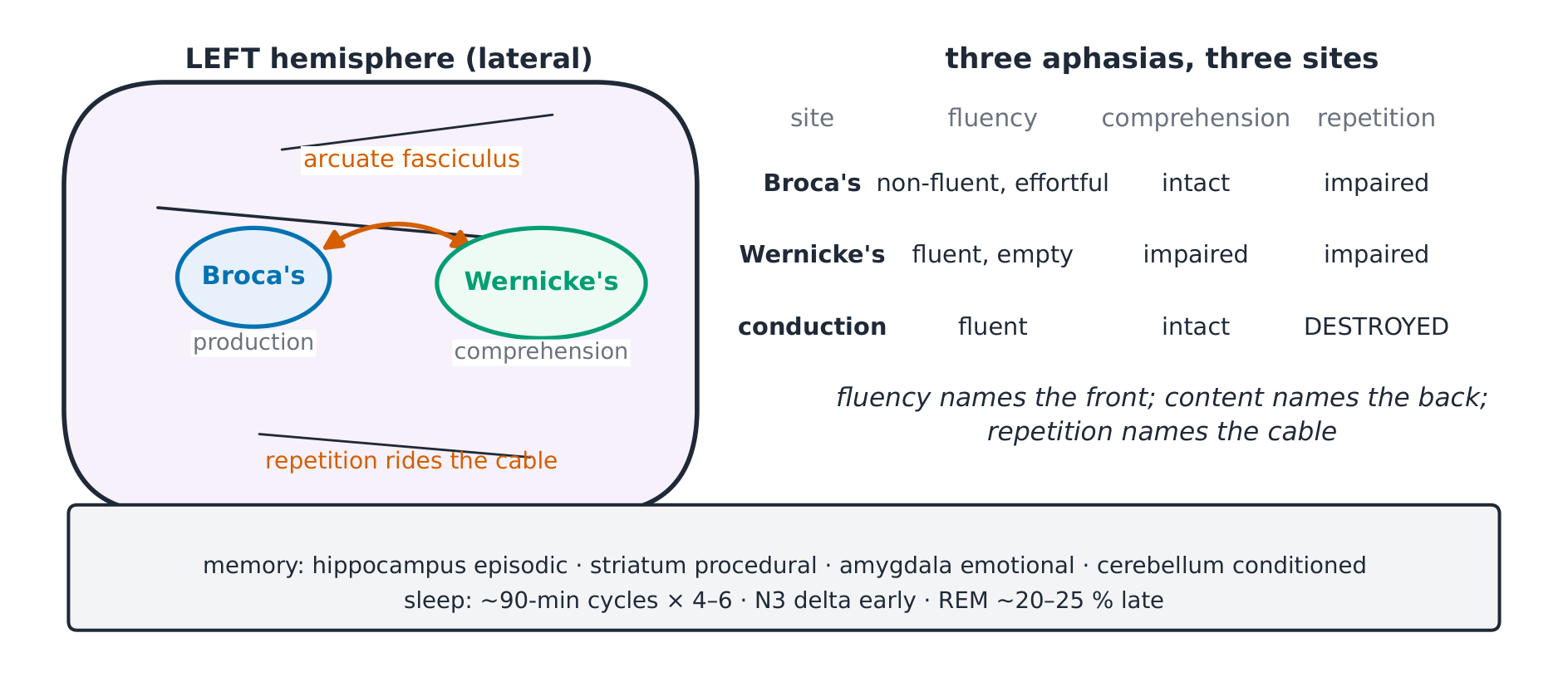
- Broca's area 布洛卡区 in the left inferior frontal lobe produces speech. Wernicke's area 韦尼克区 in the left superior temporal lobe understands it.
- The arcuate fasciculus 弓状束 connects them, which is needed for repeating what someone says.
Three aphasias
- Broca aphasia: slow, effortful speech; understanding is good. Wernicke aphasia: fluent but empty speech; understanding is poor.
- Conduction aphasia (arcuate fasciculus): fluent speech and good understanding, but repetition fails. Fluency points to the front, understanding to the back, repetition to the cable.
A patient speaks fluently but makes little sense and cannot follow instructions. Which area is damaged?
الصعوبة 1/5 · 100 عملة + مكافأة صغيرة عند الإنجاز الأول اليوم
Fluent, empty speech with poor understanding is Wernicke aphasia.
A patient speaks fluently and understands well but cannot repeat a sentence. Where is the lesion?
الصعوبة 1/5 · 100 عملة + مكافأة صغيرة عند الإنجاز الأول اليوم
Both language areas work, but the cable between them is cut.
Worked example: a night's arithmetic
- Five 90-minute cycles take $5 \times 90 = 450$ minutes, 7.5 hours. If REM is 25% of 7.5 hours, that is about 112 minutes.
- Most of the deep sleep comes in the first 3 hours; most REM in the last 3. The pattern, not only the total, matters.
How many hours do five 90-minute sleep cycles take?
الصعوبة 2/5 · 140 عملة + مكافأة صغيرة عند الإنجاز الأول اليوم
5 × 90 = 450 minutes = 7.5 hours.
Worked example: one patient, two memories
- The patient's medial temporal lobes, including most of both hippocampi, had been removed to control epilepsy. He could no longer form new memories of events, yet most old memories survived.
- He still learned mirror drawing, though he never remembered practising: skill learning uses the striatum and cerebellum, not the hippocampus.
Why could the patient learn mirror drawing without remembering any practice?
الصعوبة 1/5 · 100 عملة + مكافأة صغيرة عند الإنجاز الأول اليوم
Procedural and episodic memory are separate systems; only the episodic one was lost.
Three common slips
- "Dreams happen only in REM." They happen in other stages too; vivid, story-like dreams are typical of REM.
- "Hippocampal damage wipes old memories." It mainly stops new ones from forming.
- Naming an aphasia without testing fluency, understanding and repetition. The three together give the site.
Recap
- 90-minute cycles, 4–6 a night; N3 early, REM late (20–25%, muscles switched off).
- Hippocampus: new event memories. Striatum and cerebellum: skills. Amygdala: emotion.
- Broca: non-fluent, understands. Wernicke: fluent, does not understand. Conduction: cannot repeat.