Budgeting: the set that ties
مُقدَّم| English | المعنى |
|---|---|
| budget/ˈbʌdʒɪt/ | A financial plan setting out expected income, expenditure or resource use over a period. |
| production budget | production budget |
| flexible budget | flexible budget |
A plan with numbers that commits
- The July budget 预算 is not a forecast — it is a promise the departments make to each other: sales promises 4,000 meals, production promises 4,020, the kitchen promises £4,829 of purchases.
- Build it once and the couplings show: change the sales plan and the whole sheet breathes.
The set, left to right
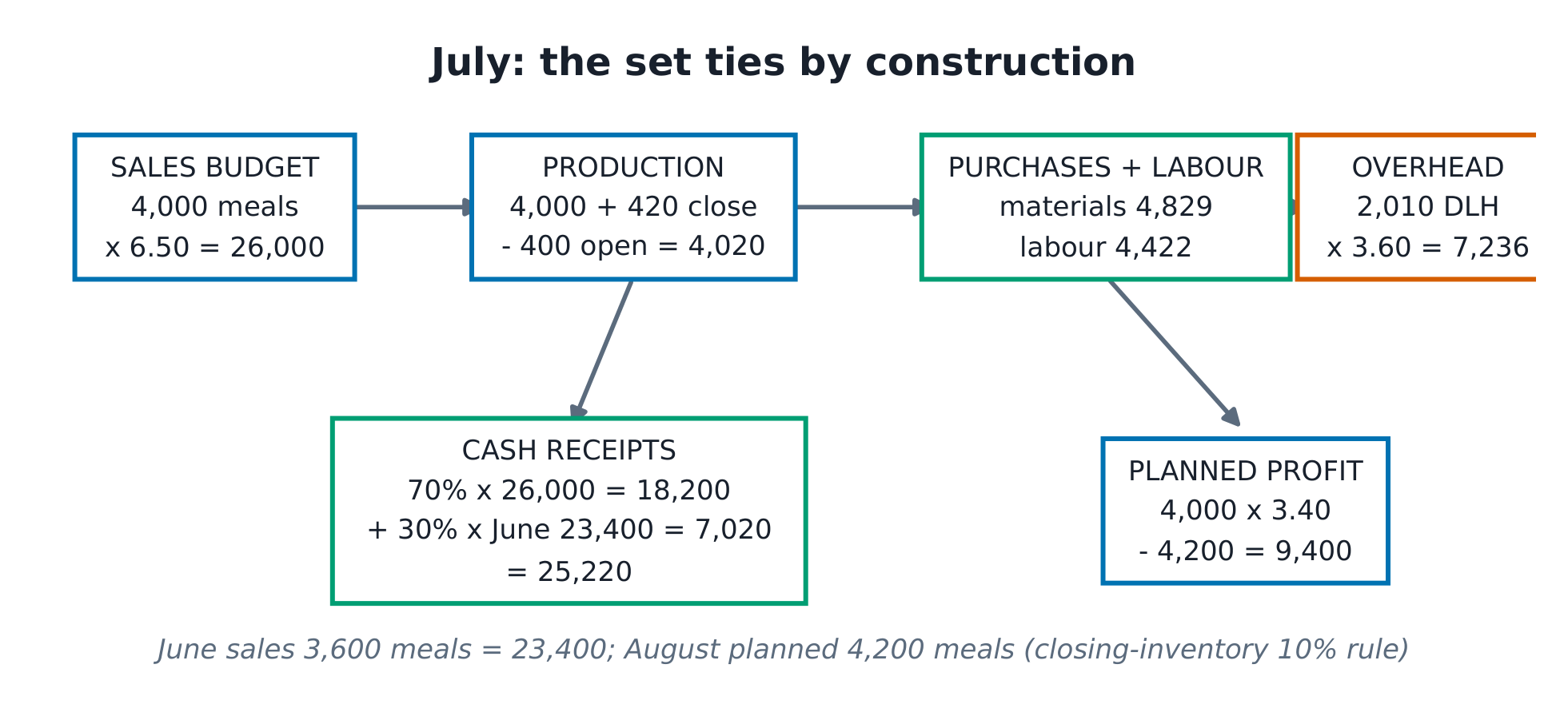
- Sales 4,000 meals × £6.50 = £26,000 → production budget 生产预算: 4,000 + 420 closing (10% of August's 4,200) − 400 opening = 4,020 ✓.
- Purchases: 4,020 × £1.20 = £4,824, adjusted for the 5% materials rule (£246 closing − £241 opening) = £4,829 ✓. Labour £4,422; overhead applied 2,010 hours × £3.60 = £7,236.
July sales 4,000; closing inventory 10% of August (4,200); opening 400. Production, in meals?
الصعوبة 2/5 · 140 عملة + مكافأة صغيرة عند الإنجاز الأول اليوم
$4{,}000 + 420 - 400 = 4{,}020$. The inventory policy is the hinge between sales and production.
Production 4,020 at 1.20 materials; closing materials 246, opening 241. Purchases, to the nearest pound?
الصعوبة 2/5 · 140 عملة + مكافأة صغيرة عند الإنجاز الأول اليوم
$4{,}020 \times 1.20 = 4{,}824$; $4{,}824 + 246 - 241 = £4{,}829$.
August's sales forecast rises by 200 meals. Which July lines move immediately?
الصعوبة 1/5 · 100 عملة + مكافأة صغيرة عند الإنجاز الأول اليوم
The closing-inventory rule ties July to August: 10% of the new forecast enters production, which enters purchases. Coupling is the point of the set.
Cash is not profit with a lag
- July cash receipts: 70% of July (£18,200) + 30% of June (£7,020) = £25,220 ✓ — a different measure, a different calendar.
- Planned profit: $4{,}000 \times 3.40 - 4{,}200 = £9{,}400$ ✓, tying straight back to CVP. The profit budget and the cash budget disagree honourably: receivables in transit.
Which budget line is it?
Route each planning figure to the sales, production, purchases, cash or profit budget - and catch the couplings.
July receipts: 70% of July sales 26,000 plus 30% of June sales 23,400. The total?
الصعوبة 2/5 · 140 عملة + مكافأة صغيرة عند الإنجاز الأول اليوم
$18{,}200 + 7{,}020 = £25{,}220$ - cash, not profit: receivables in transit.
Planned July profit at 4,000 meals (CM 3.40, fixed 4,200)?
الصعوبة 2/5 · 140 عملة + مكافأة صغيرة عند الإنجاز الأول اليوم
$4{,}000 \times 3.40 - 4{,}200 = £9{,}400$ - the profit budget ties straight back to CVP.
The cash budget is just the profit budget shifted one month later.
الصعوبة 1/5 · 100 عملة + مكافأة صغيرة عند الإنجاز الأول اليوم
Different measure (receipts and payments, not revenue and expense) AND different timing - the two budgets disagree for honourable reasons.
Budgets shape behaviour
- The production manager bonused on 4,020 faces August demand of 3,700. The honest flexible budget 弹性预算 says 3,730; the incentive says overproduce toward target, parking £1.00 a meal in inventory and reporting profit the cash cannot find.
- Participative budgets and rolling reforecasts exist because plans and incentives drift. The arithmetic was never wrong — the target was.
August demand collapses to 3,700. The honest production budget is 3,730 (3,700 + 370 - 340), but the manager overproduces toward 4,020. What is the cost of hitting the old target?
الصعوبة 1/5 · 100 عملة + مكافأة صغيرة عند الإنجاز الأول اليوم
Absorption parking (unit 0603) meets the budget target: about $290 \times £1.00$ of fixed cost sits in stock while the P&L smiles. The target, not the arithmetic, was wrong.
Why do firms use participative budgets and rolling reforecasts?
الصعوبة 1/5 · 100 عملة + مكافأة صغيرة عند الإنجاز الأول اليوم
Budgets shape behaviour as surely as they record plans; the process designs are behavioural answers, not clerical ones.
Three budgeting slips
- Budgeting production as sales. The inventory policy disappears with it.
- Reading the cash budget as lagged profit. Measure and timing both differ.
- Judging volume against a budget nobody re-based after the world moved.
Recap
- Sales → production → purchases/labour/overhead → cash: each consumes the last.
- Inventory and collection policies are the hinges.
- Budgets record plans AND shape the people measured by them.