The Sun and the life cycle of stars
مُقدَّم 16:59
فيزياء الفضاء
انظر إلى السماء في ليلة صافية، وقد ترى بضعة آلاف من النجوم. لكن هذا شبه لا شيء. شمسنا هي مجرد نجم واحد بين مائة مليار نجم في مجرتنا…
سرد باللغة الإنجليزية · ترجمة نصية بالإنجليزية و中文 يمكنك التبديل بينهما
In this lesson
| English | المعنى |
|---|---|
| fusion/ˈfjuːʒn/ | اندماج نووي |
| Universe/ˈjuːnɪvɜːs/ | كون |
| galaxy/ˈɡæləksi/ | مجرة |
| Milky Way/ˈmɪlki weɪ/ | درب التبانة |
| light-years/laɪt jɪəz/ | سنة ضوئية |
| nebula/ˈnebjʊlə/ | سديم |
| protostar/ˈprəʊtəʊstɑː/ | نجمة أولية |
| red giant/red ˈdʒaɪənt/ | عملاق أحمر |
| white dwarf/waɪt dwɔːf/ | قزم أبيض |
| supernova/ˌsuːpəˈnəʊvə/ | مستعر أعظم |
| neutron star/ˈnjuːtrɒn stɑː/ | نجم نيوتروني |
| black hole/blæk həʊl/ | ثقب أسود |
The lives of stars
- Stars are born, shine for billions of years, and then die.
- Our Sun is one ordinary star among billions.
- Let's meet the Sun, the galaxies, and how a star lives and dies.
The Sun as a star
- The Sun is a medium-sized star, made mostly of hydrogen and helium.
- It radiates energy as infrared, visible light and ultraviolet.
- It is powered by nuclear fusion 聚变 in its core: hydrogen nuclei join to make helium, releasing huge energy.
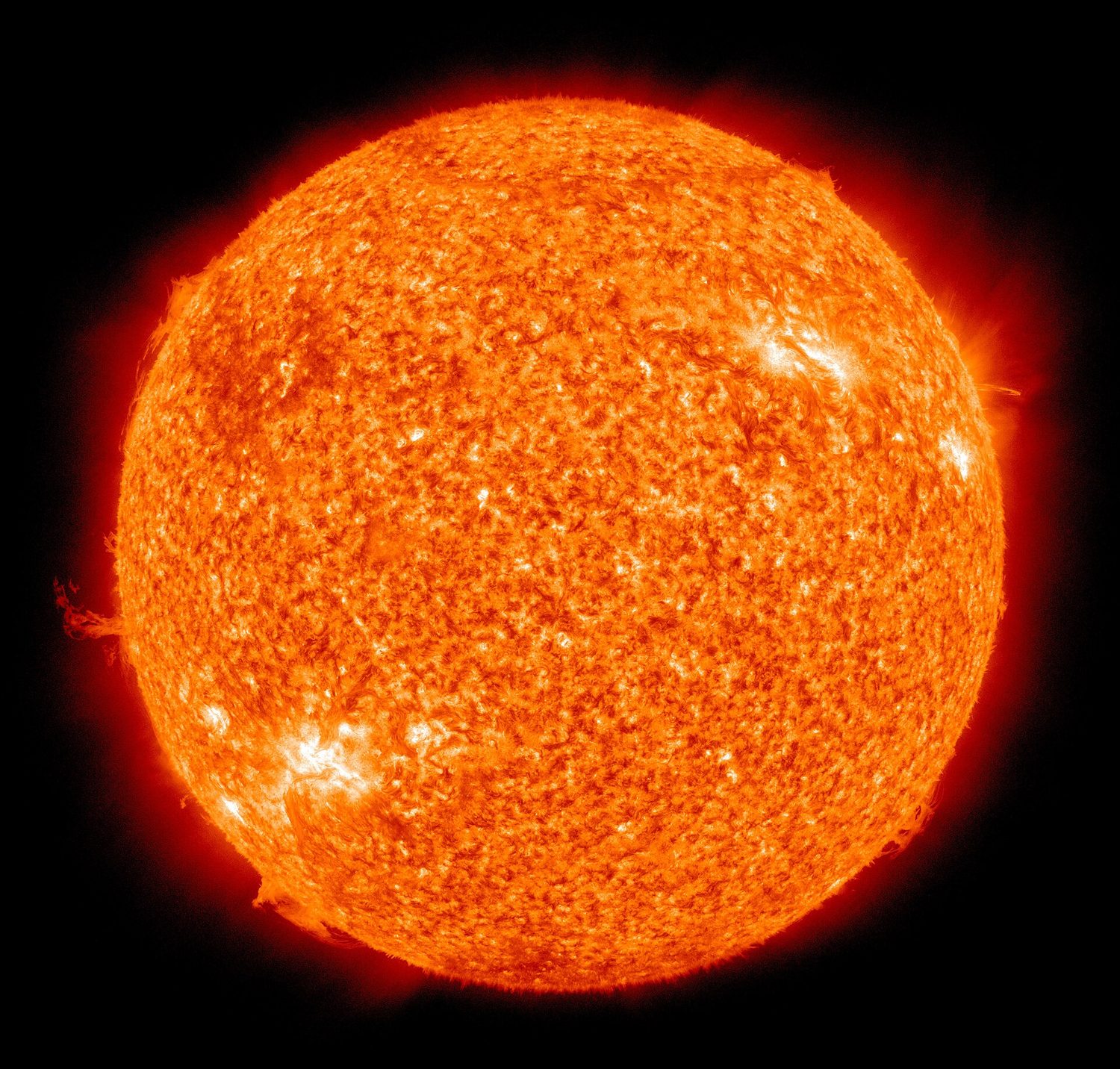
The Sun, our nearest star, seen in ultraviolet light
دورة حياة النجم
Gravity pulls a gas cloud together; fusion lights the star; when its fuel runs low it swells and finally fades.
What powers the Sun?
الصعوبة 1/5 · 100 عملة + مكافأة صغيرة عند الإنجاز الأول اليوم
In a stable star, hydrogen nuclei fuse into helium in the core, releasing huge amounts of energy.
Galaxies and the Universe 宇宙
- A galaxy 星系 is billions of stars held together by gravity. Our Sun is in the Milky Way 银河系.
- Distances between stars are measured in light-years 光年 — the distance light travels in one year ($\approx 9.5 \times 10^{15}\ \text{m}$).
- The Milky Way is about $100\,000$ light-years across, and is just one of billions of galaxies that make up the Universe.
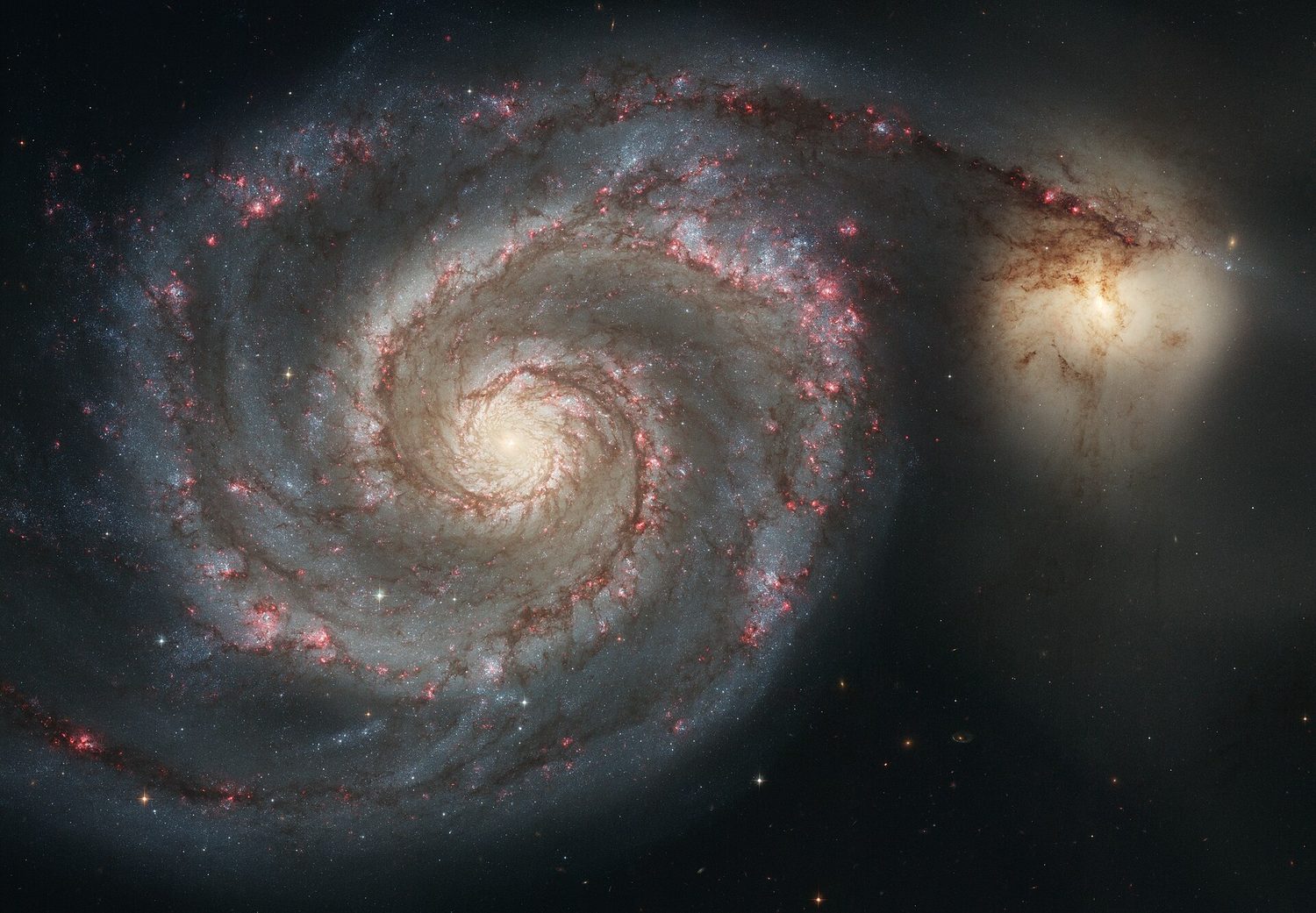
A spiral galaxy: billions of stars held together by gravity
A galaxy is:
الصعوبة 1/5 · 100 عملة + مكافأة صغيرة عند الإنجاز الأول اليوم
A galaxy is a huge collection of billions of stars bound by gravity. The Sun is one star in the Milky Way galaxy.
A light-year is a unit of:
الصعوبة 1/5 · 100 عملة + مكافأة صغيرة عند الإنجاز الأول اليوم
A light-year is the distance light travels in one year — a measure of distance, not time.
Match each stage to what it is.
الصعوبة 2/5 · 140 عملة + مكافأة صغيرة عند الإنجاز الأول اليوم
Each item links the term to its correct meaning.
The life cycle of a star
- A star forms from a nebula 星云 (a cloud of gas and dust).
- Gravity pulls it together and it heats up — a protostar 原恒星.
- It becomes a stable star when gravity's inward pull is balanced by the outward push from its very hot core.
- When the hydrogen fuel runs low, what happens next depends on the star's mass:
- a medium star → red giant 红巨星 → throws off a planetary nebula → leaves a white dwarf 白矮星;
- a massive star → red supergiant → explodes as a supernova 超新星 → leaves a neutron star 中子星 or a black hole 黑洞.
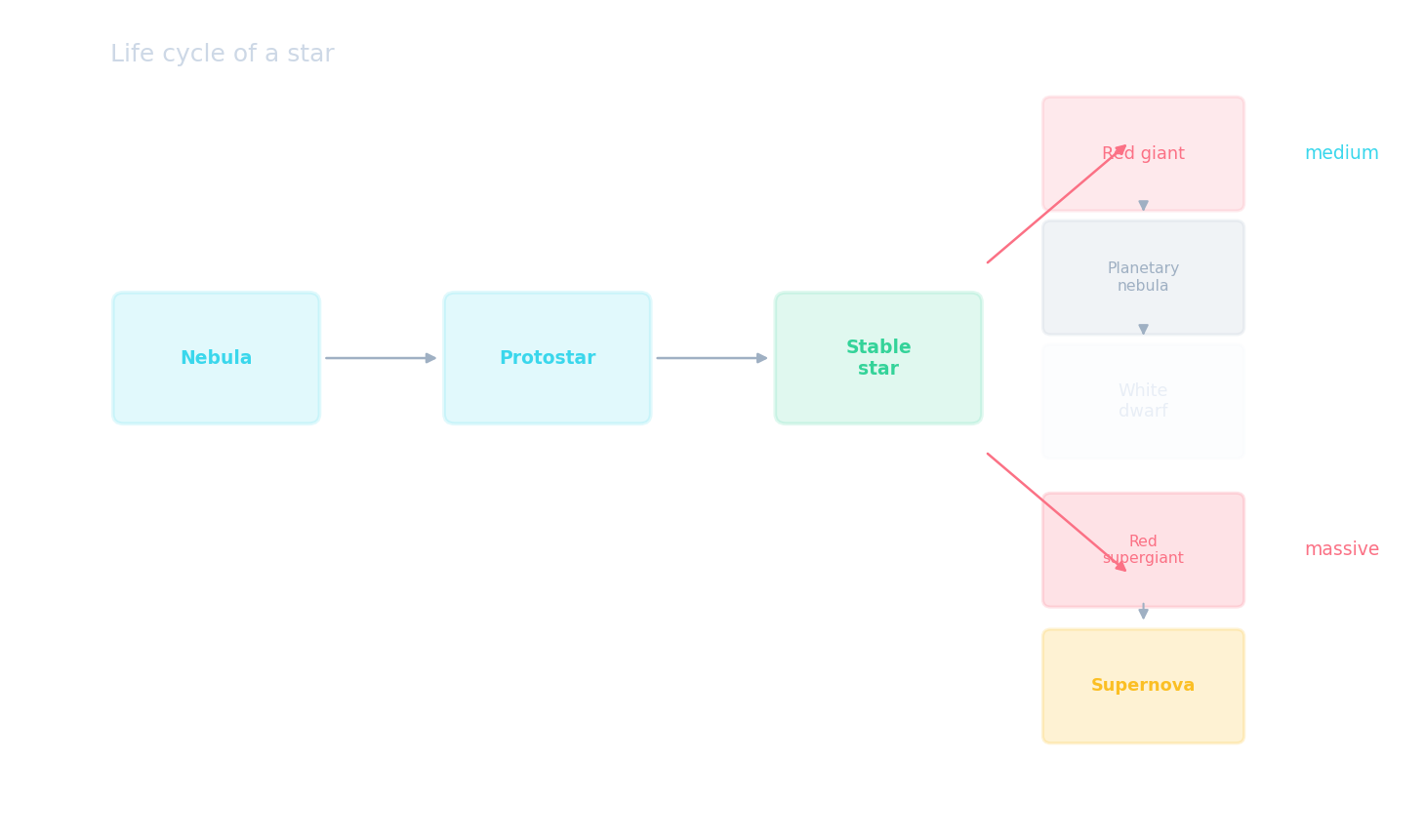
The life cycle of a star: all stars start the same way, but their mass determines how they end. Medium stars become white dwarfs; massive stars explode as supernovae and leave neutron stars or black holes.
Why does a supernova matter? A supernova explosion creates and scatters heavy elements (iron, gold, uranium) into space. Every atom of gold on Earth was forged inside a star that exploded billions of years ago.
A black hole is not a hole. It is an incredibly dense remnant where gravity is so strong that not even light can escape. It's a collapsed core, not an empty space.
Put the life stages of a Sun-like star in order.
الصعوبة 3/5 · 200 عملة + مكافأة صغيرة عند الإنجاز الأول اليوم
A star forms from a nebula → protostar → stable star → (fuel runs low) red giant → white dwarf.
In a stable star, the inward pull of gravity is balanced by:
الصعوبة 1/5 · 100 عملة + مكافأة صغيرة عند الإنجاز الأول اليوم
The hot core pushes outward, balancing gravity's inward pull, so the star stays a stable size.
A much heavier star ends its life as a supernova, leaving behind:
الصعوبة 1/5 · 100 عملة + مكافأة صغيرة عند الإنجاز الأول اليوم
A massive star becomes a red supergiant, explodes as a supernova, and leaves a neutron star or a black hole.
You've got it
- the Sun is a medium star (H + He), powered by fusion of hydrogen into helium
- a galaxy = billions of stars held by gravity; we are in the Milky Way
- distances in light-years ($\approx 9.5 \times 10^{15}\ \text{m}$); billions of galaxies make the Universe
- life cycle: nebula → protostar → stable star → (red giant → white dwarf) or (supergiant → supernova → neutron star/black hole)
Write from the data given
- A star is 4 light-years away. One light-year is 9.5 times 10 to the 15 metres.
- Find the distance in metres. A much heavier star does not end as a white dwarf.
A star is 4 light-years away and one light-year is 9.5 times 10 to the 15 metres. What is the distance in metres, and what can a much heavier star leave after a supernova?
4 times 9.5 times 10 to the 15 is 3.8 times 10 to the 16 metres. The Sun is a medium star.
How far away is the star in metres?
الصعوبة 1/5 · 100 عملة + مكافأة صغيرة عند الإنجاز الأول اليوم
4 light-years times 9.5 times 10 to the 15 metres is 3.8 times 10 to the 16 metres.