The nuclear atom
مُقدَّم 15:46
فيزياء نووية
كل ما حولك مصنوع من ذرات — ومع ذلك الذرة فارغة تقريباً بالكامل. إذا كانت النواة بحجم حبة مرمر، ستكون الذرة كاملة بحجم…
سرد باللغة الإنجليزية · ترجمة نصية بالإنجليزية و中文 يمكنك التبديل بينهما
In this lesson
| English | المعنى |
|---|---|
| nucleus/ˈnjuːklɪəs/ | نواة |
| nuclear model/ˈnjuːklɪə ˈmɒdl/ | النموذج النووي |
| neutral/ˈnjuːtrəl/ | متعادل |
| alpha particles/ˈælfə ˈpɑːtɪklz/ | جسيمات ألفا |
| gold foil/ɡəʊld fɔɪl/ | رقاقة الذهب |
| nucleons/ˈnjuːklɪənz/ | نيوكليونات |
| protons/ˈprəʊtɒnz/ | بروتونات |
| neutrons/ˈnjuːtrɒnz/ | نيوترونات |
| isotopes/ˈaɪsətəʊps/ | نظائر |
Mostly empty space
- If an atom were the size of a football stadium, its nucleus 原子核 would be a pea on the centre spot. Almost everything in between is empty space.
- This lesson builds the nuclear model 核模型 of the atom, shows the experiment that proved it, and explains how to read nuclide notation such as $^{23}_{11}\text{Na}$.
The nuclear atom
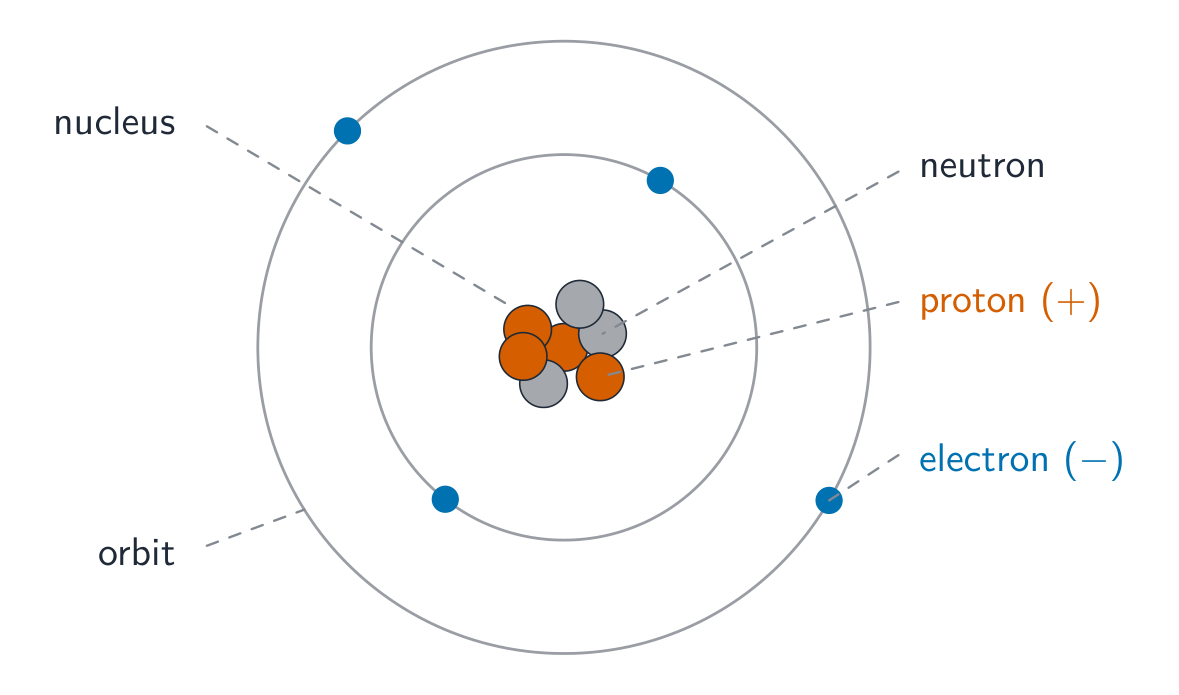
- An atom has a tiny, positive nucleus in the centre, with negative electrons in orbit around it.
- An atom has equal numbers of protons and electrons, so it is neutral 中性的 overall. Almost all its mass is in the nucleus.
| Ion | How it forms | Example |
|---|---|---|
| positive ion | the atom loses one or more electrons, so protons outnumber electrons | sodium: 11 protons, 10 electrons → charge +1 |
| negative ion | the atom gains one or more electrons | chlorine: 17 protons, 18 electrons → charge −1 |
- Only electrons move when ions form. The nucleus does not change, so the element stays the same.
داخل الذرة
A tiny dense nucleus sits at the centre with electrons in shells around it — drag the proton number and watch the shells fill outward.
Where is almost all of an atom's mass?
الصعوبة 1/5 · 100 عملة + مكافأة صغيرة عند الإنجاز الأول اليوم
Almost all the mass is concentrated in the tiny, dense nucleus; the rest of the atom is mostly empty space.
An atom that loses an electron becomes a positive ion.
الصعوبة 1/5 · 100 عملة + مكافأة صغيرة عند الإنجاز الأول اليوم
Losing a negative electron leaves the atom with more positive charge — a positive ion.
A magnesium atom has 12 protons. It loses 2 electrons. What is the charge on the ion?
الصعوبة 1/5 · 100 عملة + مكافأة صغيرة عند الإنجاز الأول اليوم
It now has 12 protons but only 10 electrons, so there are 2 more positive charges than negative: +2.
The alpha-scattering experiment
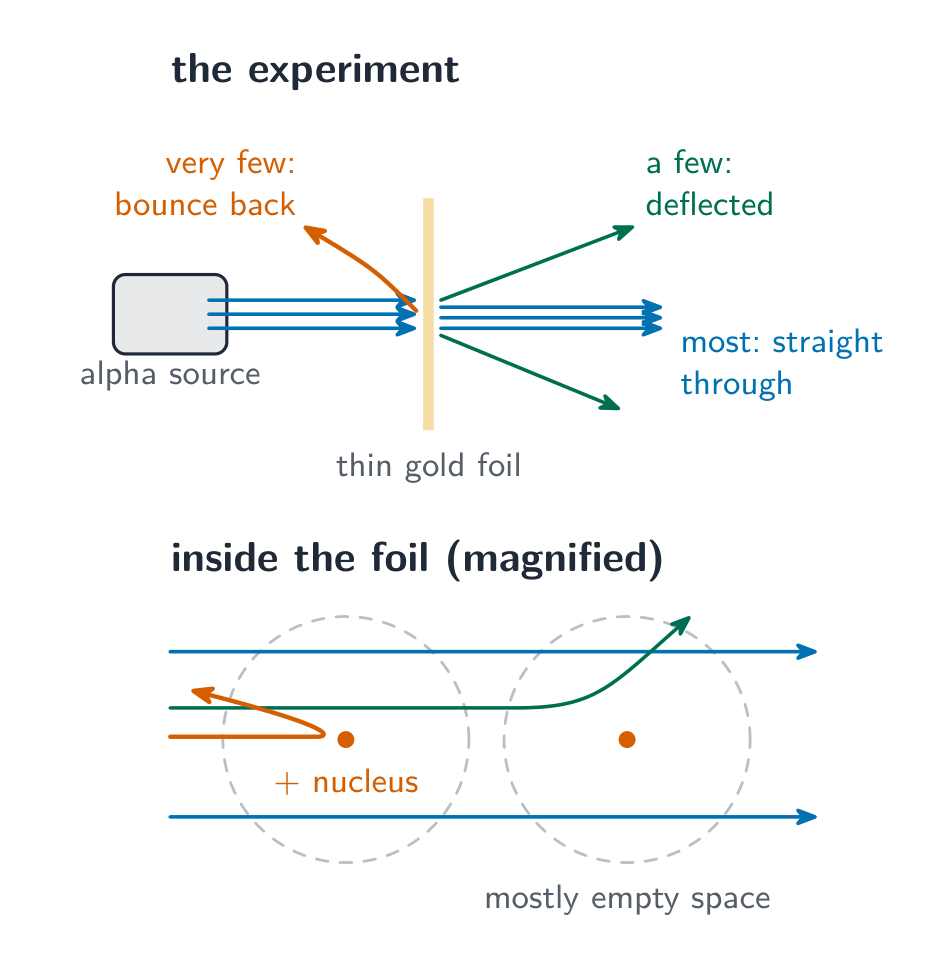
- Fast, positive alpha particles α粒子 were fired at a very thin sheet of gold foil 金箔, and a detector counted where they went.
| Observation | What it shows |
|---|---|
| most go straight through | the atom is mostly empty space; the nucleus is very small |
| a few are deflected | the nucleus is positive: it repels the positive alpha particles that pass close |
| a very few bounce back | the nucleus is tiny but contains most of the mass: an alpha particle hitting it head-on cannot push it aside |
Exam question. In the alpha-scattering experiment, a very small number of alpha particles were deflected through large angles. State what this shows about the nucleus. [2]
- Answer: the nucleus is positively charged (1) and contains most of the mass of the atom in a very small volume (1).
- Mark-scheme reasoning: each mark needs a property of the nucleus. "The alpha particles hit something" earns nothing. Match each observation to its own conclusion, as in the table.
In the alpha-scattering experiment, most alpha particles passed straight through the foil. This shows that:
الصعوبة 1/5 · 100 عملة + مكافأة صغيرة عند الإنجاز الأول اليوم
If most pass straight through, there must be very little in the way — the atom is mostly empty space.
A very few alpha particles bounced straight back from the gold foil. What does this show?
الصعوبة 1/5 · 100 عملة + مكافأة صغيرة عند الإنجاز الأول اليوم
To turn back a fast alpha particle, the nucleus must be heavy. Because so few bounce back, it must also be very small. 'Mostly empty space' comes from the alphas that go straight through.
Inside the nucleus
- The nucleus is made of nucleons 核子: protons 质子 and neutrons 中子.
| Particle | Where | Relative charge | Relative mass |
|---|---|---|---|
| proton | nucleus | +1 | 1 |
| neutron | nucleus | 0 | 1 |
| electron | orbits | −1 | about 1/2000 (tiny) |
- Proton number $Z$ (atomic number) = the number of protons. It decides the element and gives the relative charge of the nucleus: $+Z$.
- Nucleon number $A$ (mass number) = protons + neutrons. It gives the relative mass of the nucleus. Number of neutrons = $A - Z$.
The proton number (Z) of a nucleus is:
الصعوبة 1/5 · 100 عملة + مكافأة صغيرة عند الإنجاز الأول اليوم
Z is the proton number (atomic number). The nucleon number A is protons + neutrons.
What is the relative charge of a neutron?
الصعوبة 1/5 · 100 عملة + مكافأة صغيرة عند الإنجاز الأول اليوم
Neutrons are neutral: relative charge 0. Protons are +1 and electrons −1. 1/2000 is roughly the relative mass of an electron, not a charge.
Reading nuclide notation
- A nucleus is written $^{A}_{Z}\text{X}$: the top number is $A$, the bottom number is $Z$, and X is the symbol of the element.
Worked example. For $^{23}_{11}\text{Na}$ (sodium):
- protons = $Z$ = 11; neutrons = 23 − 11 = 12; electrons in a neutral atom = 11
- relative charge of the nucleus = +11; relative mass of the nucleus = 23
- the sodium ion Na⁺ still has 11 protons and 12 neutrons, but only 10 electrons
The top number is not the number of neutrons. $A$ counts protons plus neutrons. A common wrong answer for $^{23}_{11}\text{Na}$ is "23 neutrons".
How many neutrons are in a nucleus of $^{14}_{\ 6}\text{C}$?
الصعوبة 2/5 · 140 عملة + مكافأة صغيرة عند الإنجاز الأول اليوم
النيوترونات $= A - Z = 14 - 6 = 8$.
A nucleus is written ²⁷₁₃Al (nucleon number 27, proton number 13). What is the relative charge of the nucleus?
الصعوبة 2/5 · 140 عملة + مكافأة صغيرة عند الإنجاز الأول اليوم
The charge of a nucleus comes only from its protons. There are 13, so the relative charge is +13. The 27 gives the relative mass, not the charge.
How many neutrons are in the nucleus ²⁷₁₃Al?
الصعوبة 2/5 · 140 عملة + مكافأة صغيرة عند الإنجاز الأول اليوم
Neutrons = A − Z = 27 − 13 = 14.
Isotopes 同位素
- Isotopes are atoms of the same element (same $Z$, so the same number of protons) with different numbers of neutrons (different $A$). An element can have several isotopes.
- They have the same electrons, so they react the same way in chemistry, but they have different masses, and some are radioactive.
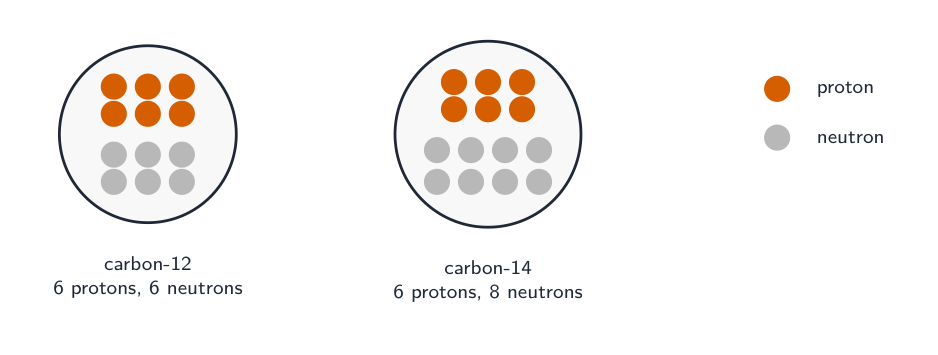
Exam question. Carbon-12 is $^{12}_{\ 6}\text{C}$ and carbon-14 is $^{14}_{\ 6}\text{C}$. Explain why they are isotopes of the same element. [2]
- Both have 6 protons (the same proton number), so both are carbon (1).
- Carbon-12 has 6 neutrons and carbon-14 has 8: different numbers of neutrons (1).
Isotopes of an element have:
الصعوبة 1/5 · 100 عملة + مكافأة صغيرة عند الإنجاز الأول اليوم
Isotopes share the proton number Z (same element) but have different nucleon numbers A (different neutron counts).
You've got it
- atom = tiny positive nucleus + negative electrons in orbit; mostly empty space; almost all the mass is in the nucleus
- lose electrons → positive ion; gain electrons → negative ion
- alpha scattering: most go straight through (empty space), a few deflect (positive nucleus), a very few bounce back (nucleus small and holds most of the mass)
- relative charges: proton +1, neutron 0, electron −1
- $Z$ = protons = relative charge of the nucleus; $A$ = protons + neutrons = relative mass; neutrons = $A - Z$
- isotopes: same proton number, different numbers of neutrons
A nucleus has proton number 8 and nucleon number 18. How many neutrons does it have, and what happens when the atom loses one electron?
18 minus 8 is 10. The nucleus is not changed by removing one orbiting electron.
How many neutrons are in this nucleus?
الصعوبة 1/5 · 100 عملة + مكافأة صغيرة عند الإنجاز الأول اليوم
18 minus 8 is 10 neutrons.