Electrical safety
مُقدَّم| English | المعنى |
|---|---|
| fuse/fjuːz/ | صمام أمان |
| live/laɪv/ | السلك الحي |
| neutral/ˈnjuːtrəl/ | خط محايد |
| earth/ɜːθ/ | خط الأرضي |
| trip switch/trɪp swɪtʃ/ | مفتاح القاطع |
| double insulation/ˈdʌbl ˌɪnsjuːˈleɪʃn/ | العزل المزدوج |
Mains can be dangerous
- The mains supply runs our homes — but used wrongly it can give a shock or start a fire.
- A few simple safety features keep it under control.
- Let's meet the hazards, the three wires, and the fuse 保险丝.
Electrical safety route
Follow fault current and see how safety devices protect people.
Hazards
- Damaged insulation — bare wires can give a shock or start a fire.
- Overheating cables — too much current makes a cable hot.
- Damp conditions — water lets current pass into a person.
- Overloading — too many appliances in one socket draw too much current.
Select جميعها of these that are electrical hazards.
الصعوبة 2/5 · 140 عملة + مكافأة صغيرة عند الإنجاز الأول اليوم
Bare wires, overloading and damp all raise the risk of shock or fire. Switching a lamp off is normal, safe use.
Live 火线, neutral 零线 and earth 地线
- A mains cable has three wires:
- the live wire carries the high voltage;
- the neutral wire completes the circuit at about zero voltage;
- the earth wire is a safety wire joined to the ground.
- The switch and fuse go in the live wire, so switching off cuts the appliance from the high voltage.
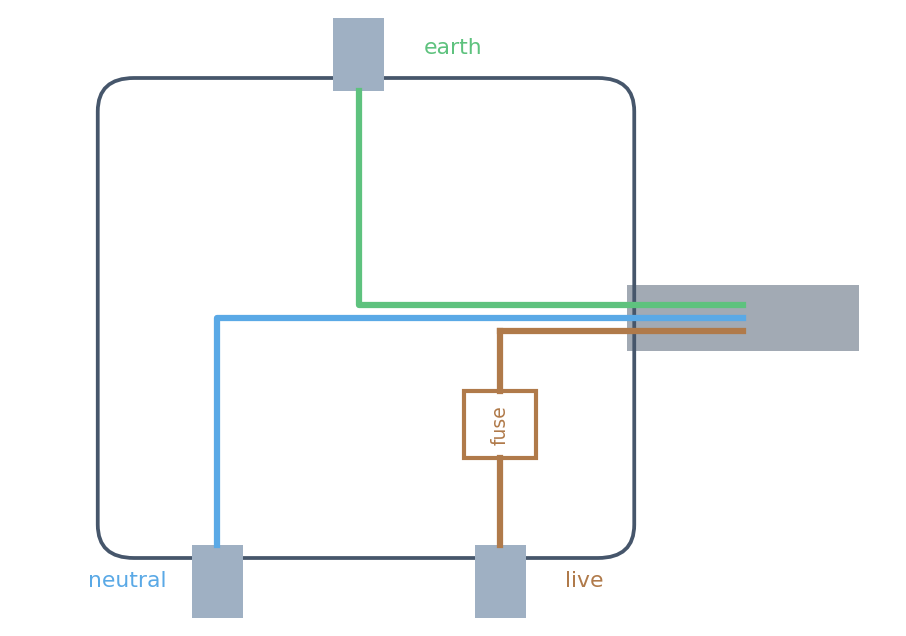
Which wire carries the high voltage?
الصعوبة 1/5 · 100 عملة + مكافأة صغيرة عند الإنجاز الأول اليوم
The live wire carries the high voltage; the neutral is near 0 V and the earth is a safety wire.
In which wire should the switch and fuse be fitted?
الصعوبة 1/5 · 100 عملة + مكافأة صغيرة عند الإنجاز الأول اليوم
Putting the switch and fuse in the live wire means that, when off, the appliance is cut off from the high voltage and is safe.
Fuses, trip switches 跳闸开关 and earthing
- A fuse is a thin wire that melts if the current gets too big, breaking the circuit before the cable overheats.
- Choose a fuse rating just above the normal current (e.g. a $13\ \text{A}$ fuse for an appliance using about $10\ \text{A}$).
- A trip switch (circuit breaker) does the same job but is faster and can be reset.
- A metal case is made safe by earthing (a fault sends a big current to earth and blows the fuse) or by double insulation 双重绝缘 (a plastic case that can never become live).
What does a fuse do?
الصعوبة 1/5 · 100 عملة + مكافأة صغيرة عند الإنجاز الأول اليوم
A fuse is a thin wire that melts if the current is too large, breaking the circuit before the cable can overheat.
An appliance normally draws about $10\ \text{A}$. Which fuse should it use?
الصعوبة 1/5 · 100 عملة + مكافأة صغيرة عند الإنجاز الأول اليوم
Choose a rating just above the normal working current. A 3 A or 5 A fuse would blow during normal use; 13 A is the right choice.
A double-insulated appliance with a plastic case needs an earth wire.
الصعوبة 1/5 · 100 عملة + مكافأة صغيرة عند الإنجاز الأول اليوم
A plastic case can never become live, so a double-insulated appliance needs no earth wire (its fuse still protects the cable).
Worked examples
1. Fuses come in $3\ \text{A}$, $5\ \text{A}$ and $13\ \text{A}$. A $2300\ \text{W}$ kettle on $230\ \text{V}$: $I = \dfrac{P}{V} = \dfrac{2300}{230} = 10\ \text{A}$, so use $13\ \text{A}$. A $60\ \text{W}$ lamp: $I = 0.26\ \text{A}$, so use $3\ \text{A}$.
2. The live wire touches an earthed metal casing. A large current flows through the earth wire, the fuse melts, and the casing is cut off from the live supply.
The fuse and the switch go in the live wire. In the neutral wire they would leave the appliance connected to the high voltage when they open.
You've got it
- hazards: damaged insulation, overheating cables, damp, overloading
- three wires: live (high voltage), neutral (≈0 V), earth (safety)
- the switch and fuse go in the live wire
- a fuse melts if the current is too big; rating just above the normal current; double insulation needs no earth
Write from a normal current of 8 amperes
- An appliance normally draws 8 A.
- Say why a 3 A fuse is unsuitable, and where the fuse and switch go.
An appliance normally draws 8 A. Why is a 3 A fuse unsuitable, and in which wire do the fuse and the switch go?
The normal current is 8 amperes. A fuse smaller than that cannot carry normal operation.
Which fuse statement fits this 8 A appliance?
الصعوبة 1/5 · 100 عملة + مكافأة صغيرة عند الإنجاز الأول اليوم
The fuse must survive 8 amperes and still open on a fault, and it is placed in the live wire.