خصائص الموجات العامة
مُقدَّم| English | المعنى |
|---|---|
| wave/weɪv/ | موجة |
| wavelength/ˈweɪvleŋθ/ | طول الموجة |
| amplitude/ˈæmplɪtjuːd/ | السعة |
| frequency/ˈfriːkwənsi/ | التردد |
| wave speed/weɪv spiːd/ | سرعة الموجة |
| transverse/trænsˈvɜːs/ | موجة مستعرضة |
| longitudinal/ˌlɒŋɡɪˈtjuːdɪnl/ | موجة طولية |
| reflection/rɪˈflekʃn/ | انعكاس |
| refraction/rɪˈfrækʃn/ | انكسار |
| diffraction/dɪˈfrækʃn/ | حيود |
Energy on the move
- Drop a stone in a pond: ripples spread out, but a floating cork just bobs up and down — it does not travel along.
- A wave 波 carries energy from place to place without carrying matter.
- All waves — water, light, sound — share the same set of ideas.
تحمل الموجة المادة معها من مكان لآخر.
الصعوبة 1/5 · 100 عملة + مكافأة صغيرة عند الإنجاز الأول اليوم
تحمل الموجة الطاقة، لا المادة. فالفقاعة العائمة تهتز للأعلى والأسفل ولا تسافر مع الموجة.
Describing a wave
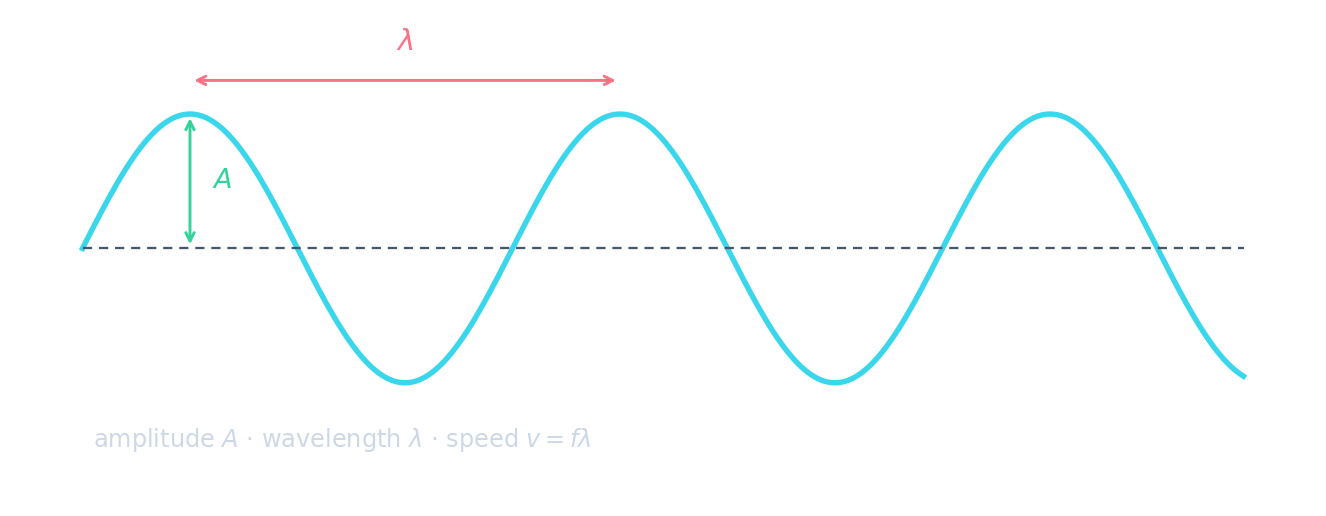
- wavelength 波长 ($\lambda$): the distance for one full wave (e.g. crest to crest).
- amplitude 振幅: the largest distance a point moves from its rest position.
- frequency 频率 ($f$): the number of waves passing a point each second, in hertz (Hz).
- wave speed 波速 ($v$): how fast a wavefront travels. These link by the wave equation:
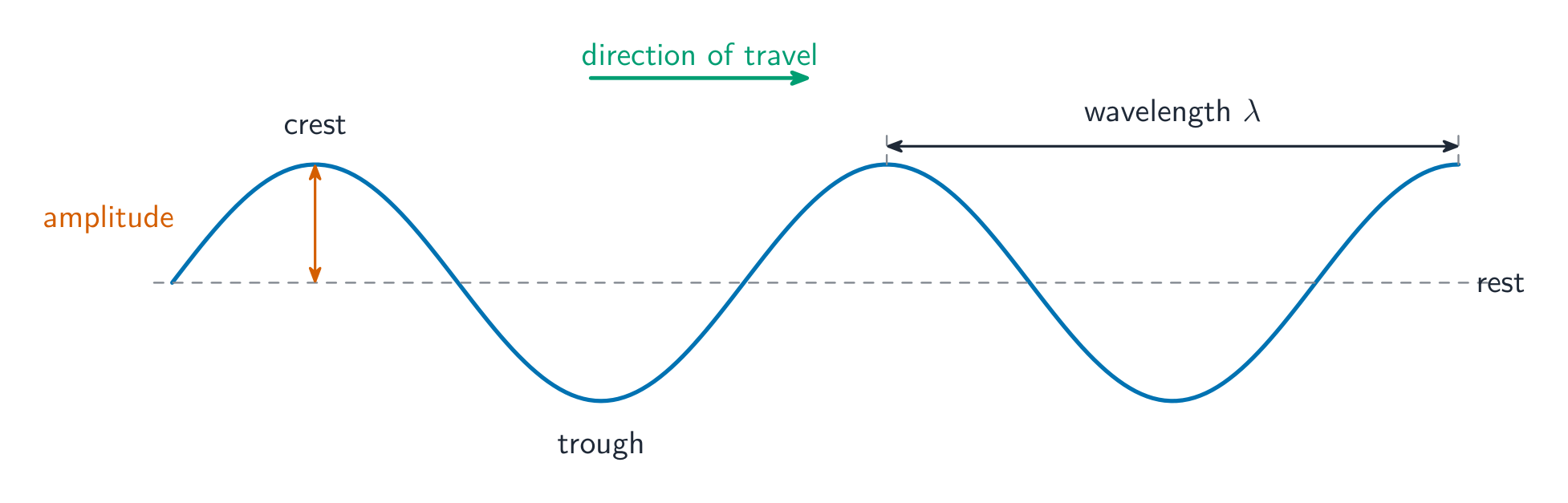
The parts of a transverse 横波 wave
خصائص الموجات
y = a sin(bx + c)
الموجة: a تمثل السعة، وb تحدد الطول الموجي.
موجات مستعرضة وطولية
انتقل بين موجة مستعرضة (جسيمات تهتز للأعلى والأسفل، كالماء والضوء) وموجة طولية (جسيمات تنزلق يميناً ويساراً، متجمعة في انضغاطات، كالصوت). تتحرك الموجة، لكن الجسيمات تبقى في مكانها.
للموجة تردد $5.0\ \text{Hz}$ وطول موجي $2.0\ \text{m}$. ما سرعتها بالمتر/ثانية؟
الصعوبة 2/5 · 140 عملة + مكافأة صغيرة عند الإنجاز الأول اليوم
$v = f\lambda = 5.0 \times 2.0 = 10\ \text{m/s}$.
تسافر موجة صوتية بسرعة $330\ \text{m/s}$ وترددها $110\ \text{Hz}$. ما طولها الموجي بالمتر؟
الصعوبة 2/5 · 140 عملة + مكافأة صغيرة عند الإنجاز الأول اليوم
أعد ترتيب $v = f\lambda$: $\lambda = \dfrac{v}{f} = \dfrac{330}{110} = 3.0\ \text{m}$.
سعة الموجة هي:
الصعوبة 1/5 · 100 عملة + مكافأة صغيرة عند الإنجاز الأول اليوم
السعة هي أقصى إزاحة عن وضع التوازن. والمسافة من قمة إلى قمة هي الطول الموجي.
Two types of wave
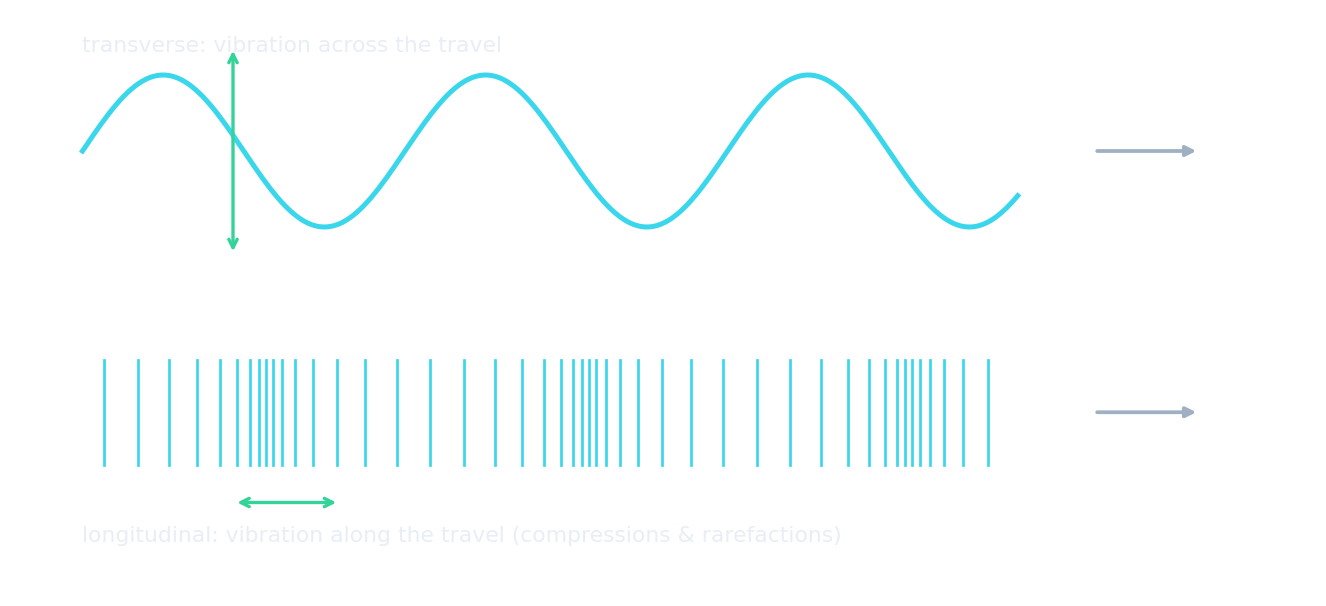
- Transverse — the particles vibrate at right angles ($90°$) to the wave's travel. Light and water waves are transverse.
- Longitudinal 纵波 — the particles vibrate along the travel direction, making compressions and rarefactions. Sound is longitudinal.
الصوت أي نوع من أنواع الموجات؟
الصعوبة 1/5 · 100 عملة + مكافأة صغيرة عند الإنجاز الأول اليوم
في الصوت، تهتز الجسيمات في اتجاه الحركة، مما يشكل انضغاطات وتخلخلات — وهي موجة طولية.
How waves behave
- All waves can do three things (easy to see in a ripple tank):
- Reflection 反射 — the wave bounces off a surface.
- Refraction 折射 — the wave changes speed (and usually direction) entering a new material or depth.
- Diffraction 衍射 — the wave spreads out through a gap or around an edge; spreading is greatest when the gap ≈ the wavelength.
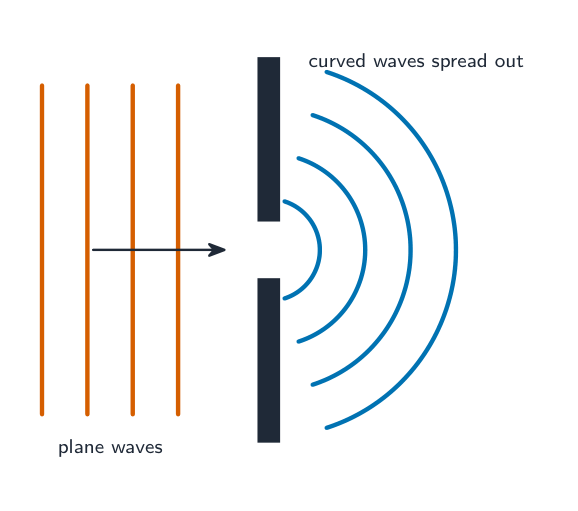
Plane waves passing through a narrow gap spread out into curved waves — diffraction is strongest when the gap is about one wavelength wide
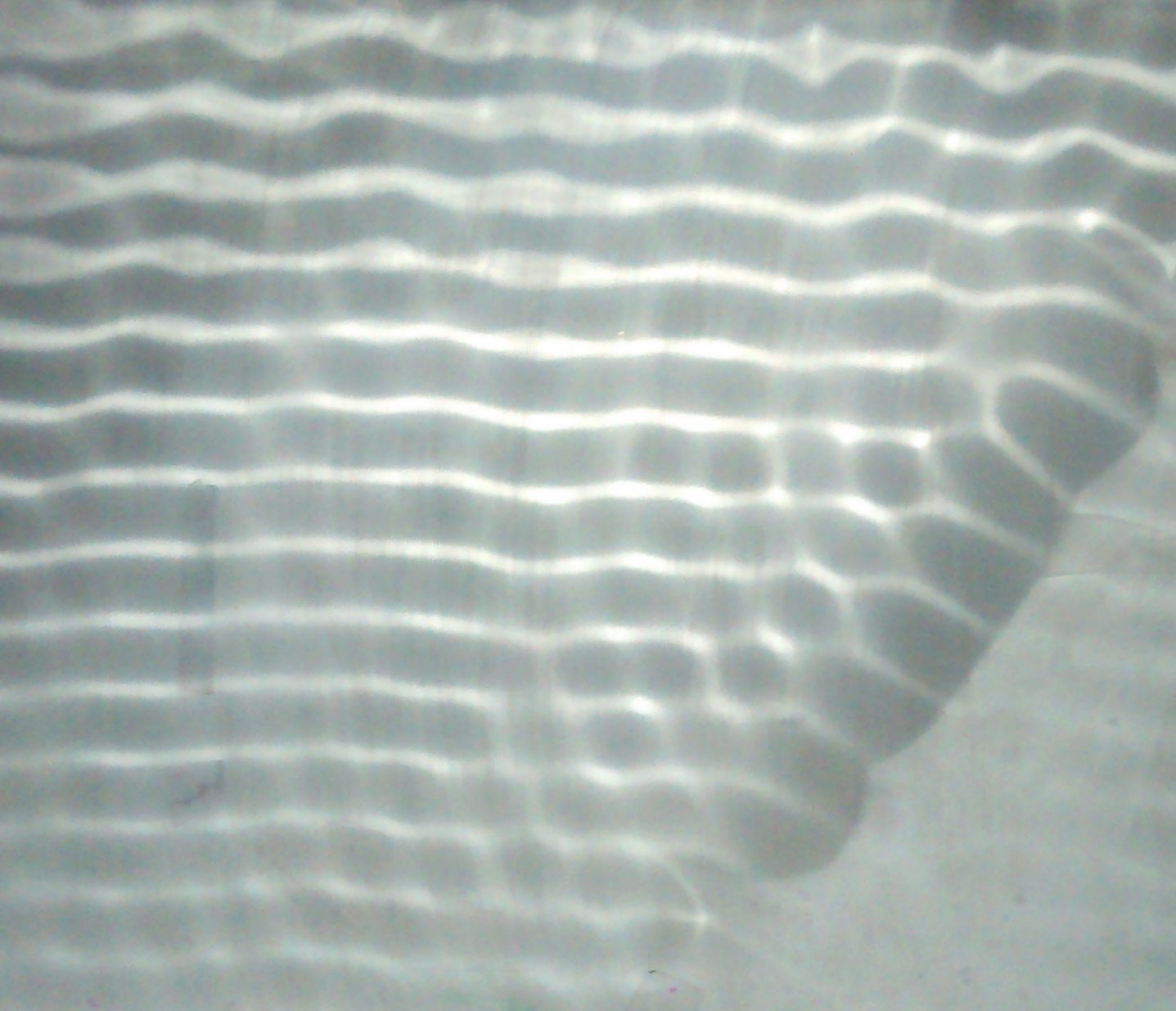
Two dippers in a ripple tank make overlapping circular water waves
تتوزع الموجة بعد المرور عبر فتحة ضيقة. هذا يسمى:
الصعوبة 1/5 · 100 عملة + مكافأة صغيرة عند الإنجاز الأول اليوم
التوزيع عبر فتحة أو حول حافة هو حيود — يكون الأكبر عندما تكون الفتحة بعرض طول موجي واحد تقريباً.
Worked examples
1. Water waves have frequency $50\ \text{Hz}$ and wavelength $0.40\ \text{m}$. $v = f\lambda = 50 \times 0.40 = 20\ \text{m/s}$.
2. A radio station broadcasts at $100\ \text{MHz}$. Radio waves travel at $3.0 \times 10^8\ \text{m/s}$, so $\lambda = \dfrac{v}{f} = \dfrac{3.0 \times 10^8}{1.0 \times 10^8} = 3.0\ \text{m}$.
Change kHz and MHz to Hz first. $100\ \text{MHz} = 1.0 \times 10^8\ \text{Hz}$. The frequency is set by the source, so when a wave enters a new material only its speed and wavelength change.
موجة ترددها 9 هرتز وطولها الموجي 0.60 متر. ما هي سرعتها، وهل تنقل المادة معها؟
9 ضرب 0.60 يساوي 5.4. التردد مضروباً في الطول الموجي يساوي السرعة.
ما هي سرعة الموجة؟
الصعوبة 1/5 · 100 عملة + مكافأة صغيرة عند الإنجاز الأول اليوم
9 ضرب 0.60 يساوي 5.4 متر في الثانية. الخيارات الأخرى — 10 متر في الثانية (نتيجة مثال الدرس لـ 5.0 هرتز و2.0 متر)؛ 3.0 م (الطول الموجي للدرس عند 330 متر في الثانية عند 110 هرتز).
You've got it
- a wave carries energy, not matter
- wave equation: $v = f\lambda$ (speed = frequency × wavelength)
- transverse (vibrate across travel) vs longitudinal (vibrate along travel; sound)
- waves can reflect, refract and diffract
Write from the data: find the wave speed
- A wave has frequency 9 Hz and wavelength 0.60 m.
- Find the speed. The wave carries energy, not the material.