Reversible reactions and equilibrium
مُقدَّم| English | المعنى |
|---|---|
| reversible reaction/rɪˈvɜːsɪbl rɪˈækʃn/ | تفاعل عكسي |
| dynamic equilibrium/daɪˈnæmɪk ˌiːkwɪˈlɪbrɪəm/ | توازن ديناميكي |
| closed system/kləʊzd ˈsɪstəm/ | نظام مغلق |
Reactions that go both ways
- Many reactions can run forwards and backwards at the same time.
- When the two directions balance, the reaction reaches equilibrium.
A reversible reaction is shown by the symbol:
الصعوبة 1/5 · 100 عملة + مكافأة صغيرة عند الإنجاز الأول اليوم
The ⇌ sign shows a reversible reaction.
Reversible reactions 可逆反应
- A reversible reaction can go both ways, shown by a ⇌ sign.
- The products can react to re-form the reactants.
Reversible reactions & equilibrium
يعمل النظام على معارضة التغير
Change the conditions and the equilibrium shifts to partly cancel your change.
At dynamic equilibrium, the forward and backward reactions:
الصعوبة 1/5 · 100 عملة + مكافأة صغيرة عند الإنجاز الأول اليوم
Equal rates mean constant amounts.
Equilibrium can only be reached in a:
الصعوبة 1/5 · 100 عملة + مكافأة صغيرة عند الإنجاز الأول اليوم
A closed system stops anything escaping.
Dynamic equilibrium 动态平衡
- In a closed system 密闭系统, the forward and backward reactions reach the same rate.
- This is dynamic equilibrium: both reactions continue, but the amounts stay constant.
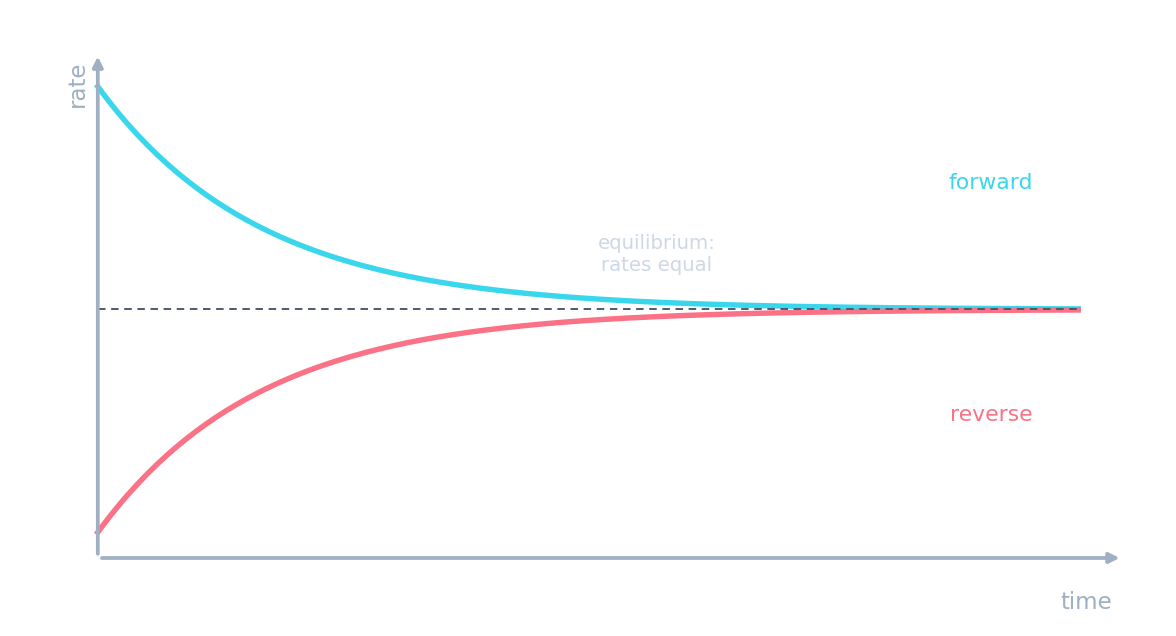
Forward and reverse rates become equal at dynamic equilibrium
At equilibrium, the reactions have completely stopped.
الصعوبة 1/5 · 100 عملة + مكافأة صغيرة عند الإنجاز الأول اليوم
Both reactions continue at the same rate — it is dynamic.
Changing temperature, pressure or ______ shifts the equilibrium position.
الصعوبة 1/5 · 100 عملة + مكافأة صغيرة عند الإنجاز الأول اليوم
The system responds to oppose the change.
Changing the conditions
- Changing temperature, pressure or concentration shifts the position of equilibrium.
- The system responds to oppose the change (more product or more reactant forms).
Equilibrium is dynamic, not stopped. The forward and backward reactions are still happening — they're just going at the same rate, so the overall amounts don't change.
Worked example: blue and white copper sulfate
Heating blue hydrated copper(II) sulfate gives white anhydrous copper(II) sulfate and water. Adding water turns it blue again and the tube gets hot.
- $\text{CuSO}_4{\cdot}5\text{H}_2\text{O} \rightleftharpoons \text{CuSO}_4 + 5\text{H}_2\text{O}$. The forward reaction (blue → white) is endothermic: it needs heat.
- The backward reaction (white → blue) is exothermic by the same amount of energy. A reversible reaction that takes in energy one way always gives it out the other way. This colour change is also the test for water.
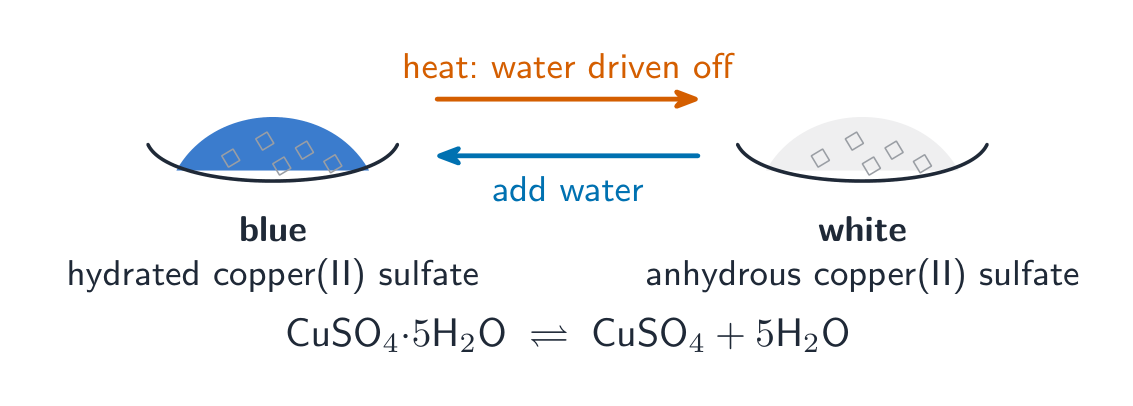
Heating blue copper sulfate drives off water; adding water turns it blue again
If the forward reaction of a reversible reaction is exothermic, the backward reaction is endothermic.
الصعوبة 1/5 · 100 عملة + مكافأة صغيرة عند الإنجاز الأول اليوم
The same energy that is released going one way must be taken in going back.
للدفاع $\text{N}_2 + 3\text{H}_2 \rightleftharpoons 2\text{NH}_3$, what does raising the pressure do?
الصعوبة 1/5 · 100 عملة + مكافأة صغيرة عند الإنجاز الأول اليوم
The system opposes the higher pressure by shifting to the side with fewer gas molecules.
Supplement: shifting the equilibrium (Haber process)
| Change | Equilibrium shifts | Yield of ammonia |
|---|---|---|
| raise the pressure | right (4 gas molecules → 2) | increases |
| raise the temperature | left (endothermic direction) | decreases |
| remove ammonia | right | increases |
| add a catalyst | no shift; equilibrium reached faster | unchanged |
- Industry uses 450 °C, 20 000 kPa and an iron catalyst: a compromise between yield, rate and cost.
The forward Haber reaction is exothermic. Why is 450 °C used rather than a lower temperature?
الصعوبة 1/5 · 100 عملة + مكافأة صغيرة عند الإنجاز الأول اليوم
Lower temperature favours the exothermic forward reaction, but reactions become too slow; 450 °C is a compromise.
Adding an iron catalyst increases the equilibrium yield of ammonia.
الصعوبة 1/5 · 100 عملة + مكافأة صغيرة عند الإنجاز الأول اليوم
A catalyst speeds up both directions equally, so equilibrium is reached faster but the yield does not change.
You've got it
- a reversible reaction (⇌) goes both ways
- in a closed system it reaches dynamic equilibrium (forward rate = backward rate)
- changing temperature, pressure or concentration shifts the equilibrium position
Write from this case
- The equilibrium is N2 plus 3 H2 in balance with 2 NH3.
- The pressure is increased and the temperature is held constant.
Which way does the equilibrium shift?
Higher pressure favours the side with fewer gas moles.
What does a higher pressure do to this equilibrium?
الصعوبة 1/5 · 100 عملة + مكافأة صغيرة عند الإنجاز الأول اليوم
Two gas molecules on the right are favoured over four on the left.