Ionic compounds
مُقدَّم| English | المعنى |
|---|---|
| giant lattice/ˈdʒaɪənt ˈlætɪs/ | شبكة بلورية عملاقة |
| molten/ˈməʊltn/ | مذاب |
| dissolved/dɪˈsɒlvd/ | ذائب |
Giant grids of ions
- A single grain of salt contains trillions of ions, locked in a perfect repeating pattern.
- Ionic compounds form giant lattices 巨型晶格 — and this structure explains all their properties.
Ionic compounds form a:
الصعوبة 1/5 · 100 عملة + مكافأة صغيرة عند الإنجاز الأول اليوم
A giant 3D lattice of ions forms.
The regular 3D arrangement of ions in an ionic compound is called a ______.
الصعوبة 1/5 · 100 عملة + مكافأة صغيرة عند الإنجاز الأول اليوم
A giant ionic lattice.
The giant ionic lattice
- Ionic compounds are giant lattices of oppositely charged ions.
- Strong forces attract the ions in all directions, in a regular 3D pattern.
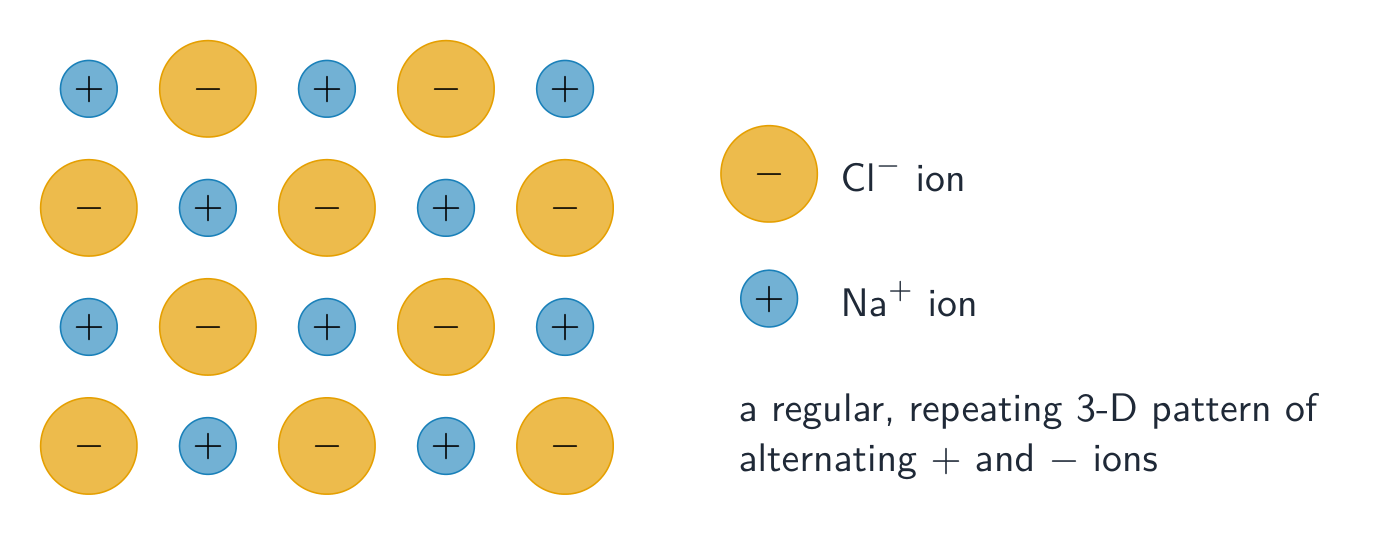
Ions pack into a giant lattice: a regular pattern of alternating positive and negative ions
الرابطة الأيونية (نقل الإلكترون)
Step through it: the metal hands its outer electron(s) to the non-metal, both reach full shells, and the resulting + and − ions attract.
Ionic compounds have high melting points because:
الصعوبة 1/5 · 100 عملة + مكافأة صغيرة عند الإنجاز الأول اليوم
Strong ionic attractions need lots of energy to break.
High melting points
- The strong attractions between ions take a lot of energy to break.
- So ionic compounds have high melting and boiling points and are solid at room temperature.
An ionic compound conducts electricity when:
الصعوبة 1/5 · 100 عملة + مكافأة صغيرة عند الإنجاز الأول اليوم
Conduction needs free-moving ions.
A solid ionic compound conducts electricity well.
الصعوبة 1/5 · 100 عملة + مكافأة صغيرة عند الإنجاز الأول اليوم
Its ions are locked in place, so it does not conduct.
Conducting electricity
- Ionic compounds conduct only when molten 熔融 or dissolved 溶解的 — when the ions are free to move.
- As a solid, the ions are locked in place, so it does not conduct.
Solid ionic compounds don't conduct. The ions are fixed in the lattice. Only when melted or dissolved can the charged ions move and carry a current.
Worked example: is it ionic?
A white solid X melts at 801 °C. Solid X does not conduct electricity, but a solution of X in water does. Is X ionic?
- High melting point → strong forces in a giant structure. Does not conduct as a solid, but does when dissolved → it has ions that are fixed in the solid but free to move in solution.
- So X is a giant ionic compound (it is in fact sodium chloride). A metal would conduct as a solid; a simple molecular substance would melt at a low temperature.
Which substance is most likely to be ionic?
الصعوبة 1/5 · 100 عملة + مكافأة صغيرة عند الإنجاز الأول اليوم
A high melting point and conducting only when molten fit an ionic lattice (this is magnesium oxide). The others are simple molecular, a metal and giant covalent.
You've got it
- ionic compounds are giant lattices of oppositely charged ions
- strong attractions → high melting/boiling points
- they conduct only when molten or dissolved (free ions), not when solid
Write from this case
- Solid sodium chloride does not conduct electricity.
- The same compound is melted.
Why can the melt conduct?
Mobile ions carry the current in a molten ionic compound.
Why does molten sodium chloride conduct?
الصعوبة 1/5 · 100 عملة + مكافأة صغيرة عند الإنجاز الأول اليوم
Melting frees the ions from the lattice.