خطة التعلم الخاصة بك · متابعة · مراجعة →
非(要) … 不可 (يجب تماماً / مصمم على)
مُقدَّميبقى موقعك المحفوظ في هذا المتصفح. لا يكتمل استئناف الموقع الدرس أو الإجابة على أسئلته.
 6:57
HSK 6 قواعد 7: أنماط متقدمة
岂不是. ميننا تؤمن بالفعل أن تصميماً جديداً الليلة فكرة سيئة. مع 岂不是 تضع هذه الاعتقاد في شكل سؤال وتُشجّع المجموعة على الاتفاق. هي لا تفعل…
شروحات إنجليزية + أمثلة ماندرين · التسميات تتبع النص المنطوق
في هذا الدرس
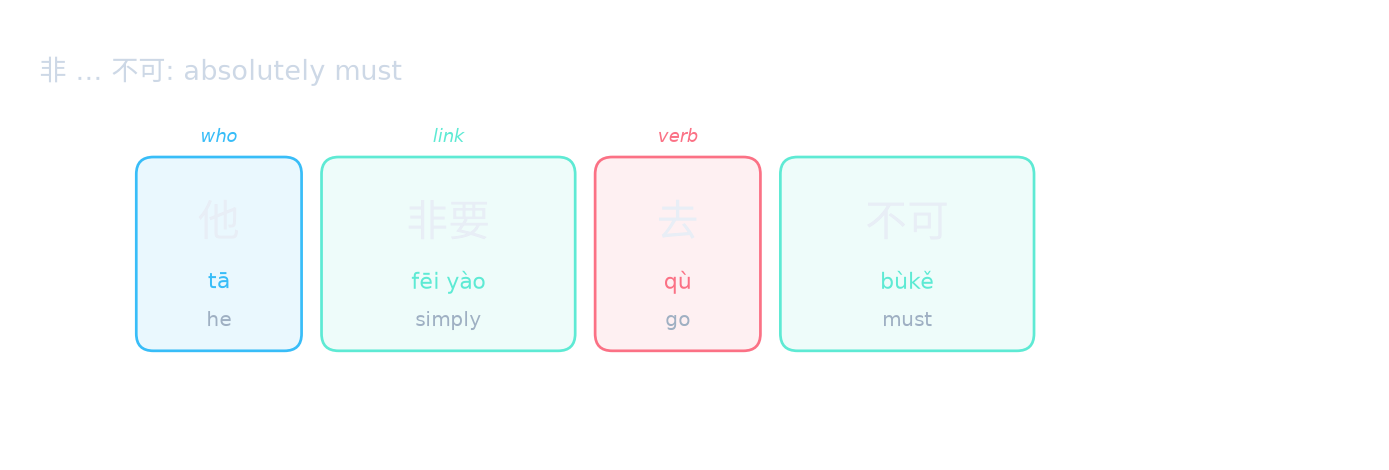
He simply must go
- Your little brother wants to go to the amusement park in the rain and won't take no for an answer.
- down / next; to fall (rain), get off下so much这么big大(modifier / structural particle)的rain雨,he他to want absolutely非要go去(must)不可。 — "It's pouring, and he simply insists on going."
- Goal: say someone insists on something with (must)非 (want / will / need要) + verb + (must)不可.
(must)非 (want / will / need要) + verb + (must)不可 = must, insist on
- (must)非…(must)不可 is a double negative: "not doing it is not allowed" → must, absolutely have to.
- With want / will / need要, it often shows insistence: he他to want absolutely非要go去(must)不可 — "He insists on going."
this matter这件事(must)非he他go去(must)不可。
Complete: “This problem absolutely must be solved.” 这个问题非解决____。
الصعوبة 1/5 · 100 عملة + مكافأة صغيرة عند الإنجاز الأول اليوم
非…不可.
Necessity and stubbornness
- Necessity: this这个problem问题(must)非be solved解决(must)不可。 — "This problem absolutely must be solved."
- Stubbornness: I / me我to speak说need not不用,she / her她to want absolutely非要to treat (someone to a meal)请客(must)不可。 — "I said there was no need, but she insisted on paying."
this这个problem问题(must)非be solved解决(must)不可。
Build: “She insisted on paying.”
الصعوبة 3/5 · 200 عملة + مكافأة صغيرة عند الإنجاز الأول اليوم
非要 + verb + 不可.
Keep both parts
- In careful style, keep (must)不可 (or won't do不行 / won't do / (…不成?) surely not不成) at the end: (must)非go去(must)不可. In speech (must)不可 is sometimes dropped: he他to want absolutely非要go去.
- (must)非 + verb, then (must)不可: not (must)非(must)不可go去.
- (must)非 + person + verb + (must)不可 = only this person will do: 这件matter事(must)非he他go去(must)不可。 — "He's the one who has to go." he他(must)非go去(must)不可。 — "He simply must go."
Which order is correct?
الصعوبة 1/5 · 100 عملة + مكافأة صغيرة عند الإنجاز الأول اليوم
The frame is 非 + (要) + verb + 不可, meaning “must, insist on”: 他非要去不可. 非 comes before the verb phrase and 不可 closes the sentence.
(must)非…(must)不可 versus must必须 and definitely / certain一定want / will / need要
- must必须 / definitely / certain一定want / will / need要 = must (plain).
- (must)非…(must)不可 is more emphatic, often with a sense of insistence or "no other way".
you你must必须on time按时finish完成。
非…不可 is more emphatic than 必须.
الصعوبة 1/5 · 100 عملة + مكافأة صغيرة عند الإنجاز الأول اليوم
It stresses there is no other way.
Recap
- (must)非 (want / will / need要) + verb + (must)不可 = absolutely must / insist on (emphatic double negative).
- Plainer: must必须 / definitely / certain一定want / will / need要.
Read the full reference: HSK 6 grammar — Sentence patterns.
Your little brother wants to go to the amusement park in the rain and won't take no for an answer. Close the examples. Say a Mandarin response, then write it in Chinese. Explain briefly in English what the lesson’s pattern adds. Compare with the model, then change one detail and try again.
This is supported productive practice. Compare meaning and structure; your answer need not copy the model. A partner or teacher must hear the spoken response to comment on pronunciation.
ما المشكلة؟ لا يرى ذلك سوى فريق الموقع.