خطة التعلم الخاصة بك · متابعة · مراجعة →
مكمّلات الدرجة المتقدمة (得 + 很 / 要命 …)
مُقدَّميبقى موقعك المحفوظ في هذا المتصفح. لا يكتمل استئناف الموقع الدرس أو الإجابة على أسئلته.
 5:44
HSK 5 القواعد 18: المكمّلات
صفة يتبعها 得 ثم 很 أو 不得了 أو 要命 أو不行. تعني 不得了 درجة لا تصدق؛ وتعني 要命 حتى الموت (عامية)؛ وتعني 不行 بشكل سيء جداً (عامية). النمط: 形容词…
شروحات إنجليزية + أمثلة ماندرين · التسميات تتبع النص المنطوق
في هذا الدرس
After a twenty-kilometre hike
- You finally reach the hostel after walking all day in the mountains.
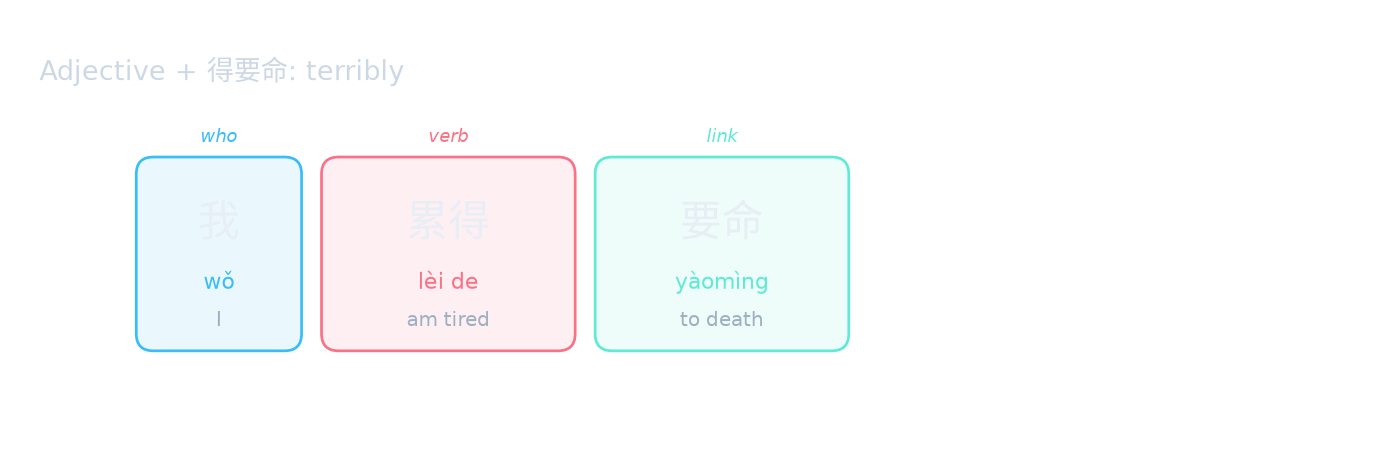
- I我tired累(degree marker)得terribly要命,what什么all / both都not want to不想to do; to make做(completed / change)了。 — "I'm dead tired; I don't feel like doing anything."
- Goal: make degree complements stronger with (degree marker)得 + degree / adjective linker很 / terribly要命 / unbearably不行.
Adj + (degree marker)得 + degree / adjective linker很 / terribly要命 / unbearably不行 / extremely / terrible不得了
- These degree complements push an adjective to a high degree: good好(degree marker)得degree / adjective linker很, tired累(degree marker)得terribly要命, hungry饿(degree marker)得unbearably不行, busy忙(degree marker)得extremely / terrible不得了 — "I'm incredibly busy."
- They all follow the pattern Adj + (degree marker)得 + complement and end the clause.
I我hungry饿得unbearably不行了。
Complete: “I'm starving.” 我饿____不行了。
الصعوبة 1/5 · 100 عملة + مكافأة صغيرة عند الإنجاز الأول اليوم
Adj + 得 + 不行.
Different flavours
- (degree marker)得degree / adjective linker很: emphatic but mild — here这里quiet安静(degree marker)得degree / adjective linker很 ("It's very quiet here"). (degree marker)得terribly要命 / (degree marker)得unbearably不行: very colloquial, often a complaint — aching疼(degree marker)得terribly要命.
- (degree marker)得extremely / terrible不得了: very strong, good or bad — happy; glad高兴(degree marker)得extremely / terrible不得了 — "I'm extremely happy."
he他tooth牙aching疼得terribly要命。
Match each phrase to its meaning.
الصعوبة 2/5 · 140 عملة + مكافأة صغيرة عند الإنجاز الأول اليوم
All are degree complements with different flavours.
Not literal, and no extra degree / adjective linker很
- terribly要命 does not mean real danger: 冷得terribly要命 just means "freezing".
- No degree / adjective linker很 before the adjective: tired累(degree marker)得terribly要命, not degree / adjective linker很tired累(degree marker)得terribly要命.
冷得要命 means it is literally dangerously cold.
الصعوبة 1/5 · 100 عملة + مكافأة صغيرة عند الإنجاز الأول اليوم
要命 is just an intensifier here.
Versus the plain degree adverb
- very非常tired累 / especially / special特别tired累 are neutral and fine in writing.
- (degree marker)得terribly要命 and (degree marker)得unbearably不行 are spoken; in a formal essay, very非常 or very十分 is safer.
I我today今天very非常tired累。
Which suits a formal essay?
الصعوبة 1/5 · 100 عملة + مكافأة صغيرة عند الإنجاز الأول اليوم
The 得 complements are colloquial; essays use 非常.
Recap
- Adj + (degree marker)得 + degree / adjective linker很 / terribly要命 / unbearably不行 / extremely / terrible不得了 = very, extremely (spoken, expressive).
- Not literal; no degree / adjective linker很 before; use very非常 in writing.
Read the full reference: HSK 5 grammar — Complements.
You finally reach the hostel after walking all day in the mountains. Close the examples. Say a Mandarin response, then write it in Chinese. Explain briefly in English what the lesson’s pattern adds. Compare with the model, then change one detail and try again.
This is supported productive practice. Compare meaning and structure; your answer need not copy the model. A partner or teacher must hear the spoken response to comment on pronunciation.