خطة التعلم الخاصة بك · متابعة · مراجعة →
任何 + Noun + 都 / 也 (أي)
مُقدَّميبقى موقعك المحفوظ في هذا المتصفح. لا يكتمل استئناف الموقع الدرس أو الإجابة على أسئلته.
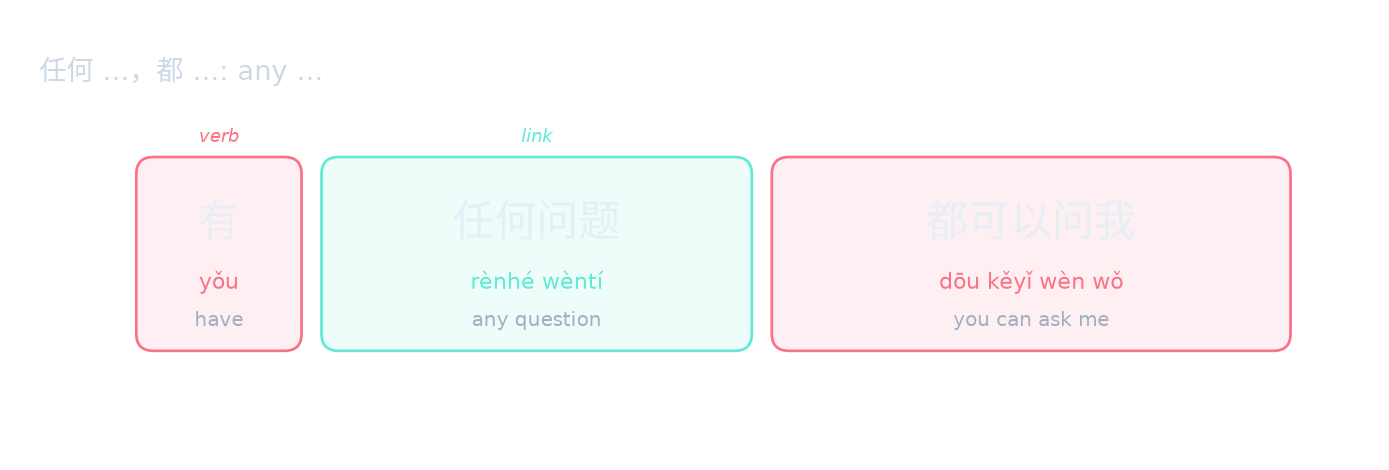
Any questions?
- At the end of the lesson your teacher wants to be sure everyone understood.
- to have / there is有any任何question / problem问题,(all)都can可以to ask问I我。 — "If you have any questions at all, you can ask me."
- Goal: say "any" with any任何 + noun + (all)都 / also也.
any任何 + Noun + (all)都 / also也
- any任何 + noun = "any (at all)"; (all)都 or also也 usually follows: any任何person人(all)都can可以take part参加 — "Anyone can participate."
- In the negative: any任何person人(all)都won't不to know知道 / he / him他not have / haven't没有any任何question / problem问题 — "nobody / no … at all".
any任何person人(all)都can可以take part参加。
Complete: “Anyone can take part.” ____人都可以参加。
الصعوبة 1/5 · 100 عملة + مكافأة صغيرة عند الإنجاز الأول اليوم
任何 + noun + 都.
Total statements
- I我won't / can't不会tell告诉any任何person人。 — "I won't tell anyone."
- any任何time; when时候you你(all)都can可以to / for / give给I我to make a telephone call打电话。 — "You can call me any time."
I我won't不(will)会tell告诉any任何person人。
Build: “I won't tell anyone.”
الصعوبة 3/5 · 200 عملة + مكافأة صغيرة عند الإنجاز الأول اليوم
Negative verb + 任何 + noun.
Add (all)都 as a subject
- As a subject, any任何 + noun needs (all)都 / also也: any任何person人(all)都to know知道, not any任何person人to know知道.
- any任何 goes before a noun only; it does not stand alone: any任何person人, not just any任何.
Which sentence is correct?
الصعوبة 1/5 · 100 عملة + مكافأة صغيرة عند الإنجاز الأول اليوم
任何人都知道这件事 is right: 任何 + noun as the subject needs 都 before the verb, and 任何 always comes before its noun.
any任何 versus question word + (all)都
- Spoken: anyone谁(all)都can可以come来 — "Anyone can come."
- any任何person人(all)都can可以come来 says the same in a more formal way.
anyone谁(all)都can可以come来。
谁都可以来 is a spoken way to say 任何人都可以来.
الصعوبة 1/5 · 100 عملة + مكافأة صغيرة عند الإنجاز الأول اليوم
QW + 都 is the spoken equivalent.
Recap
- any任何 + noun + (all)都 / also也 = any … at all; negative = no … at all.
- Needs a noun and, as a subject, (all)都 / also也. anyone谁(all)都 is the spoken equivalent.
Read the full reference: HSK 4 grammar — Sentence patterns.
At the end of the lesson your teacher wants to be sure everyone understood. Close the examples. Say a Mandarin response, then write it in Chinese. Explain briefly in English what the lesson’s pattern adds. Compare with the model, then change one detail and try again.
This is supported productive practice. Compare meaning and structure; your answer need not copy the model. A partner or teacher must hear the spoken response to comment on pronunciation.