خطة التعلم الخاصة بك · متابعة · مراجعة →
越来越 (أكثر فأكثر)
مُقدَّميبقى موقعك المحفوظ في هذا المتصفح. لا يكتمل استئناف الموقع الدرس أو الإجابة على أسئلته.
The city keeps changing
- You go back to your hometown after five years: more cars, more tall buildings, more people.
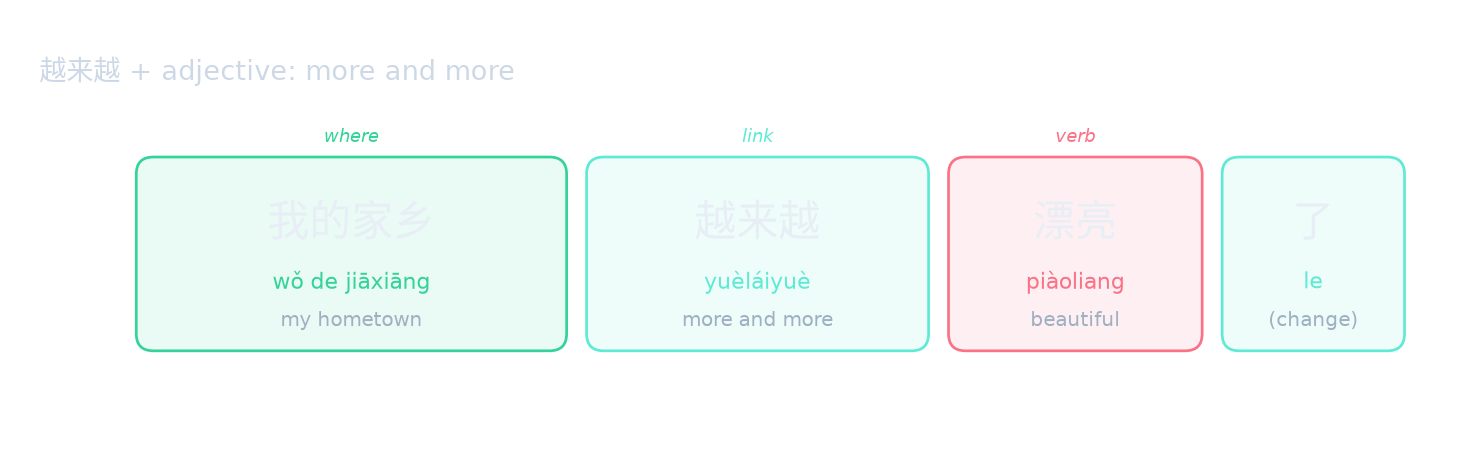
- I我(modifier / structural particle)的hometown家乡more and more越来越pretty漂亮(completed / change)了。 Wǒ de jiāxiāng yuèláiyuè piàoliang le. — "My hometown is getting more and more beautiful."
- Goal: say that something keeps changing over time with more and more越来越, including more and more people (more and more越来越many多) and less and less (more and more越来越not不 …).
more and more越来越 + Adjective
- Subject + more and more越来越 + Adj (+ (completed / change)了) = "more and more …": a quality keeps growing over time.
- (completed / change)了 at the end is common because the sentence reports a change: the weather天气more and more越来越cold冷(completed / change)了。
the weather天气more and more越来越cold冷了。
Complete: “Your Chinese is getting better and better.” 你的中文____好了。
الصعوبة 1/5 · 100 عملة + مكافأة صغيرة عند الإنجاز الأول اليوم
越来越 + Adj + 了 reports a growing change.
Feelings and abilities that grow
- Feeling verbs fit too: I我more and more越来越like喜欢this这个city城市(completed / change)了。 — "I like this city more and more."
- So do verbs of ability with an object: he / him他more and more越来越can / will会to prepare a meal做饭(completed / change)了。 — "He is getting better and better at cooking."
I我more and more越来越like喜欢this这个city城市了。
Build: “I like this city more and more.”
الصعوبة 3/5 · 200 عملة + مكافأة صغيرة عند الإنجاز الأول اليوم
Subject + 越来越 + feeling verb + object + 了.
more and more越来越many多 / more and more越来越few; little少, and the negative
- Numbers that grow or shrink: learn学Chinese汉语(modifier / structural particle)的people人more and more越来越many多(completed / change)了。 Xué Hànyǔ de rén yuèláiyuè duō le. — "More and more people are learning Chinese."
- Before a noun it usually takes (modifier / structural particle)的: more and more越来越many多(modifier / structural particle)的people人like喜欢to ride骑bicycle自行车。 — "More and more people like cycling."
- Less and less: put not不 after more and more越来越: he / him他more and more越来越not want to不想to go to school上学(completed / change)了。 — "He wants to go to school less and less." ✗ he / him他not不more and more越来越want / think / miss想to go to school上学。
learn学Chinese汉语的people人more and more越来越many多了。
“More and more people are learning to swim.” Which is correct?
الصعوبة 1/5 · 100 عملة + مكافأة صغيرة عند الإنجاز الأول اليوم
越来越多 comes before the noun, usually with 的: 越来越多的人. No 很 before 越来越.
Build: “I like this game less and less.”
الصعوبة 3/5 · 200 عملة + مكافأة صغيرة عند الإنجاز الأول اليوم
不 goes after 越来越: 越来越不喜欢.
One degree word only
- No degree / adjective linker很 or very非常 after more and more越来越: more and more越来越good好, not more and more越来越degree / adjective linker很good好.
- more and more越来越 comes after the subject and before the adjective: he / him他more and more越来越tall; high高, not more and more越来越he / him他tall; high高.
Which sentence is correct?
الصعوبة 1/5 · 100 عملة + مكافأة صغيرة عند الإنجاز الأول اليوم
东西越来越贵了 is right: 越来越 goes after the subject and takes a bare adjective. Adding 很 (越来越很贵, 很越来越贵) is wrong, and 越来越 cannot come before the subject.
more and more越来越 versus the more越…the more越…
- more and more越来越 has one quality that grows with time.
- the more越 A the more越 B links two things: the more A, the more B: the rain雨the more越falls下the more越heavy大 — "The rain is getting heavier and heavier (the longer it rains)."
the rain雨the more越falls下the more越heavy大。
越来越 links two different things, as in “the more you practise, the better you get.”
الصعوبة 1/5 · 100 عملة + مكافأة صغيرة عند الإنجاز الأول اليوم
That is 越 A 越 B. 越来越 has one quality that grows over time.
Recap
- more and more越来越 + Adj (+ (completed / change)了) = more and more …, a change over time.
- Bare adjective after it, no degree / adjective linker很; feeling verbs such as like喜欢 also work.
- more and more越来越many多 ((modifier / structural particle)的 + noun) = more and more; more and more越来越not不 + verb / adj = less and less.
Read the full reference: HSK 3 grammar — Basic sentence patterns.
You go back to your hometown after five years: more cars, more tall buildings, more people. Close the examples. Say a Mandarin response, then write it in Chinese. Explain briefly in English what the lesson’s pattern adds. Compare with the model, then change one detail and try again.
This is supported productive practice. Compare meaning and structure; your answer need not copy the model. A partner or teacher must hear the spoken response to comment on pronunciation.