Understanding yourself and others
مُقدَّم| English | المعنى |
|---|---|
| personality trait/ˌpɜːsəˈnælɪti treɪt/ | سمة شخصية |
| introversion and extraversion/ˌɪntrəˈvɜːʃn ænd ˌekstrəˈvɜːʃn/ | الانطواء والانفتاح الاجتماعي |
| self-awareness/self əˈweənəs/ | الوعي بالذات |
| values/ˈvæljuːz/ | القيم |
| empathy/ˈempəθi/ | التعاطف |
A quiet meeting does not explain a person
- Goal: in group work, describe what people actually did (not who you think they are), ask questions that bring out each person's contribution, and agree a fair next step.
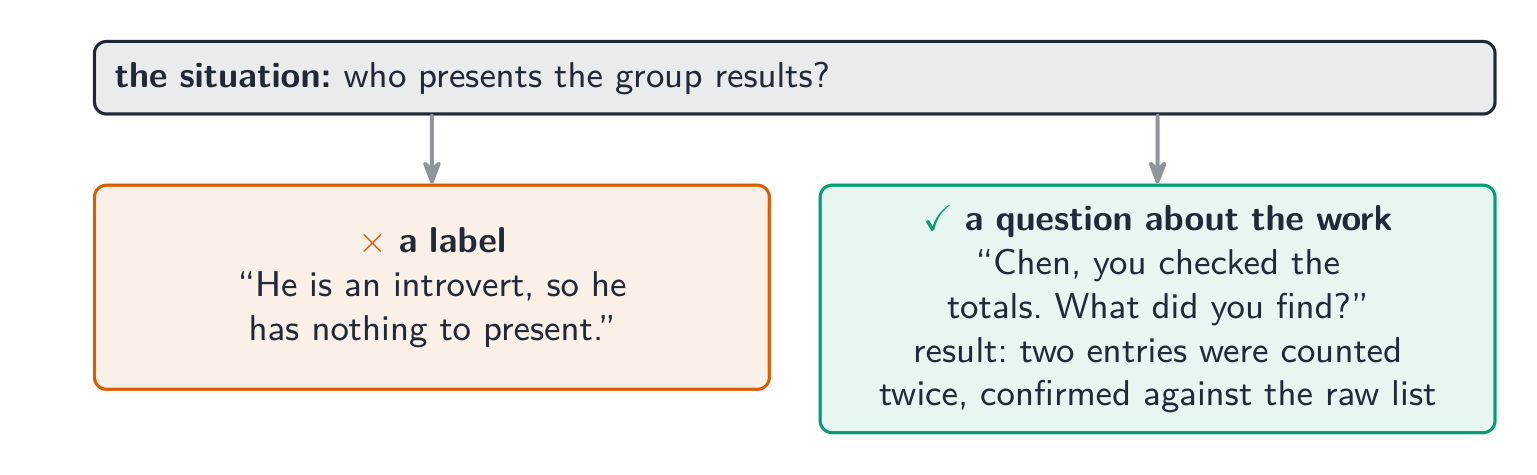
- Chen brings a carefully checked survey table to a group meeting but says nothing for twenty minutes. Wei says, "He's an introvert, so he has nothing to present." But the table shows that Chen prepared well. Silence in one meeting does not tell you his personality, what he knows, or whether he wants to help.
Which of these are facts about the meeting, not guesses? Choose all that apply.
الصعوبة 2/5 · 140 عملة + مكافأة صغيرة عند الإنجاز الأول اليوم
The table and the silence were seen by everyone. "Introvert" and "does not want to help" are guesses about why, and one meeting cannot show them.
A label is not a role
- A personality trait 人格特质 is a way of thinking, feeling or behaving that lasts over time, so one action in one meeting is not enough to show it. Introversion and extraversion 内向与外向 are a scale, not two boxes: most people are somewhere in between (APA definition).
- These labels do not tell you what someone knows or how well they present. Shy and introverted are not the same thing: a quiet person may present very well, and a talkative person may need to check their numbers. So never give or take away someone's task because of a label.
Which description treats introversion and extraversion appropriately?
الصعوبة 1/5 · 100 عملة + مكافأة صغيرة عند الإنجاز الأول اليوم
These are broad tendencies, not a diagnosis from one meeting. A label alone establishes neither skill nor the reason for silence.
Know yourself from evidence
- Self-awareness 自我认知 means noticing your own habits and limits. Use what you actually did, not a label: weak: "I'm bad at group work." Better: "I answered well after I had read the question, but I interrupted twice when the group talked quickly." The better version leads to an action: next time, write the point down and wait for my turn.
- Values 价值观 are what a person thinks is important. Rui wants to check every source; Lin wants to finish early. Both want a good report on time. Instead of arguing about who is right, ask: "How can we check the sources and still finish by Friday?"
Rui says checking every source matters most; Lin says finishing early matters most. They share the report goal. Which difference is explicitly described?
الصعوبة 1/5 · 100 عملة + مكافأة صغيرة عند الإنجاز الأول اليوم
The stated priorities differ. Disagreement alone would not establish different values, ability or effort.
Which self-reflection is based on evidence and leads to an action?
الصعوبة 1/5 · 100 عملة + مكافأة صغيرة عند الإنجاز الأول اليوم
It names what happened (I spoke most of the time), when, and a specific change to try. The other two are labels, about yourself or others, with no evidence and no next step.
Ask about the work, not the person
Wei asks, "Chen, you checked the response totals. What did you find?" Chen explains that two entries were counted twice. The group compares the table with the original list and confirms it.
- Why it works: a specific question about Chen's work gave him a clear way in, and the group got a useful correction. It still does not tell us why he was quiet before, so the group should agree turns for the next meeting and see how it goes.
Useful phrases for group work
- Ask about someone's work: "You worked on the totals. What did you find?"
- Share turns fairly: "Shall we each give a one-minute update?"
- Offer a choice: "Would you rather show the table or explain it?"
- Check you understood: "Can I check that I understood you correctly? You mean…"
A group member has been silent for twenty minutes. What is the strongest move?
الصعوبة 1/5 · 100 عملة + مكافأة صغيرة عند الإنجاز الأول اليوم
A specific question offers an opening about prepared work. Check the response; it does not establish the reason for silence.
Write one question that would bring a quiet teammate into a discussion about a survey they helped design.
الصعوبة 3/5 · 200 عملة + مكافأة صغيرة عند الإنجاز الأول اليوم
A question about the survey offers a specific opening. Listen to the response and check any claim against the work; do not assume the reason for silence.
Mei has been quiet, but she made the slides. Which question is most likely to bring out her contribution?
الصعوبة 1/5 · 100 عملة + مكافأة صغيرة عند الإنجاز الأول اليوم
It is about her work and gives her a specific, easy way in. "Why are you so quiet?" makes her feel judged, and a question to everyone may still leave her out.
Understanding someone needs a check
- Empathy 同理心 means trying to see something from another person's point of view. It does not mean guessing their feelings and treating the guess as fact. Ask instead: "Would you prefer to show the table first, or explain the two entries?" and be ready for an answer you did not expect.
- A group can help everyone take part: time to prepare, written notes, clear turns. Everyone still does the required task, and any agreed support (for example, an accessibility arrangement) is followed.
A personality label alone establishes that a student is exempt from the required presentation.
الصعوبة 1/5 · 100 عملة + مكافأة صغيرة عند الإنجاز الأول اليوم
Check task rules and agreed support. A personality label alone establishes neither an exemption nor the absence of support needs.
Observe → ask → check → agree a next step. Keep what happened (Chen prepared a table and found two errors) separate from what you guess (he is an introvert). Ask about people's work, not their personality.