Elastic and Inelastic Collisions
مُقدَّم| English | المعنى |
|---|---|
| elastic collision/ɪˈlæstɪk kəˈlɪʒn/ | تصادم مرن |
| inelastic collision/ɪnɪˈlæstɪk kəˈlɪʒn/ | تصادم غير مرن |
Click-clack balls vs a lump of clay
- Drop a steel ball onto a Newton's cradle and it clicks crisply — energy bounces along, barely lost.
- Throw a lump of clay at a wall and it just... splats, going nowhere.
- For a system including the wall or cradle and Earth, total momentum is conserved; the colliding objects treat kinetic energy very differently.
- Sorting collisions by what happens to KE is the last big idea of momentum.
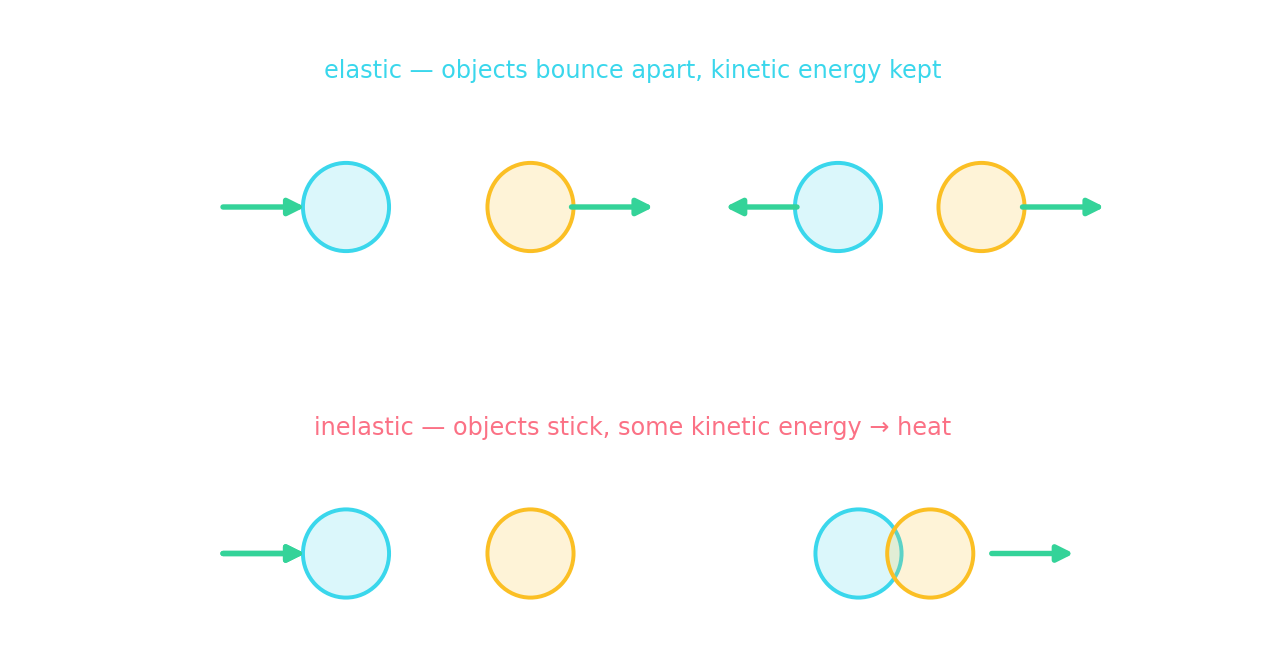
Elastic collisions keep kinetic energy
- In an elastic collision 弹性碰撞, total kinetic energy is conserved as well as momentum.
- The objects bounce apart with no energy lost to heat or sound.
- Perfectly elastic collisions are an idealisation — gas molecules come close.
- Both $\sum p$ and $\sum E_k$ are the same before and after.
في رابطة أيونية مرن collision, which quantity is conserved besides momentum?
الصعوبة 1/5 · 100 عملة + مكافأة صغيرة عند الإنجاز الأول اليوم
An elastic collision conserves الطاقة الحركية as well as momentum.
Inelastic collisions lose kinetic energy
- In an inelastic collision 非弹性碰撞, momentum is conserved but kinetic energy is not.
- The "lost" KE turns into heat, sound and deformation.
- A perfectly inelastic collision is the extreme case: the objects stick together.
- Most real, everyday collisions (cars, clay, tackles) are inelastic.
Run a collision
Change the masses and speeds, run the collision, and compare the kinetic energy before and after.
In a perfectly inelastic collision the objects ____ together.
الصعوبة 1/5 · 100 عملة + مكافأة صغيرة عند الإنجاز الأول اليوم
A perfectly inelastic collision has the objects stick together and move as one.
Select جميعها true statements about collisions.
الصعوبة 2/5 · 140 عملة + مكافأة صغيرة عند الإنجاز الأول اليوم
Elastic keeps KE; all isolated collisions keep momentum; perfectly inelastic means sticking. Inelastic collisions do ليس keep KE.
Momentum is always conserved — energy is the test
- Momentum is conserved in every collision, elastic or not (given an isolated system).
- Kinetic energy is the dividing line: kept ⇒ elastic, lost ⇒ inelastic.
- To classify a collision, compare the total KE before and after.
- Never assume KE is conserved unless the collision is stated to be elastic.
Momentum is conserved in both elastic and inelastic collisions (for an isolated system).
الصعوبة 1/5 · 100 عملة + مكافأة صغيرة عند الإنجاز الأول اليوم
Momentum is always conserved in an isolated collision. Kinetic energy is the quantity that distinguishes the two types.
A collision keeps total momentum the same but the total kinetic energy drops. It is:
الصعوبة 1/5 · 100 عملة + مكافأة صغيرة عند الإنجاز الأول اليوم
Momentum conserved but KE lost ⇒ inelastic collision (the missing KE became heat).
Do not assume kinetic energy is conserved in a collision. Momentum is always conserved (isolated system), but KE is conserved only in an elastic collision. In an inelastic one, some KE becomes heat — even though momentum is unchanged.
A $2\ \text{kg}$ trolley at $3\ \tfrac{\text{m}}{\text{s}}$ sticks to a $1\ \text{kg}$ trolley at rest; together they move at $2\ \tfrac{\text{m}}{\text{s}}$. How much kinetic energy is lost, in joules?
الصعوبة 2/5 · 140 عملة + مكافأة صغيرة عند الإنجاز الأول اليوم
KE before $= \tfrac12(2)(9) = 9\ \text{J}$; after $= \tfrac12(3)(4) = 6\ \text{J}$. Lost $= 9 - 6 = 3\ \text{J}$.
The stick-together trolleys from the last lesson: $2\ \text{kg}$ at $3\ \tfrac{\text{m}}{\text{s}}$ into a $1\ \text{kg}$ at rest, ending at $2\ \tfrac{\text{m}}{\text{s}}$ together.
- KE before $= \tfrac12(2)(3^2) = 9\ \text{J}$.
- KE after $= \tfrac12(3)(2^2) = 6\ \text{J}$.
$3\ \text{J}$ was lost to heat — so this is an inelastic collision, as expected for sticking.
For an isolated system, momentum is conserved in all collisions. In an elastic collision, kinetic energy is also conserved (objects bounce). In an inelastic collision, some kinetic energy becomes heat; a perfectly inelastic collision has the objects stick together. Compare total KE to classify.
Write from the data: find the kinetic-energy loss
- Use the same sticking carts. 4 kg at 5 m/s joins 4 kg at rest and they move at 2.5 m/s.
- Find the kinetic energy lost.
A 4 kg cart at 5 m/s sticks to a 4 kg cart at rest. They then move at 2.5 m/s. How much kinetic energy is lost, and what kind of collision is this?
Use $E_k=\tfrac12 mv^2$. Before, $E_{k,i}=\tfrac12(4)(5^2)+\tfrac12(4)(0^2)=50\ \text{J}$. After, the combined mass is $8\ \text{kg}$: $E_{k,f}=\tfrac12(8)(2.5^2)=4(6.25)=25\ \text{J}$. The loss is $50-25=25\ \text{J}$. Sticking makes this a perfectly inelastic collision.
A 4 kg cart at 5 m/s sticks to a 4 kg cart at rest. Together they move at 2.5 m/s. How much kinetic energy is lost?
الصعوبة 1/5 · 100 عملة + مكافأة صغيرة عند الإنجاز الأول اليوم
Use $E_k=\tfrac12 mv^2$. Before, $E_{k,i}=\tfrac12(4)(5^2)+\tfrac12(4)(0^2)=50\ \text{J}$. After, the combined mass is $8\ \text{kg}$: $E_{k,f}=\tfrac12(8)(2.5^2)=4(6.25)=25\ \text{J}$. The loss is $50-25=25\ \text{J}$. Sticking makes this a perfectly inelastic collision.