The Greenhouse Effect
مُقدَّم 8:14
التغير العالمي
في عام ألف وتسعمائة وخمسة وثمانين، اكتشف علماء يدرسون السماء فوق أنتاركتيكا شيئًا مرعبًا: ثقبًا في طبقة الأوزون، وهو درع رقيق يحفظ…
سرد باللغة الإنجليزية · ترجمة نصية بالإنجليزية و中文 يمكنك التبديل بينهما
في هذا الدرس
| English | المعنى |
|---|---|
| greenhouse effect/ˈɡriːnhaʊs ɪˈfekt/ | الاحترار العالمي |
| infrared/ˌɪnfrəˈred/ | الأشعة تحت الحمراء |
| Greenhouse gases/ˈɡriːnhaʊs ˈɡæsɪz/ | غازات الدفيئة |
| carbon dioxide/ˈkɑːbən daɪˈɒksaɪd/ | ثاني أكسيد الكربون |
Why Earth is not frozen
- The Moon is the same distance from the Sun as Earth, but its average surface temperature is about −20 °C, with huge swings between day and night. Earth's average is about +15 °C. The difference is Earth's atmosphere.
- Without the greenhouse effect 温室效应, Earth's surface would average about −18 °C, roughly 33 °C colder. The natural greenhouse effect produces the surface temperature necessary for life.
The natural greenhouse effect is…
الصعوبة 1/5 · 100 عملة + مكافأة صغيرة عند الإنجاز الأول اليوم
The natural greenhouse effect keeps Earth about 33 C warmer — without it, the planet would freeze.
How the greenhouse effect works
- Sunlight (mostly visible light) passes through the atmosphere and warms the ground and oceans. The warm surface gives off energy as infrared 红外线 radiation (heat).
- Greenhouse gases 温室气体 absorb this infrared and re-emit it in all directions, including back down to the surface. The surface stays warmer than it would be if the infrared escaped straight to space.
How the greenhouse effect warms Earth
Follow sunlight in, and heat trying to escape, as greenhouse gases hold it back.
العنصر greenhouse effect is when gases in the atmosphere…
الصعوبة 1/5 · 100 عملة + مكافأة صغيرة عند الإنجاز الأول اليوم
العنصر greenhouse effect is greenhouse gases trapping heat, keeping Earth warm enough for life.
The principal greenhouse gases and their sources
| Gas | Main human sources |
|---|---|
| carbon dioxide (CO₂) | burning fossil fuels, deforestation, cement production |
| methane (CH₄) | cattle digestion, rice paddies, landfills, natural gas leaks, melting permafrost |
| nitrous oxide (N₂O) | synthetic fertilizers on farmland, animal manure, burning fuels |
| CFCs | old refrigerants and aerosol propellants |
| water vapour (H₂O) | mostly natural evaporation |
- Water vapour is a strong greenhouse gas, but it does not contribute significantly to climate change, because it has a short residence time in the atmosphere (about 9 days) before it rains out.
The main greenhouse gas released by burning fossil fuels is carbon ____.
الصعوبة 1/5 · 100 عملة + مكافأة صغيرة عند الإنجاز الأول اليوم
الكربون dioxide (CO2) is the main greenhouse gas humans add by burning fossil fuels.
Select جميعها greenhouse gases.
الصعوبة 2/5 · 140 عملة + مكافأة صغيرة عند الإنجاز الأول اليوم
CO2, methane, and water vapour all trap heat. Argon does not absorb infrared, so it is not one.
Why does water vapour not contribute significantly to global climate change?
الصعوبة 1/5 · 100 عملة + مكافأة صغيرة عند الإنجاز الأول اليوم
Water vapour rains out within about 9 days, so its level is set by temperature, not by direct human emissions.
Match each source to the greenhouse gas it mainly releases.
الصعوبة 2/5 · 140 عملة + مكافأة صغيرة عند الإنجاز الأول اليوم
Cattle and rice paddies release methane; fertilizers release N₂O; burning fossil fuels releases CO₂.
Global warming potential (GWP)
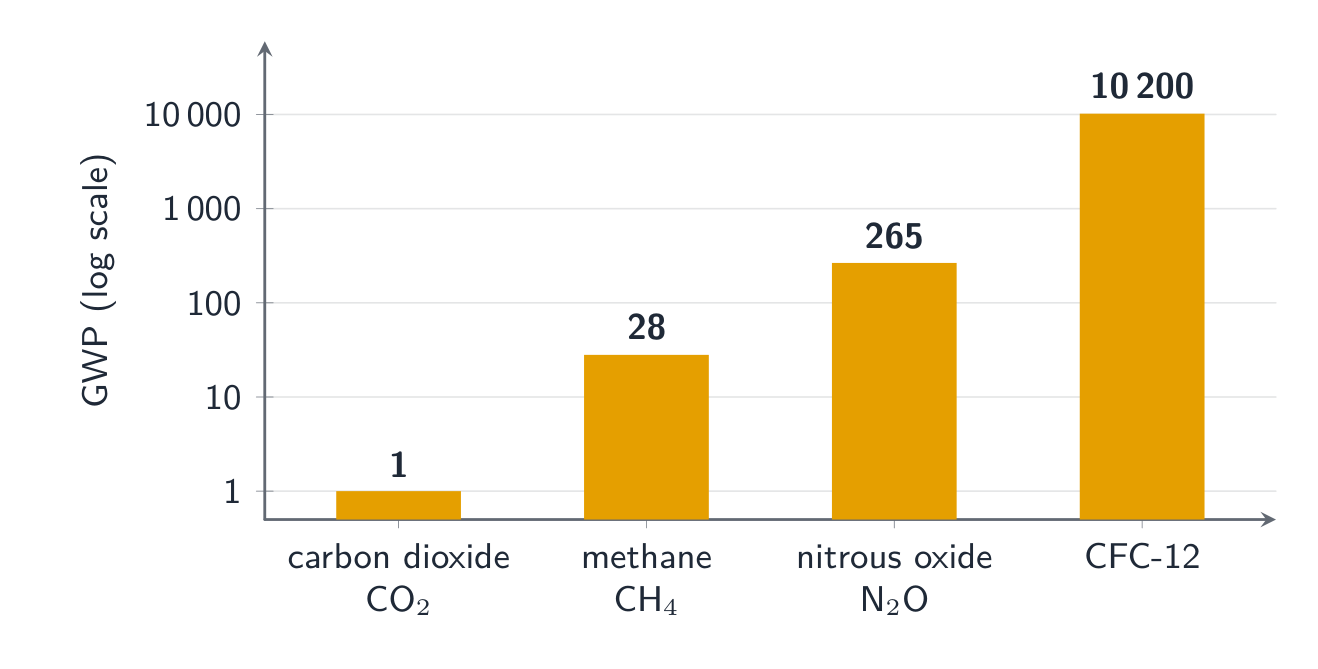
- GWP compares how much heat a gas traps over a set time (usually 100 years) compared with the same mass of CO₂. CO₂ is the reference: GWP = 1.
- Ranking: CFCs have the highest GWP, then nitrous oxide, then methane, then CO₂. CO₂ still causes the most warming overall, because humans release far more of it.
A landfill leaks 50 tonnes of methane per year. In CO₂-equivalents: $50\times28=$ 1 400 tonnes CO₂e: as much warming as 1 400 tonnes of CO₂.
Which list ranks greenhouse gases from highest إلى lowest global warming potential?
الصعوبة 1/5 · 100 عملة + مكافأة صغيرة عند الإنجاز الأول اليوم
CFCs have the highest GWP, followed by N₂O, then CH₄. CO₂ is the reference with GWP 1.
A rice-growing region emits 300 tonnes of methane per year. Using a GWP of 28, what are its emissions in tonnes of CO₂-equivalent?
الصعوبة 2/5 · 140 عملة + مكافأة صغيرة عند الإنجاز الأول اليوم
300 × 28 = 8 400 tonnes CO₂e.
The natural and the enhanced greenhouse effect
- The natural greenhouse effect is essential for life. The problem is the enhanced greenhouse effect: human activities add extra greenhouse gases, so more infrared is trapped and global average temperature rises (topics 9.4–9.5).
Adding extra greenhouse gases strengthens the effect and warms the planet more.
الصعوبة 1/5 · 100 عملة + مكافأة صغيرة عند الإنجاز الأول اليوم
More greenhouse gases trap more heat — the "enhanced" greenhouse effect that drives global warming.
Worked FRQ answer
(A) Identify one greenhouse gas released by agriculture and describe its source. Methane: released by bacteria in the digestive systems of cattle (and from flooded rice paddies).
(B) Explain why water vapour is not considered a significant driver of climate change. It stays in the atmosphere only about 9 days before it falls as precipitation, so humans cannot raise its level for long by direct emissions.
(C) A farm emits 2 tonnes of N₂O per year. Calculate the CO₂-equivalent emissions (GWP of N₂O = 265). $2\times265=$ 530 tonnes CO₂e per year.
- Why it scores: (A) names the gas and a specific source; (B) uses the term residence time; (C) shows the setup and the unit.
- The greenhouse effect itself is not bad. Say "the enhanced greenhouse effect" when you mean the human-caused warming.
- Highest GWP ≠ most warming. CFCs have the highest GWP, but CO₂ causes the most warming because of the huge amount emitted.
- Greenhouse gases trap infrared (heat), not UV. The ozone hole is a different problem.
The greenhouse effect: the surface absorbs sunlight and emits infrared; greenhouse gases absorb and re-emit it, keeping Earth warm enough for life. Principal gases: CO₂, CH₄, H₂O, N₂O, CFCs. Water vapour has a short residence time, so it is not a major driver of climate change. GWP compares gases with CO₂ (GWP = 1): CFCs > N₂O > CH₄ > CO₂.