Indoor Air Pollutants
مُقدَّم| English | المعنى |
|---|---|
| Carbon monoxide/ˈkɑːbən mʌˈnɒksaɪd/ | أول أكسيد الكربون |
| Radon/ˈreɪdɒn/ | الراديون |
| Asbestos/æsˈbestəs/ | الألياف الزجاجية |
| ventilation/ˌventɪˈleɪʃn/ | التكييف الهوائي |
The most dangerous air may be at home
- About 2.3 billion people still cook over open fires or simple stoves burning wood, dung, charcoal or coal. The World Health Organization links the smoke to about 3.2 million deaths a year.
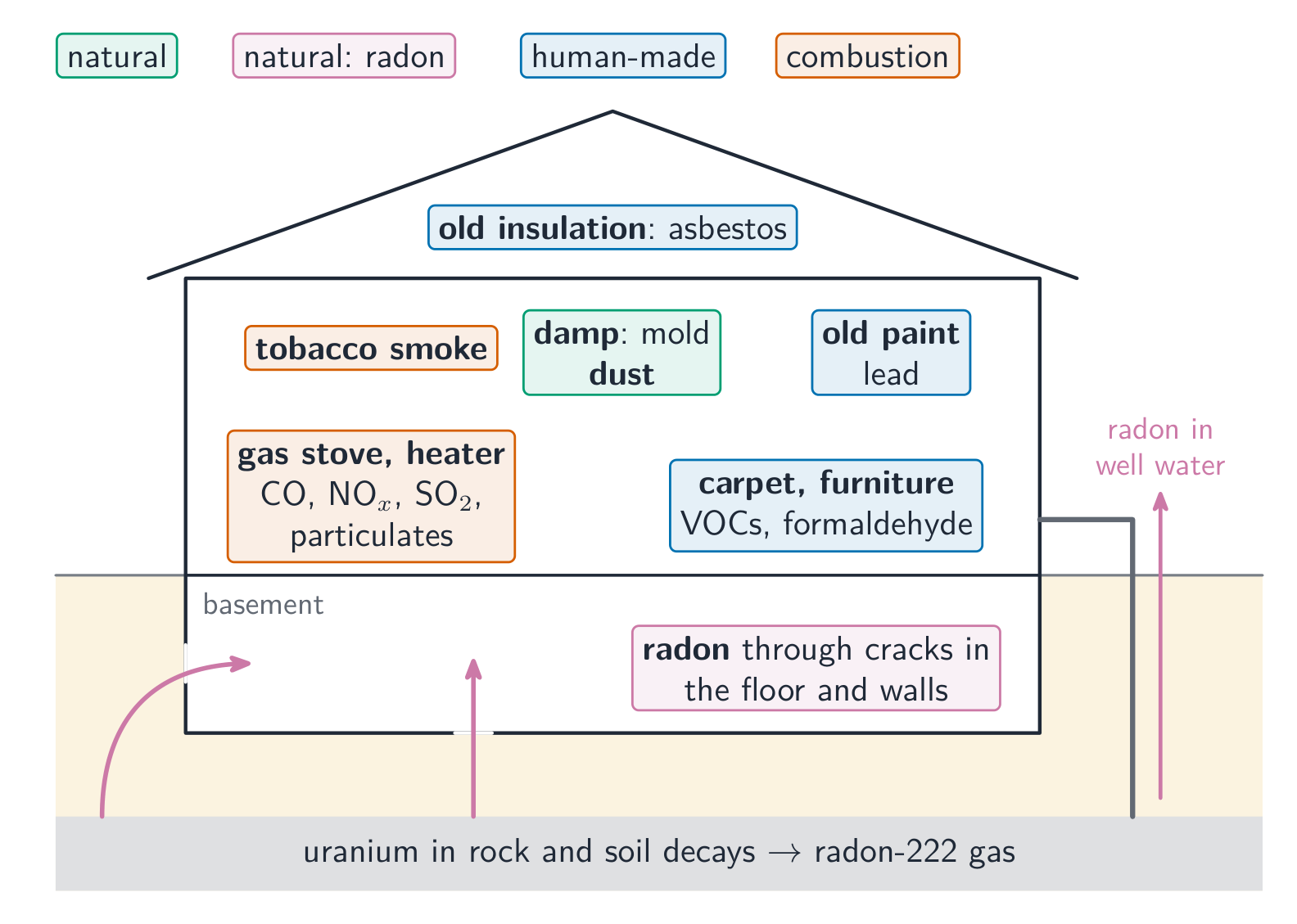
- In richer countries, people spend about 90% of their time indoors, where sealed rooms let pollutants build up. Indoor air pollutants 室内空气污染物 come from three kinds of source: natural, human-made and combustion 燃烧.
Select جميعها common indoor air pollutants.
الصعوبة 2/5 · 140 عملة + مكافأة صغيرة عند الإنجاز الأول اليوم
Carbon monoxide, radon, and tobacco smoke are all indoor pollutants. Fresh air is the cure, not a pollutant.
Natural sources
- Radon 氡, mold 霉菌 and dust occur naturally. Mold grows on damp walls and releases spores that trigger asthma and allergies.
- Radon-222 is a radioactive gas made when uranium in rocks and soil decays. It moves up through the soil and enters through cracks in the basement floor, walls or foundation; it also dissolves in groundwater and enters homes through a well.
Radon is a pollutant that…
الصعوبة 1/5 · 100 عملة + مكافأة صغيرة عند الإنجاز الأول اليوم
Radon is a radioactive gas that rises from rock and soil and collects in basements.
Human-made sources
- Asbestos 石棉 from old insulation; lead from old paint (flakes and dust, dangerous to young children's brains).
- VOCs (volatile organic compounds 挥发性有机化合物) from furniture, paneling and carpets, and formaldehyde 甲醛 from building materials, furniture, upholstery and carpeting. These are the "new smell" of a new carpet or sofa; they irritate eyes and lungs.
Combustion sources
- Burning fuel indoors (gas stoves, heaters, fireplaces, wood and dung fires) releases carbon monoxide, nitrogen oxides, sulfur dioxide and particulates. Tobacco smoke is another combustion pollutant.
- Carbon monoxide 一氧化碳 is an asphyxiant 窒息剂: it binds to hemoglobin in red blood cells far more strongly than oxygen does, so the blood carries less oxygen. It has no colour or smell, so a CO detector is the only warning.
Carbon monoxide is especially dangerous indoors because it…
الصعوبة 1/5 · 100 عملة + مكافأة صغيرة عند الإنجاز الأول اليوم
Carbon monoxide cannot be seen or smelled, so it can build up and kill without warning.
Carbon monoxide is classified as an asphyxiant because it…
الصعوبة 1/5 · 100 عملة + مكافأة صغيرة عند الإنجاز الأول اليوم
An asphyxiant stops the body getting enough oxygen. CO binds to hemoglobin far more strongly than O₂.
Two classifications the exam uses
| Pollutant | Source type | Also classified as |
|---|---|---|
| Carbon monoxide | combustion | asphyxiant |
| Asbestos | human-made (insulation) | particulate |
| Dust | natural | particulate |
| Smoke (tobacco, wood fires) | combustion | particulate |
| Radon-222 | natural (uranium decay) | radioactive gas |
| Mold | natural | biological |
| VOCs, formaldehyde | human-made | gases from materials |
| Lead | human-made (paint) | toxic metal |
Where does each indoor pollutant come from?
Sort each indoor pollutant by whether it comes from burning or from materials and the ground.
Select جميعها indoor pollutants that are classified as particulates.
الصعوبة 2/5 · 140 عملة + مكافأة صغيرة عند الإنجاز الأول اليوم
Asbestos, dust and smoke are solid particles. Radon and CO are gases.
Match each indoor pollutant to its source type.
الصعوبة 2/5 · 140 عملة + مكافأة صغيرة عند الإنجاز الأول اليوم
Natural, human-made and combustion are the three source types the course uses.
Health effects
- Radon causes radon-induced lung cancer, the second leading cause of lung cancer in the USA after smoking. Radon is invisible and odourless; only a test kit finds it.
- Asbestos fibres scar the lungs and cause cancer years later; particulates from smoke cause lung and heart disease, especially in women and children who cook over open fires.
Radon is the second leading cause of lung cancer in the USA.
الصعوبة 1/5 · 100 عملة + مكافأة صغيرة عند الإنجاز الأول اليوم
Only smoking causes more lung cancer. A radon test kit is the only way to know a home's level.
Worked data analysis
A family tests for radon on three floors of their house (EPA action level: 4 pCi/L).
| Floor | Radon (pCi/L) |
|---|---|
| Basement | 9.6 |
| Ground floor | 3.8 |
| Upstairs | 1.5 |
Describe the pattern and explain it. Radon is highest in the basement and falls on each higher floor. Radon enters from the soil below the house, so it is most concentrated in the rooms in contact with the ground.
Propose ONE way to reduce the risk. Seal cracks in the basement floor and walls, and ventilate the basement (or install a fan that pulls soil gas out from under the floor), so less radon enters and more is removed.
In most homes radon is highest in the basement. The best explanation is that radon…
الصعوبة 1/5 · 100 عملة + مكافأة صغيرة عند الإنجاز الأول اليوم
Radon comes from uranium decay in rock and soil and seeps in through cracks in the foundation.
Worked FRQ answer
(A) Identify ONE natural indoor air pollutant. Radon (also accepted: mold, dust).
(B) Explain how radon gets into a home. Uranium in rocks and soil decays to radon gas, which moves up through the soil and enters through cracks in the foundation or basement, or in well water.
(C) Describe ONE human health effect of carbon monoxide and explain why it happens. CO causes headaches, unconsciousness and death, because it binds to hemoglobin instead of oxygen and the body's cells are starved of oxygen.
- Why it scores: (B) gives the source (uranium decay) and the entry route. (C) names the effect and the reason (binding to hemoglobin). Just "CO is poisonous" would not score.
- Radon is natural, not human-made. Humans do not produce it; houses trap it.
- Asbestos is a particulate, not a gas: its harm comes from tiny fibres breathed into the lungs.
- Airtight buildings save energy but trap pollutants. Ventilation, CO detectors and radon tests are how the trade-off is managed.
Good ____ (fresh air flow) is the simplest way to lower indoor pollution.
الصعوبة 1/5 · 100 عملة + مكافأة صغيرة عند الإنجاز الأول اليوم
Good ventilation flushes pollutants out and brings fresh air in.
Sealing a building tightly always makes indoor air cleaner than outdoor air.
الصعوبة 1/5 · 100 عملة + مكافأة صغيرة عند الإنجاز الأول اليوم
False. Without ventilation, pollutants from cooking, furniture and radon build up indoors, sometimes to levels higher than outside.
Indoor air pollutants come from natural sources (radon, mold, dust), human-made sources (asbestos insulation, VOCs from furniture and carpets, formaldehyde, lead paint) and combustion (CO, NO$_x$, SO₂, particulates, tobacco smoke). CO is an asphyxiant; asbestos, dust and smoke are particulates. Radon-222 comes from uranium decay, enters through basement cracks and well water, and is the second leading cause of lung cancer in the USA.