Photochemical Smog
مُقدَّم| English | المعنى |
|---|---|
| photochemical smog/ˌfəʊtəʊˈkemɪkl smɒɡ/ | دخان ضوئي كيميائي |
| sunlight/ˈsʌnlaɪt/ | ضوء الشمس |
| nitrogen oxides/ˈnaɪtrədʒn ˈɒksaɪdz/ | أكاسيد النيتروجين |
| vapours/ˈveɪpəz/ | بخارات |
| ozone/ˈəʊzəʊn/ | أوزون |
Brown air on sunny afternoons
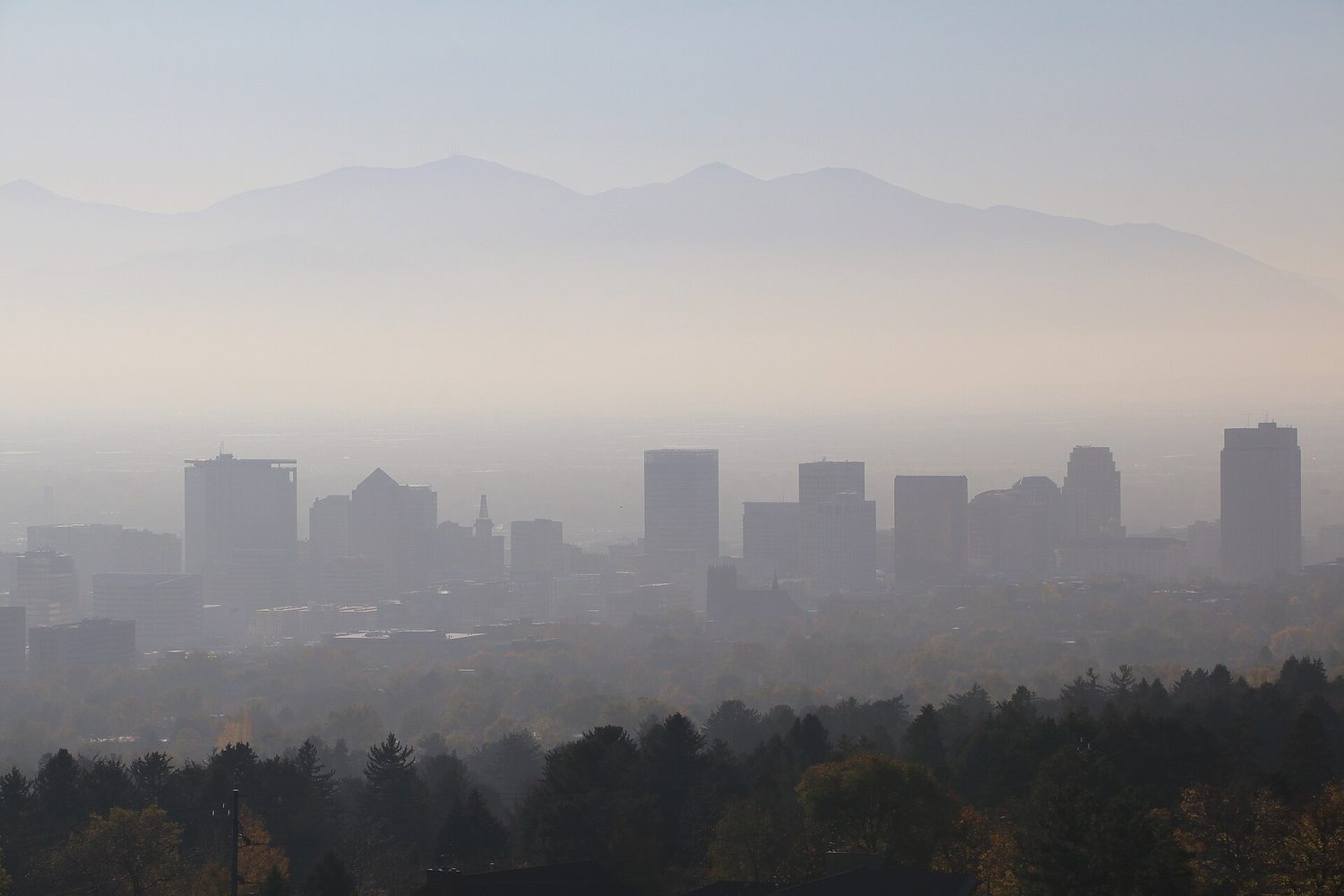
- In the 1940s, Los Angeles residents thought they were under chemical attack: on sunny days their eyes stung and a brown haze hid the mountains. The cause was traffic exhaust "cooked" by sunlight. Today, cities from Mexico City to Beijing face the same problem.
- Photochemical smog 光化学烟雾 forms when nitrogen oxides 氮氧化物 (NOₓ) and volatile organic compounds 挥发性有机物 (VOCs) react with heat and sunlight to make a mix of pollutants. The main one is ground-level ozone 臭氧 (O₃).
Photochemical smog needs which one to form?
الصعوبة 1/5 · 100 عملة + مكافأة صغيرة عند الإنجاز الأول اليوم
"Photochemical" means light-driven — strong sunlight powers the reactions that make smog.
The ingredients
- NOₓ come mainly from vehicle engines and power plants: fuel burns so hot that N₂ and O₂ in the air combine. That is why smog is worst in cities with many motor vehicles.
- VOCs are carbon compounds that evaporate at room temperature, such as gasoline vapour, paint solvents and formaldehyde. Trees are a natural source of VOCs.
The pollutants that start photochemical smog come mostly from…
الصعوبة 1/5 · 100 عملة + مكافأة صغيرة عند الإنجاز الأول اليوم
Vehicle exhaust supplies the nitrogen oxides and vapours that sunlight turns into smog.
Select جميعها sources of VOCs.
الصعوبة 2/5 · 140 عملة + مكافأة صغيرة عند الإنجاز الأول اليوم
VOCs evaporate at room temperature; fuels, solvents and trees all release them. A dam releases none.
How sunlight makes ozone
- Normally the NO formed then destroys ozone again ($\text{NO}+\text{O}_3\rightarrow\text{NO}_2+\text{O}_2$), so ozone does not build up much. VOCs react with NO to make photochemical oxidants instead, so NO is used up and ozone accumulates.
- Ozone is a secondary pollutant: no tailpipe emits it; it forms in the air.
How photochemical smog forms
Follow car exhaust and sunlight combining into the ozone smog over a city.
The main harmful gas in photochemical smog is ground-level ____.
الصعوبة 1/5 · 100 عملة + مكافأة صغيرة عند الإنجاز الأول اليوم
Ground-level ozone is the key ingredient of smog and irritates the lungs.
The daily cycle
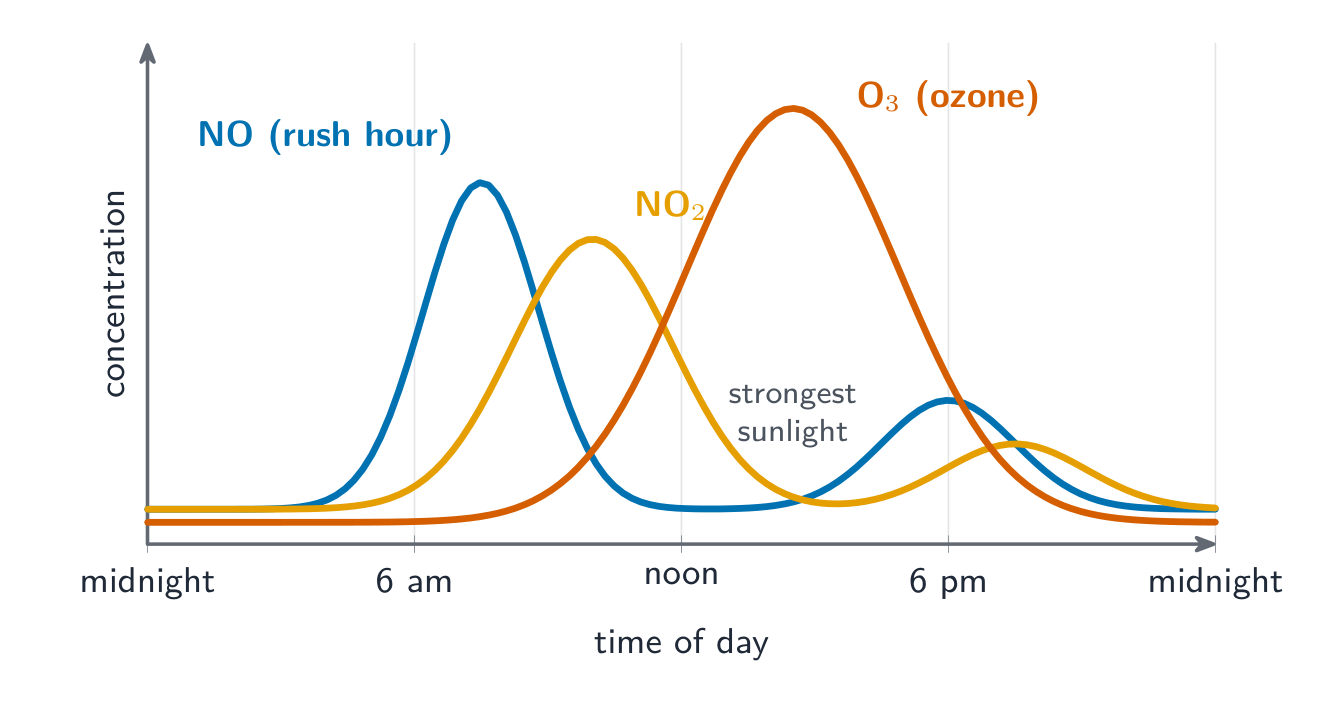
- NO peaks during the morning rush hour. It is oxidized to NO₂, which peaks a few hours later. Ozone peaks in the afternoon, when sunlight is strongest, then falls at night without sunlight.
- Ozone levels are higher in summer (more intense sunlight, higher temperatures). Other factors: calm air (no wind to disperse pollutants), no rain to wash them out, and cities in valleys or behind mountains, where air is trapped.
Smog is usually worst on cold, cloudy days with little traffic.
الصعوبة 1/5 · 100 عملة + مكافأة صغيرة عند الإنجاز الأول اليوم
False. Photochemical smog needs sunlight and heat acting on vehicle exhaust, so it is worst on hot, sunny days in cities with heavy traffic.
Select جميعها ingredients photochemical smog needs.
الصعوبة 2/5 · 140 عملة + مكافأة صغيرة عند الإنجاز الأول اليوم
Smog forms from sunlight + nitrogen oxides + vapours. Rain actually clears the air.
On a sunny summer day in a large city, when is ground-level ozone concentration usually highest?
الصعوبة 1/5 · 100 عملة + مكافأة صغيرة عند الإنجاز الأول اليوم
Ozone needs strong sunlight to split NO₂, and NO₂ builds up from morning traffic first, so ozone peaks in the afternoon.
Effects and solutions
| Effects | Ways to reduce smog |
|---|---|
| respiratory problems: coughing, asthma attacks, reduced lung function | cut NOₓ: catalytic converters, fewer car trips, public transport, electric vehicles |
| eye irritation | cut VOCs: vapour-recovery nozzles at gas pumps, low-VOC paints and solvents |
| damage to plant leaves, lower crop yields | burn less fossil fuel in power plants (renewables) |
| damage to rubber and plastics |
- Smog falls only if the ingredients fall. Ozone cannot be filtered out of the air, so we must cut NOₓ and VOCs before they are released.
Match each method to the smog ingredient it mainly reduces.
الصعوبة 2/5 · 140 عملة + مكافأة صغيرة عند الإنجاز الأول اليوم
Catalytic converters turn NOₓ into N₂ and O₂; vapour recovery traps evaporating fuel; less combustion means less NOₓ.
Worked FRQ answer
Use the graph of NO, NO₂ and O₃ in a city on a sunny day.
(A) Identify the time of day when ozone concentration is highest. In the early to mid-afternoon (about 2–3 pm).
(B) Explain why ozone peaks later than NO. Ozone is a secondary pollutant. NO from morning traffic is first converted to NO₂; then strong midday sunlight splits NO₂, and the free oxygen atom combines with O₂ to form O₃. This takes several hours and needs the most intense sunlight, which comes after noon.
(C) Describe one method to reduce photochemical smog, and explain how it works. Install catalytic converters on cars: they convert NOₓ in exhaust to N₂ and O₂, so there is less NO₂ for sunlight to split into ozone.
- Why it scores: (B) names ozone as secondary and gives the sequence (NO → NO₂ → sunlight → O₃). (C) links the method to the specific ingredient it removes.
Photochemical smog is usually worst on cold, cloudy winter mornings.
الصعوبة 1/5 · 100 عملة + مكافأة صغيرة عند الإنجاز الأول اليوم
That describes industrial (sulfurous) smog. Photochemical smog needs strong sunlight and heat, so it is worst on hot, sunny afternoons.
- Ground-level ozone is harmful; stratospheric ozone is helpful (it absorbs UV). Same molecule, different place.
- Photochemical smog ≠ industrial smog. Industrial (sulfurous) smog comes from burning coal, contains SO₂ and particulates, and is worst on cold winter days. Photochemical smog needs sunlight.
- Planting trees does not remove smog VOCs: trees themselves release VOCs.
Photochemical smog forms when NOₓ (mostly from vehicles) and VOCs react with heat and sunlight, producing ground-level ozone, a secondary pollutant. NO peaks at morning rush hour, ozone in the afternoon and in summer. It is worst in sunny, calm, traffic-heavy cities. It causes respiratory problems and eye irritation and is reduced by cutting NOₓ and VOC emissions.