Energy of Phase Changes
مُقدَّم| English | المعنى |
|---|---|
| heat of fusion/hiːt ɒv ˈfjuːʒn/ | حرارة الانصهار |
| heat of vaporization/hiːt ɒv ˌveɪpəraɪˈzeɪʃn/ | حرارة التبخر |
The flat spots on the graph
- Heat ice steadily and its temperature climbs — then stalls at $0\ ^\circ\text{C}$ at atmospheric pressure.
- All the heat goes into melting, not warming.
- Only once it is fully liquid does the temperature rise again.
- Those flat spots hide a big energy cost.
Temperature pauses
- For a pure substance at fixed pressure, temperature stays constant while both phases coexist in equilibrium.
- During melting or boiling, added heat overcomes attractions rather than increasing average kinetic energy.
- So a heating curve has flat plateaus.
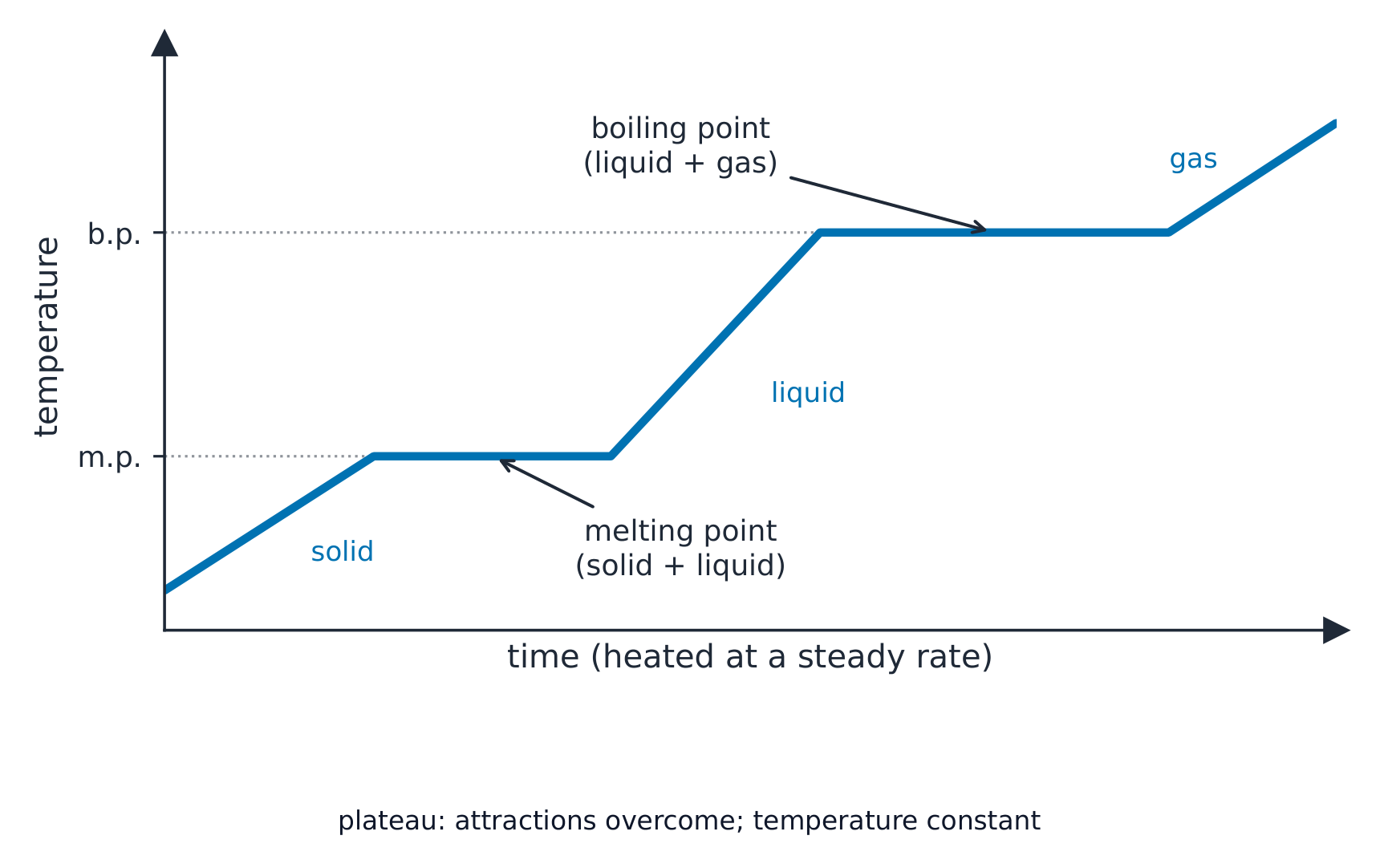
Heating curve: the temperature stays flat while a phase changes
A pure substance at fixed pressure stays at constant temperature while melting with solid and liquid both present.
الصعوبة 1/5 · 100 عملة + مكافأة صغيرة عند الإنجاز الأول اليوم
Energy overcomes some attractions while both phases coexist, rather than increasing average kinetic energy.
On a heating curve, a phase change appears as a flat ____.
الصعوبة 1/5 · 100 عملة + مكافأة صغيرة عند الإنجاز الأول اليوم
The temperature is constant, giving a flat plateau.
The hidden heats
- The heat of fusion 熔化热 is the energy to melt a solid.
- The heat of vaporization 汽化热 is the energy to boil a liquid.
- For equal amounts of water, vaporization takes far more energy than fusion.
For water, which usually requires more energy?
الصعوبة 1/5 · 100 عملة + مكافأة صغيرة عند الإنجاز الأول اليوم
The heat of vaporization is much larger than the heat of fusion.
Warming versus changing
- Warming within one phase uses $q = mc\Delta T$.
- Changing phase uses $q=mL$ for latent heat per gram, or $q=n\Delta H_{phase}$ for molar data.
- A full heating curve combines both.
The heating curve
For a pure substance at fixed pressure, temperature stays flat while both phases coexist; latent heat overcomes particle attractions.
To warm a liquid without changing its phase, you use...
الصعوبة 1/5 · 100 عملة + مكافأة صغيرة عند الإنجاز الأول اليوم
Within a single phase, use $q = mc\Delta T$.
Why does steam burn worse than boiling water at the same temperature?
- Steam releases its large heat of vaporization as it condenses on skin.
- That extra energy makes the burn much worse.
Steam burns worse than boiling water because it also releases its...
الصعوبة 1/5 · 100 عملة + مكافأة صغيرة عند الإنجاز الأول اليوم
Condensing steam gives up a large heat of vaporization to the skin.
You should use $q = mc\Delta T$ during a phase change.
الصعوبة 1/5 · 100 عملة + مكافأة صغيرة عند الإنجاز الأول اليوم
With $\Delta T = 0$, use the latent heat instead.
Why boiling costs more than melting
- Water: $\Delta H_{\text{fus}}=6.01$ kJ/mol, but $\Delta H_{\text{vap}}=40.7$ kJ/mol, almost 7 times more.
- Melting only loosens the particles: they still touch. Boiling separates them completely, so every attraction must be overcome.
How much energy, in kJ, boils 36.0 g of water at 100 °C? (heat of vaporization 40.7 kJ/mol, M = 18.0 g/mol)
الصعوبة 2/5 · 140 عملة + مكافأة صغيرة عند الإنجاز الأول اليوم
36.0 ÷ 18.0 = 2.00 mol; 2.00 × 40.7 = 81.4 kJ.
Why is the heat of vaporization of water much larger than its heat of fusion?
الصعوبة 1/5 · 100 عملة + مكافأة صغيرة عند الإنجاز الأول اليوم
In a liquid the molecules still touch; in a gas almost all attractions are gone.
One stage at a time. How much energy turns 18.0 g of ice at −10.0 °C into water at 25.0 °C? ($c_{\text{ice}}=2.09$, $c_{\text{water}}=4.18$ J/(g·°C); 18.0 g = 1.00 mol)
- Warm the ice: $q_1=18.0\times2.09\times10.0=376$ J.
- Melt it: $q_2=1.00\times6010=6010$ J. Warm the water: $q_3=18.0\times4.18\times25.0=1881$ J.
- Total $=376+6010+1881=8267$ J $\approx8.27$ kJ. The plateau (melting) costs the most.
How much energy, in kJ, turns 18.0 g of water at 20.0 °C into steam at 100.0 °C? (c = 4.18 J/(g·°C); heat of vaporization 40.7 kJ/mol; 18.0 g = 1.00 mol)
الصعوبة 2/5 · 140 عملة + مكافأة صغيرة عند الإنجاز الأول اليوم
Warm: 18.0 × 4.18 × 80.0 = 6019 J = 6.02 kJ. Boil: 1.00 × 40.7 = 40.7 kJ. Total 46.7 kJ.
For a pure substance at fixed pressure with both phases present, temperature is constant — heat changes particle attractions, so do not use $q = mc\Delta T$ there ($\Delta T = 0$). Use the latent heat instead. For equal amounts of water, vaporization needs much more energy than fusion. And the plateaus on a heating curve mark the phase changes.
For a pure substance at fixed pressure, temperature holds constant while two phases coexist and energy changes particle attractions — the plateaus on a heating curve. The heat of fusion melts a solid and the heat of vaporization boils a liquid (much larger). Warming within a phase uses $q = mc\Delta T$; changing phase uses the latent heat.