Selecting Procedures for Calculating Derivatives
مُقدَّمYou have a toolbox: now choose the tool
- You know the power, sum, product, quotient and chain rules and the derivatives of $\sin$, $\cos$, $e^x$, $\ln x$. The skill is picking the right rule and using rules in the right order.
- A messy derivative is usually easy once you see its structure.
Read the outermost structure first
- Ask what the last operation would be if you calculated $y$ for a number: a sum, a product, a quotient or a composition (function of a function)?
- That last operation picks the first rule. Then each piece gets its own rule, working outside-in.
Which rule does $y=x^2\sin x$ need at the top level?
الصعوبة 1/5 · 100 عملة + مكافأة صغيرة عند الإنجاز الأول اليوم
It is a product of $x^2$ و $\sin x$ → product rule.
The top-level structure of $\dfrac{\sin x}{x^2}$ is a...
الصعوبة 1/5 · 100 عملة + مكافأة صغيرة عند الإنجاز الأول اليوم
إنه $\sin x$ divided by $x^2$ — a quotient (or rewrite as $x^{-2}\sin x$).
Match each function to the top-level rule it needs.
الصعوبة 2/5 · 140 عملة + مكافأة صغيرة عند الإنجاز الأول اليوم
Read the outermost operation: term-by-term, product, quotient, or composition.
Three structures. Name the top-level rule, then differentiate.
- $x^2\sin(3x)$: a product, and $\sin(3x)$ needs the chain rule: $2x\sin(3x)+3x^2\cos(3x)$.
- $\sin^2(3x)=\big(\sin(3x)\big)^2$: a composition three layers deep: $2\sin(3x)\cdot\cos(3x)\cdot3=6\sin(3x)\cos(3x)$.
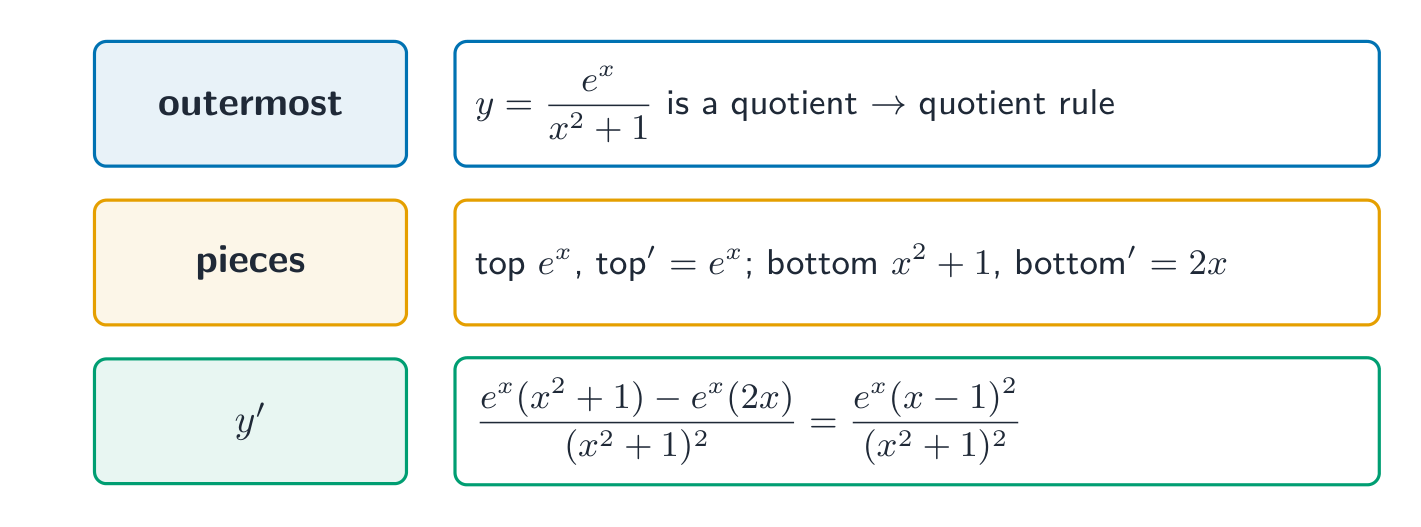
- $\dfrac{e^{x}}{x^2+1}$: a quotient: $\dfrac{e^x(x^2+1)-e^x(2x)}{(x^2+1)^2}=\dfrac{e^x(x-1)^2}{(x^2+1)^2}$.
For nested functions, apply rules working from the ____ level inward.
الصعوبة 1/5 · 100 عملة + مكافأة صغيرة عند الإنجاز الأول اليوم
Handle the outermost structure first, then each sub-piece.
Find the derivative of $y=(x^2+1)^3$ at $x=1$.
الصعوبة 2/5 · 140 عملة + مكافأة صغيرة عند الإنجاز الأول اليوم
A composition: $y'=3(x^2+1)^2\cdot2x$. At $x=1$: $3(2)^2(2)=24$.
Rewrite first when it is cheaper
- $\dfrac{5}{x^3}=5x^{-3}$ needs only the power rule: $-15x^{-4}$. $\dfrac{x^2+x}{x}=x+1$ (for $x\neq0$) has derivative 1.
- $\dfrac{\sin x}{x^2}$ can be a quotient, or the product $x^{-2}\sin x$. Choose the one you make fewer mistakes with.
Simplify $\dfrac{x^2+x}{x}$ first, then differentiate. What is the derivative?
الصعوبة 2/5 · 140 عملة + مكافأة صغيرة عند الإنجاز الأول اليوم
$\frac{x^2+x}{x}=x+1$, so the derivative is $1$ — no quotient rule needed.
Rewrite, then differentiate. Find $\dfrac{d}{dx}\left[\dfrac{x^3-4\sqrt x}{x}\right]$.
- Split the fraction: $x^2-4x^{-1/2}$.
- Power rule on each term: $2x+2x^{-3/2}$. No quotient rule needed.
What is $\dfrac{d}{dx}\left[\dfrac{6}{x^2}\right]$?
الصعوبة 1/5 · 100 عملة + مكافأة صغيرة عند الإنجاز الأول اليوم
Rewrite as $6x^{-2}$. Power rule: $-12x^{-3}=-\dfrac{12}{x^3}$. No quotient rule needed.
- Match the rule to the top-level structure, not the first symbol you see. $\dfrac{\sin x}{x^2}$ is a quotient, not "the derivative of $\sin$".
- Don't forget the inner derivative: $\dfrac{d}{dx}\sin(3x)$ is $3\cos(3x)$, not $\cos(3x)$.
- A constant over a function, like $\dfrac{5}{x^3}$, is easier as a power than with the quotient rule.
Find the last operation (sum, product, quotient, composition), apply that rule first, then handle each piece outside-in. Rewrite with powers or split fractions when that is cheaper. Check the result is reasonable.
After differentiating, checking the answer for reasonableness (term count, signs) is good practice.
الصعوبة 1/5 · 100 عملة + مكافأة صغيرة عند الإنجاز الأول اليوم
A quick sanity check catches many slips.